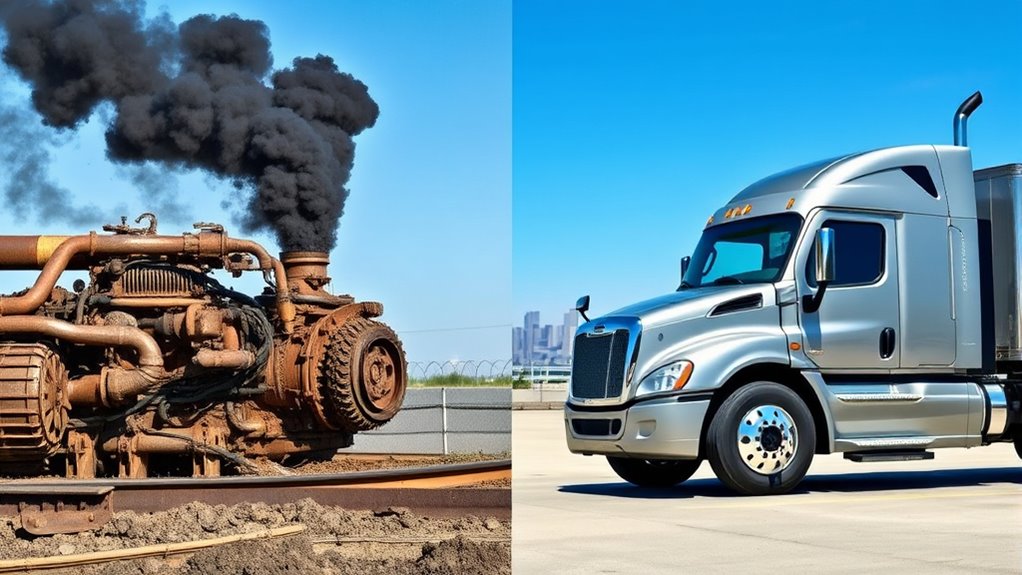

If you’re choosing between diesel and natural gas, consider your priorities: diesel offers widespread infrastructure and operational convenience, making it ideal for long-distance or remote operations. Natural gas, however, provides lower emissions and environmental benefits, especially if your region supports refueling infrastructure. While switching to natural gas may require upfront investment, it can help meet future regulations. To understand which fuel choice fits your needs best, explore the key factors that align with your goals and resources.

Get backup power and energy gear delivered free with Prime
- Fast, free delivery on millions of items
- Prime Video, Amazon Music and more included
- Member-only deals all year
Key Takeaways
- Natural gas offers lower emissions and environmental benefits but has limited fueling infrastructure compared to diesel’s extensive network.
- Diesel provides operational simplicity and widespread availability, making it suitable for long-haul and remote applications.
- Lifecycle emissions favor natural gas, reducing air pollution and supporting compliance with environmental regulations.
- Converting fleets to natural gas requires initial investment in equipment and fueling infrastructure.
- The choice depends on balancing immediate operational convenience with long-term environmental and regulatory considerations.
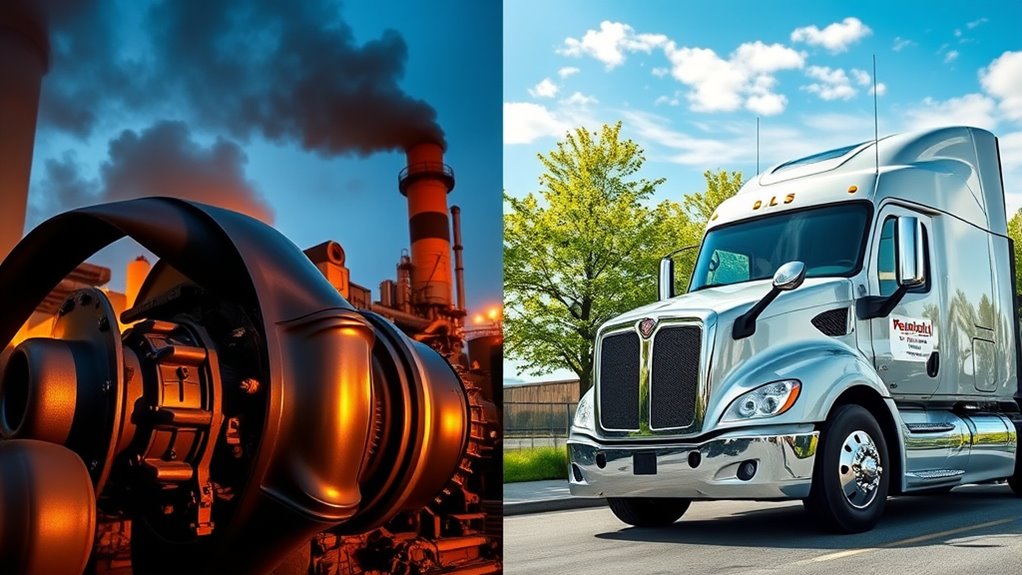
Have you ever wondered how diesel and natural gas compare as fuel options? The decision often hinges on understanding their emissions profiles and the infrastructure available to support them. Diesel fuel has long been a staple in transportation and heavy-duty applications because of its energy density and widespread availability. However, its emissions profile is less favorable, emitting higher levels of nitrogen oxides (NOx), particulate matter, and carbon dioxide (CO2). These pollutants contribute to air quality issues and climate change, making diesel less appealing from an environmental perspective. Natural gas, on the other hand, burns cleaner, producing considerably lower emissions of NOx, particulates, and greenhouse gases. It’s often touted as a greener alternative, especially when considering the full lifecycle emissions, including extraction, processing, and combustion.
Diesel emits more NOx, particulates, and CO2, while natural gas burns cleaner with lower emissions across the lifecycle.
When it comes to infrastructure availability, diesel benefits from a well-established network. Gas stations and fueling points are readily accessible across most regions, simplifying logistics for transportation companies and industries relying on diesel. This extensive infrastructure makes switching or integrating diesel into existing operations straightforward, with minimal disruption. Natural gas, however, faces a different landscape. While compressed natural gas (CNG) and liquefied natural gas (LNG) infrastructure is growing, it’s still not as widespread. You might find fewer fueling stations, especially in remote or rural areas, which can pose challenges for fleet operations and long-haul transportation. Converting vehicles or equipment to run on natural gas also requires investment in specialized tanks and fueling systems, adding initial costs and logistical considerations. Additionally, advancements in AI Security are helping monitor and optimize natural gas infrastructure to improve safety and reliability.
If you’re weighing these options, consider how your operational environment influences your choice. Diesel’s established infrastructure makes it convenient, but its emissions profile could mean facing stricter regulations and potential future costs associated with pollution controls. Conversely, natural gas offers environmental benefits and lower emissions, but the limited infrastructure could restrict your flexibility, especially if your operations extend into areas with fewer fueling stations. You may also need to factor in the availability of refueling stations and the costs of converting your fleet.
Ultimately, your choice depends on balancing immediate logistical convenience with long-term environmental and regulatory considerations. If you’re in an area with ample natural gas infrastructure and are committed to reducing emissions, natural gas might be the better option. But if operational simplicity and widespread fueling options are priorities, diesel still holds considerable appeal. Both fuels have distinct advantages and challenges, so understanding their emissions profiles and infrastructure availability helps you make an informed decision tailored to your specific needs.
Frequently Asked Questions
What Are the Environmental Impacts of Diesel Compared to Natural Gas?
You’ll find that natural gas has a smaller ecological footprint than diesel, mainly because it produces lower carbon emissions. When you choose natural gas, you’re reducing greenhouse gases and air pollution, which benefits the environment. Diesel, on the other hand, releases more carbon emissions and pollutants, contributing more to climate change. By opting for natural gas, you’re making a cleaner, more sustainable choice that minimizes environmental impacts.
How Do Maintenance Costs Differ Between Diesel and Natural Gas Engines?
Think of your engine as a finely-tuned orchestra—natural gas engines often play a smoother, less wear-prone tune, resulting in lower repair costs and longer engine lifespan. Diesel engines, however, can be more like a thunderstorm—powerful but demanding, leading to higher maintenance costs over time. You’ll find natural gas engines generally cost less to maintain, keeping your operation humming longer and more efficiently.
Are There Specific Industries That Prefer One Fuel Over the Other?
You’ll find agricultural machinery often favors diesel because of its high energy density and reliability in remote fields. Maritime shipping, on the other hand, tends to prefer natural gas for its cleaner emissions and cost savings on fuel over long voyages. These industries choose their fuels based on operational needs, environmental regulations, and fuel availability, ensuring efficiency and compliance in their specific sectors.
What Are the Safety Considerations When Handling Diesel Versus Natural Gas?
Handling diesel is like walking a tightrope—you must watch for fire hazards and prevent leaks carefully. Natural gas requires vigilance too, as leaks can cause explosions. Always guarantee proper storage, use leak detection systems, and follow safety protocols to minimize risks. Regular maintenance and training help you stay safe, making sure your operations run smoothly without accidents. Safety is your best insurance in managing these fuels effectively.
How Does Fuel Availability Influence the Choice Between Diesel and Natural Gas?
Fuel availability plays a big role in your choice between diesel and natural gas. You’ll want to contemplate the fuel infrastructure and regional supply—if natural gas infrastructure is limited in your area, diesel might be more reliable. Conversely, if natural gas is readily available through pipelines or local supplies, it can be a more consistent and cost-effective option. Your decision depends on access and regional supply stability.
Conclusion
Choosing between diesel and natural gas is like selecting a ship’s sails—each offers different winds to navigate your journey. Diesel might be your sturdy, reliable sail, powering through storms with strength, while natural gas is like a gentle breeze, cleaner but sometimes less predictable. Ultimately, your choice shapes your voyage—embrace the one that guides you best through the waters ahead, balancing power and sustainability as your true compass.
Halloween Picks
halloween
As an affiliate, we earn on qualifying purchases.