
TL;DR

Get backup power and energy gear delivered free with Prime
- Fast, free delivery on millions of items
- Prime Video, Amazon Music and more included
- Member-only deals all year
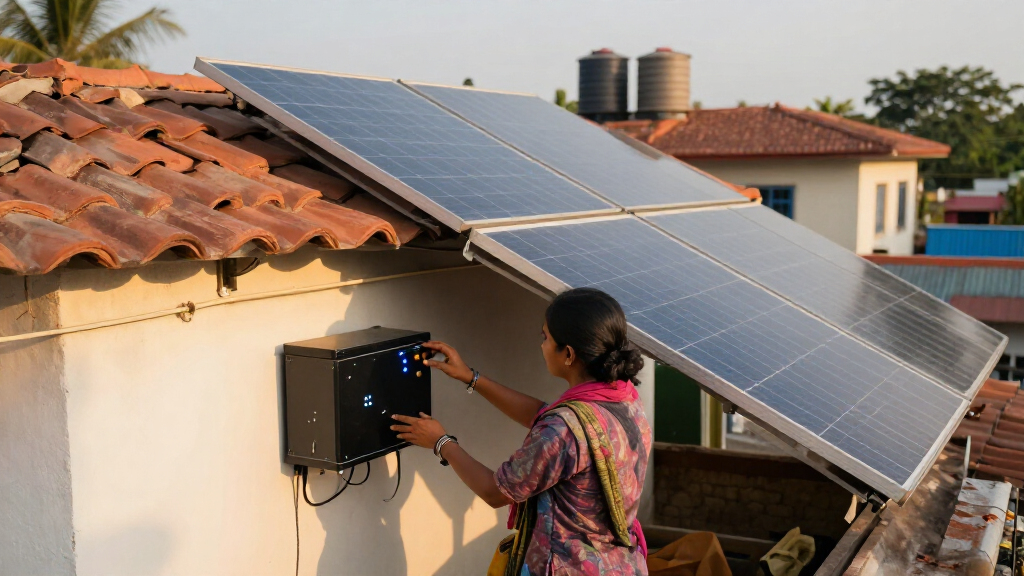
Ember estimates that extending India’s PM Surya Ghar rooftop solar subsidy to cover part of battery costs could support 15–25 GWh of distributed storage. Its analysis says a 5 kWh battery can sharply reduce daytime exports, but without support it stretches a typical system’s payback from 3.3 years to more than nine years.
Energy think tank Ember says extending India’s rooftop solar subsidy to cover part of household battery costs could help build 15–25 GWh of distributed storage, if hybrid systems were supported for half of the current 10 million-household target under the PM Surya Ghar scheme. The proposal addresses a cost barrier identified in Ember’s analysis: adding a battery can reduce solar exports to the grid, but, under current net metering rules, it lengthens a typical household system’s payback period from 3.3 years to more than nine years without additional financial support.
Ember modeled a 3 kW rooftop solar system for a household using 350 units of electricity a month. Solar alone costs INR 87,000 after the INR 78,000 PM Surya Ghar subsidy, with a modeled payback of 3.3 years. Adding a 5 kWh battery cuts daytime electricity exports by an estimated 85% to 90%, shifting about 1,600 to 1,800 units a year for use in the evening. But the higher upfront cost extends the payback period to more than nine years without battery support.
Under one scenario in the analysis, covering 50% of battery capital costs would reduce the payback period for the solar-and-battery system to 6.3 years. Ember proposes delivering this support through a future tranche of PM Surya Ghar: Muft Bijli Yojana. Its estimate of 15–25 GWh depends on subsidizing hybrid installations for half of the scheme’s stated 10 million target; it is a modeled potential, not a confirmed deployment commitment.
Ember says batteries could help make household solar generation more useful to the power system by storing electricity that would otherwise be exported around midday and releasing it later. The report also points to state-level top-ups as one possible route: states could follow Tamil Nadu and Bihar in providing additional support, while directing it toward the battery cost gap.
Battery Costs Shape Rooftop Solar Value
The analysis highlights a mismatch between household incentives and potential grid benefits. Under India’s current net metering framework, households can receive credit for daytime solar exported to the grid and use that credit against electricity consumed later. Ember says this arrangement gives consumers little financial reason to buy batteries, even when storing power could reduce the volume of midday exports and shift supply toward evening demand.
That matters as rooftop solar grows. Batteries could provide a distributed source of flexibility and, according to the analysis, help distribution companies manage changing flows of power. But the modeled payback period suggests that households may not adopt storage at scale on economics alone. A subsidy could lower the upfront barrier, though the report does not establish how much storage would actually be installed or whether the proposed support would be adopted.
Ember also argues that batteries installed now could help households adapt if export-credit rules change. Its modeling suggests a subsidized hybrid system would pay back in 6.5 years in a scenario with a 40% cap on banked exports. In a separate scenario that bars use of banked solar from 6 p.m. to 10 p.m. and applies a 20% peak surcharge, the modeled payback is 5.7 years after subsidies. These are policy scenarios, not announced changes to current rules.
Products Worth Considering

Hisense 85 U6 Pro Series Mini-LED ULED 4K UHD HDR Gaming AI Smart Fire TV (85U6SF Pro)

Levoit Eleva 300X HEPA Air Purifier for Home and Bedroom

eufy E25 Robot Vacuum and Mop Combo with HydroJet Roller Mop
As an affiliate, we earn on qualifying purchases.
Growth Since PM Surya Ghar Began
India’s rooftop solar capacity has tripled since PM Surya Ghar launched in 2024, reaching 30.7 GW by July 2026, according to the source report. That represented 19% of the country’s 165 GW of installed solar capacity. About half of rooftop capacity was installed on the roofs of more than five million households, which the analysis says typically use less electricity in the middle of the day and more in the evening.
Under the described net metering framework, a unit exported at midday can be credited against a unit consumed later. Ember says households can bank surplus solar and withdraw it at any time, making the grid function as a low-cost store of electricity from the consumer’s perspective. The report argues that this arrangement helps explain why battery storage is difficult to justify financially for households, even when it could change the timing of power flows.
The source also reports that Kerala, Maharashtra and Uttar Pradesh have begun exploring rooftop solar-plus-battery systems. It says the Central Electricity Authority has suggested distribution companies could require two hours of storage alongside rooftop installations. Those developments indicate policy interest, but the supplied material does not describe them as nationwide requirements or confirmed programs.
Policy and Uptake Remain Unsettled
The proposed battery subsidy is an Ember recommendation, not an announced extension of PM Surya Ghar. The supplied report gives no government decision, budget allocation, eligibility rules, launch date or confirmation that a future tranche will include battery costs. It is also unclear whether any state top-ups will be adopted or how they would interact with central support.
The 15–25 GWh estimate depends on supporting hybrid systems for half of the scheme’s 10 million target. Actual storage would depend on program design, household participation, battery prices and installation capacity. The material does not specify the cost of the proposed subsidy or quantify its effects on electricity tariffs, distribution-company finances or emissions.
Ember’s payback figures are model results based on stated system and usage assumptions. The report does not provide enough information here to determine how results would vary across states, household consumption patterns, local tariffs or battery lifetimes. The possible export caps and peak-period restrictions are modeled scenarios; the source does not say they have been adopted.
A Future Scheme Tranche Is Key
The next policy milestone would be a decision on the design of a future PM Surya Ghar tranche, including whether it subsidizes batteries and what share of their cost it covers. The supplied material does not give a timetable for such a decision. Any state-level battery top-ups or formal rules on storage requirements would also clarify whether the proposal is moving beyond analysis.
For now, the report’s figures serve as an estimate of the opportunity and the financial challenge, rather than evidence of new installations. Further detail on program funding, participation and the treatment of stored or exported electricity would be needed to assess how much of the projected storage potential could be realized.
Key Questions
How much battery storage could the proposal support?
Ember estimates 15–25 GWh if hybrid rooftop systems receive support for half of PM Surya Ghar’s current 10 million-household target. This is a modeled potential, not confirmed storage deployment.
What happens to payback when a household adds a battery?
In Ember’s model of a 3 kW system for a household using 350 units a month, solar alone has a 3.3-year payback. Adding a 5 kWh battery extends it to more than nine years without additional support; a modeled 50% battery-cost subsidy lowers it to 6.3 years.
Has India approved a battery subsidy under PM Surya Ghar?
The supplied report describes a proposal from Ember. It does not report government approval, a budget allocation or a launch date for battery subsidies.
Why do batteries reduce household exports?
A household battery stores some midday solar generation for later use. Ember estimates a 5 kWh battery could cut daytime exports by 85% to 90% in its modeled system, shifting about 1,600 to 1,800 units a year to evening consumption.
Are new limits on solar credits or peak-hour use in effect?
The report discusses a 40% cap on banked exports and restrictions on using banked solar from 6 p.m. to 10 p.m. as modeled scenarios. It does not say these changes have been adopted.
Source: ess-news.com