TL;DR

Get backup power and energy gear delivered free with Prime
- Fast, free delivery on millions of items
- Prime Video, Amazon Music and more included
- Member-only deals all year
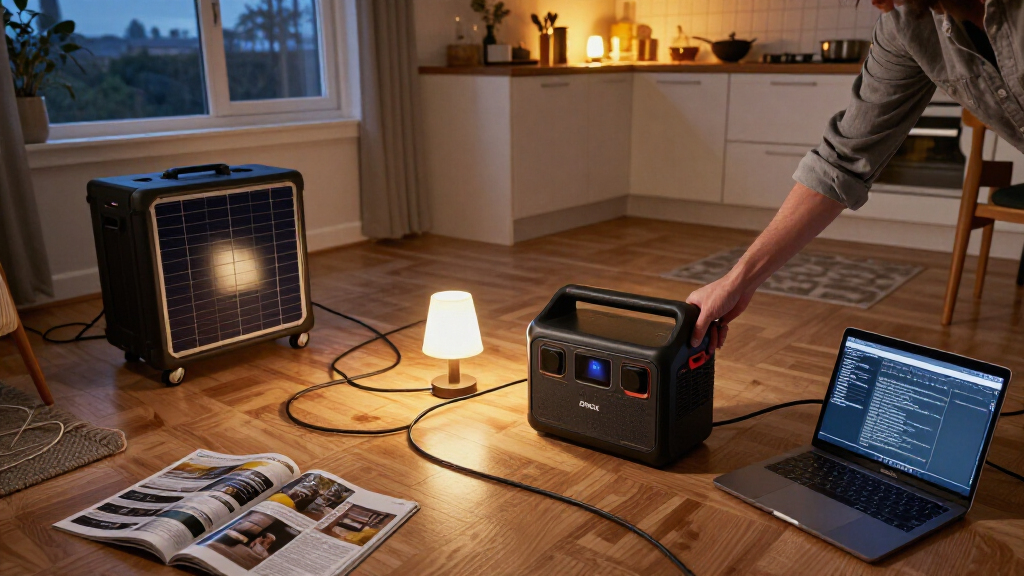
An ESS News reviewer tested a pre-release Anker Solix S5000 in Northern California, including its charging performance and use during a real three-day power outage. The unit has 5,024 Wh of LFP storage and a 4,500 W inverter; the reviewer also measured differences between displayed and wall-meter charging figures and tested solar input. Some capabilities, including 240 V charging and generator charging, were not tested.
An ESS News reviewer tested Anker’s Solix S5000, a wheeled power station with 5,024 Wh of LFP storage and a 4,500 W inverter, during charging trials and a real three-day power outage in Northern California. The review offers measured results from a pre-release unit, including how long AC charging took and how the station performed as backup power; it does not establish how every unit will perform in other conditions.
The reviewer charged the S5000 from a standard 120 V outlet at two settings, using a wall energy meter. At the app’s 1,800 W setting, a full charge took 3 hours 40 minutes and used 6.24 kWh from the wall. At 1,000 W, it took 6 hours 3 minutes and used 6.13 kWh. The reviewer reported that the higher setting drew about 1.79 kW for nearly three hours before dropping to about 1.43 kW, consistent with a limit described in Anker’s specifications.
The station’s app and display reported less incoming energy than the wall meter: 5.91 kWh against 6.24 kWh at the higher setting, and 5.95 kWh against 6.13 kWh at the lower setting. The reviewer said the reason for that difference was unknown. The article also reports a solar test with two Anker PS400 panels wired in series. Their output peaked at 680 W on a sunny October day, compared with the panels’ combined 800 W rating; the reviewer attributed the limit to the panels rather than the S5000’s input.
During the outage, the reviewer used the S5000 to keep household needs running, including preserving a relative’s homemade pasta sauce. The review describes the event as a three-day outage, but the supplied report does not give a full household load log or a measured account of how much stored energy was used. The S5000 has four 120 V outlets, a 240 V outlet, USB ports and wheels. Anker rates its LFP battery for 6,000 cycles to 80% capacity and lists a five-year warranty.
What the Outage Test Shows
The review gives buyers more than a specification sheet: it documents real charging measurements and use during a multi-day power cut. A 5 kWh-class battery and 4,500 W inverter may support more demanding backup needs than smaller portable stations, while its 240 V output can serve some equipment that requires that voltage. Actual runtime, however, depends on the household’s loads and how much power is available to recharge the unit.
The measured charging results also show why buyers should distinguish a device’s app readings from energy measured at the wall. The two did not match in the test, and the reviewer could not identify where the difference arose. At the 1,000 W setting, charging took considerably longer but used slightly less wall energy, a trade-off that may be relevant when sharing a circuit or using a smaller generator.
Products Worth Considering

TCL 85-Inch QM6K Series QLED Mini LED 4K HDR Smart Google TV

Shark AI Ultra Robot Vacuum with Self-Empty Base

Hisense 85 U6 Pro Series Mini-LED ULED 4K UHD HDR Gaming AI Smart Fire TV (85U6SF Pro)
As an affiliate, we earn on qualifying purchases.
Anker’s S5000 Specifications
Anker announced the S5000 on October 9, 2026; ESS News published the review on October 25. The reviewer tested a pre-release unit in Northern California, concentrating on charging, usable capacity, idle consumption, portability and outage backup. The article lists the product’s capacity as 5,024 Wh, its continuous AC output as 4,500 W and its peak output as 8,000 W.
The S5000 supports AC, solar, Anker’s Smart Generator and vehicle-alternator charging, according to its specifications. Its solar inputs are rated for 3,000 W combined, and it can connect to expansion batteries for up to 30 kWh of capacity. In the reported tests, the reviewer tried 120 V AC charging and solar charging, but not 240 V charging. The article also cites Anker’s claims of a UPS switchover time of 10 milliseconds or less and UL 9540 and UL 9540A certifications.
“The S5000 is rated for 5,024 Wh of capacity and 4,500 W continuous AC output.”
— Anker, in product specifications cited by ESS News
Limits of the Reported Tests
The review covers a pre-release sample, so the report does not show whether retail units will produce the same results. It also does not provide a detailed, independently measured household load profile for the outage, making it difficult to draw a precise conclusion about runtime at particular power levels. The battery’s measured usable capacity and idle consumption are listed as areas of focus, but the supplied source material does not include those test results.
Several specifications and capabilities remain unverified in the reported tests. The reviewer did not test 240 V charging, the stated ability to maintain 240 V output while charging from a 120 V source, or charging from the Smart Generator or vehicle alternator. The report says the S5000’s DC input accepts up to 4,500 W from Anker’s generator, but also describes a cable-connection problem: the reviewer’s E10 Smart Generator cable would not fully seat in the S5000. The supplied source text ends before explaining that issue further.
Retail Testing and Open Questions
The review’s results come from a single pre-release unit and a limited set of tests. Further testing of retail units could clarify usable capacity, idle draw and outage runtime, as well as whether the app’s charge figures consistently differ from wall-meter readings. Tests under different household loads would also help readers estimate how long the S5000 can support particular backup needs.
For buyers considering the S5000, the outstanding questions include performance with 240 V charging, the reported 240 V bypass behavior and compatibility with the Smart Generator cable. The source report does not provide a retail availability date or price, so those details cannot be confirmed here.
Key Questions
What is the Anker Solix S5000?
It is a wheeled power station with 5,024 Wh of LFP storage and a manufacturer-rated 4,500 W continuous inverter, according to specifications cited in the ESS News review.
How long did 120 V AC charging take in the review?
A full charge took 3 hours 40 minutes at the app’s 1,800 W setting and 6 hours 3 minutes at 1,000 W. The reviewer measured energy use at the wall during both tests.
Did the reviewer test the S5000 during a real outage?
Yes. The reviewer used the pre-release unit during a three-day power outage in Northern California. The supplied report does not include a full measured load log or detailed runtime figures for individual appliances.
How much solar power did the test produce?
Two Anker PS400 panels, rated at 800 W combined, reached a reported peak of 680 W on a sunny October day. That result describes the tested panels and conditions, not a guaranteed output in other weather or locations.
Which S5000 features were not tested?
The reviewer did not test 240 V charging, the claimed 240 V output while charging from a 120 V source, or charging from Anker’s Smart Generator or a vehicle alternator. The report also notes that an E10 generator cable would not fully seat in the S5000’s DC input.
Source: rss