
When choosing a portable inverter generator for home backup, the central decision is how much of the home you want to keep running. Compact models in the 2,000–3,000 starting-watt range can cover selected essentials such as a refrigerator, lights, phone chargers, and some electronics, but require careful load management. High-output models in the 5,000–8,000 starting-watt range can handle more appliances and may support a window air conditioner or selected larger loads, depending on their running and surge ratings. They also cost more, weigh more, and need more storage space.

Get backup power and energy gear delivered free with Prime
- Fast, free delivery on millions of items
- Prime Video, Amazon Music and more included
- Member-only deals all year
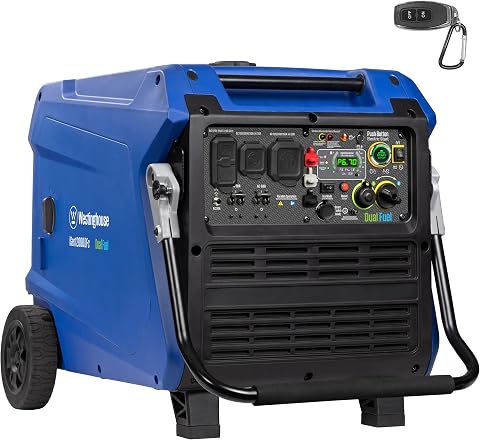
Westinghouse iGen12000DFc Dual Fuel Portable Inverter Generator
- ✔ Fuel: Gasoline or propane
- ✔ Running output: 9,000 W gasoline; 8,100 W propane
- ✔ Peak output: 12,000 W gasoline; 11,000 W propane

Oxseryn 4400-Watt Gasoline Inverter Generator
- ✔ Fuel: Gasoline
- ✔ Running output: 3,400 W
- ✔ Peak output: 4,400 W

PowerSmart 4000W Portable Inverter Generator
- ✔ Fuel: Gasoline
- ✔ Running output: 3,200 W
- ✔ Starting output: 4,000 W
The comparison is between a lighter, lower-cost generator for targeted backup and a larger unit for households that want to run several loads with fewer compromises. Neither category should be used indoors or in an attached garage: gasoline engines produce carbon monoxide, so operation outdoors, far from doors and windows, is essential. Choose compact capacity if you can prioritize a short list of essentials; pay for high output if your backup plan depends on starting and running larger loads at the same time.
At a Glance
| Criteria | Compact portable inverter generators (2,000–3,000 starting watts) | High-output portable inverter generators (5,000–8,000 starting watts) | Winner |
|---|---|---|---|
| Power capacity and load coverage | Typically 2,000–3,000 starting watts; best for a limited set of essentials. | Typically 5,000–8,000 starting watts; supports more simultaneous loads, subject to running watts. | B |
| Starting larger appliances | Often insufficient for larger motor loads or multiple appliances starting together. | More likely to start larger motors, but check surge ratings and appliance requirements. | B |
| Portability and storage | Usually lighter and easier for one person to move and store. | Heavier and bulkier; may need wheels, a ramp, or two people to position. | A |
| Runtime and fuel use | Often uses less fuel under a modest load; runtime depends on tank size and load. | Can run longer on a larger tank, but consumes more fuel as load rises. | Depends |
| Noise and placement | Generally quieter at light loads, though actual sound varies by model and distance. | Often louder under heavy load and needs more space outdoors. | A |
| Purchase and connection cost | Lower purchase cost; household connection equipment can add expense. | Higher purchase cost; transfer equipment and installation can raise the total. | A |
| Best backup use | Selected essentials, charging, lights, and carefully managed loads. | Several household circuits or larger appliances when connected correctly. | Depends |
Westinghouse iGen12000DFc Dual Fuel Portable Inverter Generator
When backup needs extend beyond a few small essentials, the Westinghouse iGen12000DFc is the most capable option in this group. Its stated 9,000 watts of gasoline running output and 120/240-volt supply give us considerably more headroom than the Oxseryn’s 3,400 watts or the PowerSmart’s 3,200. That matters when a household wants to run several loads or equipment that requires 240 volts, though the actual combination still has to fit the generator’s continuous and surge limits.Dual-fuel operation is a practical distinction: we can choose gasoline or propane based on what is available and how we plan to store fuel. The model also includes electric and remote start, an LED data display, a CO sensor, and transfer-switch-ready outlets. With less than 3% THD stated, it is designed to supply cleaner power for sensitive electronics. The listed gasoline runtime reaches 19 hours at 25% load, but runtime varies with demand, and the supplied product information has inconsistent fuel details. We would verify the current manual before estimating outage coverage.The tradeoff is scale. A 457 cc engine and this level of output make it substantially less convenient to move and store than either smaller model, even with wheels and a foldable handle. Its noise claim of as low as 64 dBA also needs context: operating conditions affect noise, and it is not the quietest listing here. We favor it over the Oxseryn and PowerSmart when broad load capacity and fuel choice matter more than compactness; households seeking a lightweight unit for a refrigerator and a few essentials may find the smaller picks easier to manage.
Pros:
- Highest listed running output in this comparison at 9,000 watts on gasoline
- Runs on gasoline or propane and provides 120/240-volt output
- Remote and electric start, LED data display, and CO sensor
- Transfer-switch-ready outlets and stated under-3% THD
Cons:
- Large engine and high output make it bulky compared with the Oxseryn and PowerSmart
- Supplied runtime and fuel details are inconsistent, so confirm current documentation
- The listed noise figure is not as low as the PowerSmart’s under-59-dBA claim
Best for: Households that need substantial backup output, 120/240-volt capability, and a choice between gasoline and propane, with space to store a larger wheeled generator.
Not ideal for: Buyers who need a generator that one person can easily lift, store in a small space, or operate close to noise-sensitive neighbors; also unsuitable if the planned load has not been checked against its ratings.
Bottom line: We rank the Westinghouse first for households prioritizing substantial output and fuel flexibility over easy handling.
“We rank the Westinghouse first for households prioritizing substantial output and fuel flexibility over easy handling.”
Oxseryn 4400-Watt Gasoline Inverter Generator
The Oxseryn sits between the other two on the most important home-backup measure: continuous capacity. Its 3,400 running watts edge the PowerSmart’s 3,200, giving a little more stated room for a carefully selected set of household loads. It remains far below the Westinghouse, however, and supplies 120 volts rather than 120/240 volts. We see it as a middle-capacity option for essentials, not a substitute for a high-output backup system.Its strongest case is the combination of a 14-hour stated runtime at 25% load and a 2-gallon tank. That runtime condition is relatively light, so it should not be read as a promise for heavier outage use. At 56 pounds, the Oxseryn is a few pounds heavier than the PowerSmart, but its compact dimensions and stated RV outlet make it useful for buyers who want one portable unit for home essentials and occasional RV needs. The AC and DC connections add flexibility, although buyers should check that the specific outlets match their planned equipment.There are clear compromises. This is an open-frame generator, and the listed noise level is under 72 dBA at 23 feet, a less reassuring fit around sleeping areas or close neighbors than the PowerSmart’s under-59-dBA specification. It runs only on gasoline, and the one-year warranty is shorter than the PowerSmart’s two-year coverage. We prefer it to the PowerSmart when its extra running wattage and longer stated quarter-load runtime are more useful than lower listed noise; the PowerSmart makes more sense when quiet operation and lower weight come first.
Pros:
- 3,400 watts of stated running output, the highest of the two smaller models
- Up to 14 hours of runtime listed at 25% load in ECO mode
- Includes AC, DC, and RV connections
- Compact frame with a stated weight of 56 pounds
Cons:
- Open-frame design and noise rating under 72 dBA at 23 feet may be intrusive
- Gasoline only, with no listed 120/240-volt output
- One-year warranty is shorter than the PowerSmart’s stated coverage
Best for: Buyers who want a gasoline inverter generator with a little more running capacity than the PowerSmart and value its stated quarter-load runtime and RV outlet.
Not ideal for: Noise-sensitive households, anyone needing 240-volt output or dual-fuel flexibility, and buyers who need more capacity than 3,400 running watts.
Bottom line: We recommend the Oxseryn when its extra output over the PowerSmart and stated light-load runtime outweigh noise and fuel limitations.
“We recommend the Oxseryn when its extra output over the PowerSmart and stated light-load runtime outweigh noise and fuel limitations.”
PowerSmart 4000W Portable Inverter Generator
For a household that wants to power a limited set of essentials and keep generator noise lower, the PowerSmart offers the clearest fit. Its under-59-dBA listing at 23 feet is the lowest stated noise figure among these three, and its 50.7-pound weight is the lightest. That makes it easier to position and handle than the Oxseryn, while remaining much less substantial than the wheeled Westinghouse. These traits matter when storage space and placement near a home are real constraints.PowerSmart lists 3,200 running watts, 4,000 starting watts, and under 3% THD. That puts its continuous capacity just below the Oxseryn, while the clean-power specification is comparable to the Westinghouse’s stated THD. It has six AC, DC, and USB outlets and an Eco Mode, but its 1.3-gallon tank is the smallest here. The listed runtime is up to eight hours without a stated load condition in the supplied specs, so we would not compare it directly with the other models’ explicitly quarter-load runtime claims.Two compatible units can be connected in parallel using a separately sold kit, which may offer a path to more capacity, but it adds cost and setup and does not change the output of one unit. Compared with the Oxseryn, we give up 200 running watts and some stated runtime while gaining lower listed noise, lower weight, and a longer warranty. Compared with the Westinghouse, this is a much more manageable choice for selected loads, but it cannot match the larger model’s 120/240-volt output or dual-fuel operation. We would skip it if the plan includes many appliances or long intervals between refueling.
Pros:
- Lowest listed noise level in the lineup at under 59 dBA from 23 feet
- Lightest of the three at 50.7 pounds
- Under-3% THD and six AC, DC, and USB outlets
- Two-year limited warranty and lifetime technical support are listed
Cons:
- Lowest running output of the lineup at 3,200 watts
- Small 1.3-gallon tank; listed runtime is up to eight hours with no load condition specified
- Parallel kit is sold separately
Best for: Buyers prioritizing lower listed noise, easier handling, and clean power for a modest set of essential 120-volt loads.
Not ideal for: Households seeking broad backup capacity, 120/240-volt supply, dual-fuel operation, or longer refueling intervals from a larger fuel tank.
Bottom line: We choose the PowerSmart for quieter, more manageable backup of a modest load list, not for running the most household equipment.
“We choose the PowerSmart for quieter, more manageable backup of a modest load list, not for running the most household equipment.”
As an Amazon Associate we earn from qualifying purchases.
Key Differences
Capacity determines how much you can run at once, but the headline wattage is not a complete sizing guide. Compare both running watts and starting watts with the nameplate requirements of the appliances you expect to use. A refrigerator may need a brief surge to start its compressor; a compact unit could handle it alone yet struggle if another motor starts at the same time. A high-output model offers more headroom, but it cannot run every household appliance automatically. Electric ranges, central air conditioning, and other large loads may exceed its capacity.
Convenience pulls in the other direction. Compact generators are easier to transport, store, and position outdoors, and they can be a sensible match when the outage plan is limited to essentials. Larger units reduce the need to switch loads on and off, but their weight and fuel demand make them less casual to use. The right value depends on your intended loads and connection method: a larger generator only earns its premium if you will use its extra capacity, while a smaller unit can become frustrating if it repeatedly trips or forces you to leave key appliances off.
Detailed Comparison
Power capacity and load coverage (High-output portable inverter generators (5,000–8,000 starting watts) wins — major)
High-output generators win; the gap is major for households with several simultaneous loads. Their higher running capacity can support more appliances at once, subject to the model’s ratings. Compact units suit a prioritized list, such as a refrigerator, lights, and device charging. Add up expected running watts and account for the largest starting surge before buying; do not assume the generator’s peak figure is available continuously.
Starting larger appliances (High-output portable inverter generators (5,000–8,000 starting watts) wins — major)
High-output generators usually win; the gap is moderate to major depending on the appliance. More surge capacity makes them a better candidate for compressors and other motor-driven loads. Still, the specific generator must meet the appliance’s starting requirement. A high-output portable unit may not run central air conditioning or an electric water heater, so verify each load rather than relying on category labels.
Portability and storage (Compact portable inverter generators (2,000–3,000 starting watts) wins — major)
Compact generators win; the gap is major when one person must move the unit. Their lower weight and smaller footprint make them easier to store and take outside for each use. High-output models can have wheels, but remain bulky and may require help to load or position. If you cannot safely move and store a large unit, its extra capacity may go unused.
Runtime and fuel use (moderate difference)
This is a tie in general, with the better fit depending on load and tank size. A compact generator often sips less fuel when powering a small set of essentials, while a larger model may have a larger tank and run longer between refills. Under heavy demand, though, it can consume fuel faster. Compare published runtime at a similar load and plan fuel storage and replenishment for the outage you expect to manage.
Noise and outdoor placement (Compact portable inverter generators (2,000–3,000 starting watts) wins — minor)
Compact models often win at light loads; the gap is minor to moderate and varies by model. Inverter generators can adjust engine speed to demand, but a larger generator working hard may be more noticeable. Check measured noise specifications and remember that placement matters. Every gasoline generator must operate outdoors, well away from doors, windows, and vents, with exhaust directed away from the home.
Purchase and connection cost (Compact portable inverter generators (2,000–3,000 starting watts) wins — moderate)
Compact models win on upfront cost; the gap is moderate. High-output capacity usually costs more, and safe household connection hardware or installation can add to either option’s total. Paying extra makes sense if it covers loads the compact unit cannot support and those loads matter during an outage. If your plan only involves a few essentials, the premium may buy capacity you will rarely use.
Best backup use (major difference)
The winner depends on the household’s backup plan. Compact models suit targeted backup where people can rotate loads and accept limits. High-output models are better when several appliances must run together or a larger motor load is part of the plan. For frequent outages or automatic, whole-home coverage, compare professionally installed standby systems as a separate category; these portable units are not a substitute for safe, code-compliant connections.
Compact portable inverter generators (2,000–3,000 starting watts): Pros and Cons
Pros:
- Lower purchase cost and generally lower fuel demand at modest loads.
- Lighter, smaller, and easier to move or store.
- A practical fit for selected essentials and limited backup plans.
Cons:
- Less capacity for simultaneous appliances.
- May not start larger motors or handle overlapping surges.
- Requires more active load prioritization during an outage.
High-output portable inverter generators (5,000–8,000 starting watts): Pros and Cons
Pros:
- More capacity for running several loads at once.
- Better chance of starting larger motor-driven appliances when ratings match.
- Can reduce the need to rotate loads manually.
Cons:
- Higher purchase cost and often higher fuel consumption under load.
- Heavier and bulkier to move, store, and position outdoors.
- Still may fall short of central air conditioning or other large household loads.
Who Should Choose What
Choose Compact portable inverter generators (2,000–3,000 starting watts) if:
- You mainly need a refrigerator, lights, communications, and device charging.
- You can rotate appliances and avoid starting multiple motors together.
- Low cost, easy storage, and one-person handling matter more than broad coverage.
Choose High-output portable inverter generators (5,000–8,000 starting watts) if:
- You want to power several appliances at the same time.
- Your outage plan includes a larger motor load and its starting watts fit the generator rating.
- You have suitable outdoor space, safe connection equipment, and a plan for the added fuel use.
Skip both if: You need automatic whole-home backup, expect to power large central systems, or cannot operate a gasoline generator outdoors at a safe distance. Compare a professionally installed standby system or other backup options suited to those needs.
Value for Money
The compact option is usually the better value when your goal is a defined set of essentials. Its lower purchase price and easier handling matter more than spare wattage if you will not use the extra capacity. The high-output model earns its higher cost when its running and surge ratings match loads you genuinely need to operate together. Include the cost of a safe transfer switch or other approved connection method, plus fuel and storage, in either budget. A bigger generator is poor value if it is too heavy to use or still cannot power the appliance that drove the purchase.
Final Verdict
Choose a compact portable inverter generator for economical, manageable backup of a short list of essentials. Choose a high-output model if your household needs several loads at once and you have verified both running and starting requirements. The biggest deciding factor is the load plan: write down what must run, check appliance ratings, and compare their overlapping demand with the generator’s continuous capacity. For most households seeking modest emergency coverage, compact capacity is the more practical starting point; pay more for high output only when the extra watts cover a specific, important need.
Frequently Asked Questions
Can a portable inverter generator power a whole house?
Usually not in the same way as a properly sized standby system. A high-output portable may supply selected household circuits through approved transfer equipment, but major loads such as central air conditioning or an electric range can exceed its capacity. Confirm the generator and circuit requirements with a qualified electrician.
How do I know what wattage I need?
List the appliances you plan to run at the same time, check their running watts, and identify the highest starting surge among motor-driven appliances. Compare the total running load and surge needs with the generator’s rated running and starting watts. Appliance labels and manuals are more useful than broad estimates.
Is a high-output inverter generator worth the extra cost?
It is worth paying more if you need its additional capacity for specific appliances or simultaneous loads. If you only need lights, charging, and a refrigerator, a compact unit may cover the plan at lower cost and with easier handling. Check the actual ratings before choosing.
Can I run a portable generator in a garage during an outage?
No. A gasoline generator must run outdoors, far from doors, windows, and vents, because its exhaust contains carbon monoxide. Follow the manufacturer’s placement instructions and use working carbon monoxide alarms in the home.