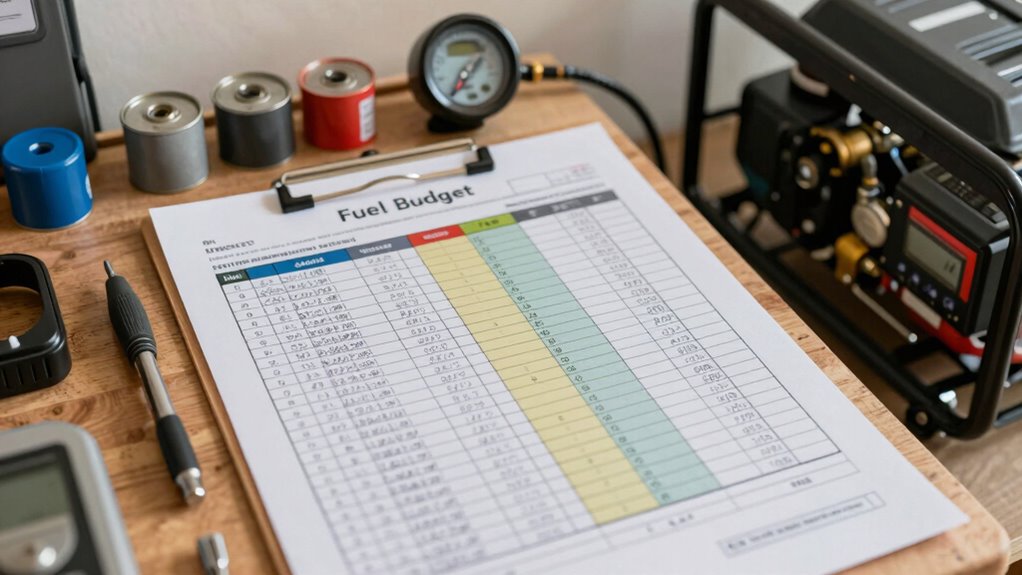

To build a realistic fuel budget for standby power, start by listing your essential devices’ wattages and calculating the total load. Use manufacturer fuel consumption rates at different loads and consider fuel type and energy density for accurate estimates. Add a safety margin for unexpected increases and environmental factors. Regularly review and update your calculations as your generator ages or conditions change. If you’re curious about fine-tuning your plan, you’ll find helpful insights ahead.
Key Takeaways
- Calculate total wattage of essential devices and determine the generator load at 70-80% capacity for efficiency.
- Use manufacturer fuel consumption rates at various loads to estimate hourly fuel needs accurately.
- Choose fuel type based on energy density, considering diesel’s higher energy content for longer run times.
- Incorporate safety margins and environmental factors like temperature and altitude to account for performance variations.
- Regularly review and update the fuel budget based on generator maintenance, aging, and changing operational conditions.
Have you ever wondered how long your standby power system can keep your essential devices running during an outage? To answer that, you need to build a realistic fuel budget, starting with an accurate fuel consumption estimation. This process involves understanding how much fuel your generator consumes at specific loads and how efficiently it operates. Generator efficiency plays a vital role here; a more efficient generator uses less fuel to produce the same amount of power, which extends your runtime and helps you plan better.
Understanding your generator’s efficiency and load levels is key to estimating runtime during outages.
First, you should identify the total wattage of all the devices you want to keep powered during an outage. Once you have that, determine the total load on your generator. Keep in mind that running a generator at its maximum capacity isn’t ideal; most operate more efficiently at around 70-80% load. Knowing your load helps you estimate fuel consumption more precisely because generator efficiency varies with load levels. Manufacturers often provide fuel consumption figures at different loads — use these to create a baseline for your calculations.
Next, you’ll want to consider the type of fuel your generator uses, whether it’s gasoline, diesel, or propane. Each fuel type has different energy content, impacting how long a given volume will last. For example, diesel generally provides more energy per gallon than gasoline, translating into longer run times for the same volume of fuel. Once you understand the energy density of your chosen fuel, you can more accurately estimate your fuel needs. It’s also helpful to recognize that fuel quality and storage conditions can influence fuel efficiency and consumption, affecting your overall calculations. Once you know your generator’s efficiency at your typical load, you can multiply the fuel consumption rate (usually expressed in gallons or liters per hour) by the number of hours you expect to operate during an outage.
It’s also wise to factor in some buffer. No system is perfectly predictable, so adding a safety margin ensures you won’t run out of fuel unexpectedly. Consider potential increases in load or inefficiencies caused by environmental factors like temperature or altitude, which can affect generator performance. Additionally, understanding the fuel content and energy density of your chosen fuel type can help in more accurately estimating your fuel needs. Keep in mind that as your generator ages, its efficiency may decline slightly, so regular maintenance and recalibration of your estimates will keep your fuel budget accurate.

Anker SOLIX C1000 Portable Power Station, 1800W (Peak 2400W) Solar Generator, Full Charge in 58 Min, 1056wh LiFePO4 Battery for Home Backup, Power Outages, and Outdoor Camping (Optional Solar Panel)
- Charge Up in a Flash: Achieve 80% battery capacity in...
- A Decade of Power: Trust in a decade-long journey...
- Powerhouse Versatility: The Anker SOLIX C1000's SurgePad...
As an affiliate, we earn on qualifying purchases.
Frequently Asked Questions
How Often Should I Update My Fuel Budget?
You should update your fuel budget whenever there’s a significant change in fuel price or your storage capacity. Regular updates—at least quarterly—help you account for fluctuating fuel costs and guarantee your storage can meet your standby power needs. Keep an eye on market trends, and adjust your budget accordingly. This way, you stay prepared, avoid shortages, and optimize your fuel usage for reliable standby power.
What Are Common Mistakes in Estimating Fuel Consumption?
You might make mistakes in fuel calculation by overestimating or underestimating consumption estimation, leading to inaccurate fuel budgets. Common errors include neglecting to account for variable loads or weather conditions, and not considering efficiency losses. Always double-check your assumptions and use real data whenever possible. Avoid relying solely on generic estimates; instead, base your calculations on actual usage patterns to guarantee a reliable standby power fuel budget.
Can Renewable Energy Sources Reduce Standby Fuel Needs?
Renewable energy sources can considerably reduce your standby fuel needs through renewable integration, which decreases reliance on fossil fuels. By implementing solar or wind power, you can achieve fuel substitution, lowering the amount of backup fuel required during outages. This approach not only cuts costs but also promotes sustainability. Keep in mind, though, that ensuring reliable renewable sources and proper system integration is key to maximizing these benefits effectively.
How Does Climate Affect Standby Power Fuel Requirements?
Imagine your standby power needs as a sailboat steering through shifting seas. Climate variability and seasonal fluctuations act like unpredictable weather, causing your fuel requirements to ebb and flow. Warmer winters may reduce heating fuel needs, while colder spells increase them. Conversely, hot summers might boost cooling demands. You must adjust your fuel budget accordingly, staying flexible to weather the changing climate waves and guarantee reliable power without over- or underestimating your needs.
What Safety Precautions Are Necessary When Handling Fuel?
When handling fuel, you need to follow proper safety protocols to prevent accidents. Always store fuel in approved containers and keep it away from heat sources or open flames. Use protective gear like gloves and goggles, and work in well-ventilated areas. Regularly inspect fuel storage for leaks or corrosion. By adhering to safety protocols, you minimize risks and guarantee safe handling of standby power fuel.

Porch Shield Generator Cover for 5500-15000W, 38 x 28 x 30 inch, Black
- Compatible - More sizes for 5500w -15000w gas...
- Upgrade Material - Made of 600D polyester fabric...
- Tear Resistant & Waterproof - The high-level double...
As an affiliate, we earn on qualifying purchases.
Conclusion
By carefully estimating your standby power needs and factoring in fuel efficiency, you can create a realistic fuel budget that keeps your backup systems reliable without overspending. Don’t worry if it seems complex at first—you’ll get the hang of it with practice. Just remember, a well-planned fuel budget guarantees you’re prepared for emergencies, giving you peace of mind. With a little effort, you’ll confidently manage your standby power needs and avoid unexpected shortages.

Portable Solar Generator 300W Portable Power Station with 60W Solar Panel
- Portable Generator with 60W Solar Panel Included: with a big battery pack,...
- Multiple Charging outlets for camping gear with SOS Flashlight: with 2* 300W Max AC...
- Multiple Charging Optional, Solar Panel Charger 60W Included: ZeroKor portable power bank generator...
As an affiliate, we earn on qualifying purchases.
Porch Shield Generator Cover for 5000-10000W, 32 x 24 x 24 inch, Black
- Compatible - More sizes for 5000w -10000w gas...
- Upgrade Material - Made of 600D polyester fabric...
- Tear Resistant & Waterproof - The high-level double...
As an affiliate, we earn on qualifying purchases.