
To guarantee your business stays resilient during power failures, develop a solid business continuity plan that includes backup power sources like generators and renewable energy options. Regularly test and maintain these systems, and train staff on emergency procedures. Assess critical functions that need immediate support and size your backups accordingly. Combining renewables with traditional backup solutions can minimize downtime and protect data. Continue exploring ways to strengthen your plan and keep operations running smoothly during outages.
Key Takeaways
- Identify critical business functions and prioritize their continuous operation during power outages.
- Implement reliable backup power sources such as generators and renewable energy systems.
- Develop and regularly test comprehensive response procedures and staff training for power failure scenarios.
- Incorporate automatic transfer switches and proper capacity planning to ensure seamless power source switching.
- Maintain ongoing assessment and update of backup systems to adapt to changing business needs and technological advancements.

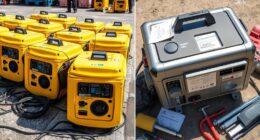
Have you ever considered how a sudden power failure could disrupt your business operations? Without warning, your systems could go offline, data loss might occur, and customer service could grind to a halt. To prevent such chaos, planning ahead is essential. One critical aspect of your business continuity strategy involves integrating renewable energy sources and backup generators. Using renewable energy, like solar or wind power, can provide a sustainable, reliable backup during outages. These sources can supplement your main power supply or serve as an emergency resource, reducing dependency on traditional grid power. Backup generators, on the other hand, are essential for immediate response; they kick in instantly when the main power fails, keeping your essential equipment running without interruption. Combining renewable energy solutions with backup generators creates a resilient system that guarantees continuity even during extended outages.
Integrate renewable energy and backup generators to ensure business continuity during power outages.
When you plan for power failures, consider how renewable energy can be part of a broader strategy. Solar panels, for example, can store excess energy in batteries, allowing your business to operate independently for hours or days if needed. Wind turbines might be another option, especially if your location has consistent wind patterns. These renewable sources not only help maintain operations but also reduce your carbon footprint, aligning your business with sustainability goals. To maximize effectiveness, ensure your backup generators are properly maintained and tested regularly. This way, you know they’ll perform when needed, without surprises. It’s also wise to invest in automatic transfer switches, which enable seamless switching from the grid to your backup power sources, avoiding costly downtime.
Furthermore, your backup power system should be designed with capacity in mind. Determine which critical functions need uninterrupted power, such as servers, communication systems, or manufacturing equipment. This prioritization helps you size your backup generators and renewable energy storage accurately, avoiding waste and ensuring reliability. It’s equally important to develop clear procedures and train staff on how to activate backup systems swiftly. Regular drills can help identify gaps in your plan, making sure everyone knows their role during a power failure. Additionally, understanding the benefits of glycolic acid for skin can be useful in other areas of business, such as employee wellness or beauty product offerings, enhancing overall company appeal.
Ultimately, integrating renewable energy with backup generators isn’t just about preventing downtime; it’s about building a resilient infrastructure that supports your long-term sustainability and operational stability. Power failures can happen unexpectedly, but with a well-thought-out business continuity plan, you can minimize their impact. By investing in renewable energy solutions and reliable backup generators, you’re not only safeguarding your business but also demonstrating your commitment to environmental responsibility. Preparedness today ensures that your business remains strong, adaptable, and ready for any power challenge tomorrow.
Frequently Asked Questions
How Often Should We Review Our Power Outage Contingency Plan?
You should review your power outage contingency plan at least annually, aligning with your maintenance schedule and technology updates. Regular reviews guarantee your plan stays effective as systems evolve and new risks emerge. Additionally, after any major technology upgrades or incidents, reassess the plan to address any gaps. This proactive approach helps you stay prepared, minimizes downtime, and keeps your business resilient during power failures.
What Are the Costs Associated With Implementing Backup Power Solutions?
The costs of implementing backup power solutions vary based on your chosen equipment and capacity. You should consider initial cost estimation for purchasing generators or UPS systems, along with ongoing expenses like equipment maintenance. Additionally, budget for regular testing and potential repairs to guarantee reliable operation. While upfront costs can be significant, investing in backup power enhances your business resilience and minimizes downtime during outages.
How Do We Train Staff for Emergency Power Outage Procedures?
You should start by scheduling regular staff drills that demonstrate emergency power outage procedures. During these drills, emphasize effective emergency communication to guarantee everyone knows their roles and responsibilities. Use clear instructions, simulate real outages, and encourage questions to boost confidence. Consistent training builds competence, calmness, and coordination, making sure your team responds swiftly, smoothly, and securely when power fails.
What Legal or Compliance Issues Relate to Power Failure Planning?
You need to make certain your power failure planning complies with regulatory standards and safeguards data security. Failing to meet regulatory compliance can result in fines or legal action, while neglecting data security could lead to data breaches or loss. Regularly review relevant laws and industry guidelines, implement secure backup systems, and document your procedures. Staying proactive not only keeps you compliant but also protects your business and customer information during power outages.
How Can Small Businesses Effectively Prepare for Prolonged Outages?
You should regularly perform equipment maintenance to guarantee everything runs smoothly during outages. Stock up on essential supplies and create backup power sources like generators. Strengthen your supply chain by establishing relationships with alternative suppliers, so you’re not dependent on a single source. Develop clear protocols for prolonged outages, train staff, and keep communication lines open. These steps help you stay operational and minimize disruptions during extended power failures.
Conclusion
As you implement your business continuity plan, you might find yourself grateful for the unexpected calm that follows a power failure. Just as the lights flicker back on, a new sense of resilience emerges, reminding you that preparation often coincides with opportunity. When you’re ready for anything, even the darkest nights can reveal brighter days ahead. Embrace the planning now, and you’ll be prepared for whatever surprises come your way.