TL;DR

Get backup power and energy gear delivered free — and shop member deals
- Fast, free delivery on millions of items
- Access to Prime Big Deal Days deals on October 6–7
- Prime Video, Amazon Music and more included
Portable solar power banks store electricity in a rechargeable battery and use small photovoltaic panels to add some charge from sunlight. Their built-in panels are usually too small for fast recharging, so charge the bank from a wall outlet before a trip and treat solar as a backup. Compare usable capacity, USB-C output, durability ratings, and weight before buying.
Your phone can run out of power long before the trail ends, but a tiny solar panel won’t magically refill a battery by lunchtime. Portable solar power banks pair stored battery power with sunlight charging, and knowing which part does the heavy lifting helps you avoid a dead phone and a disappointing purchase.
Here’s how to read capacity, judge the built-in panel, and choose the right ports and protections. You’ll also see when a solar bank makes sense—and when a regular power bank or a separate foldable panel is a better fit.
Treat a built-in solar panel as a slow backup or top-up source, not a fast way to fill an empty bank.
Compare watt-hours when possible; a 10,000 mAh label does not equal 10,000 mAh delivered to your phone.
Match USB-C PD output, wattage, and cable to your device if you want faster charging or laptop support.
Check the IP rating, safety protections, and temperature guidance before taking a bank outdoors.
Charge the bank at home, then use direct sunlight to supplement it during a trip.
What a Portable Solar Power Bank Actually Does
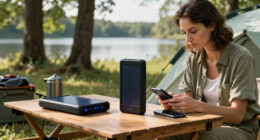
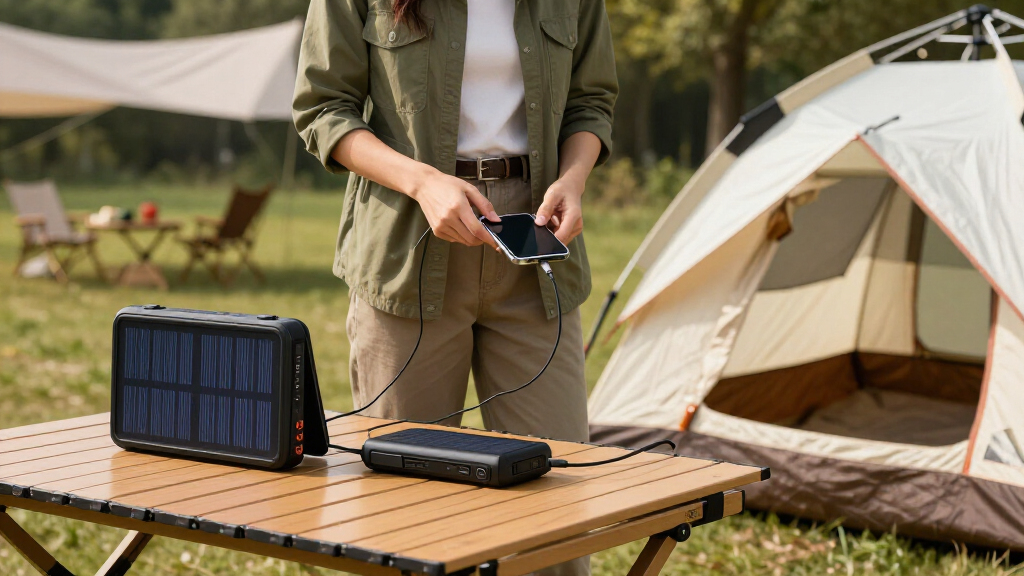
A portable solar power bank is a rechargeable battery pack with small photovoltaic panels that can collect sunlight and add energy to its battery. You can usually charge a phone through USB whether or not the sun is shining; the built-in panel is a supplemental way to replenish the bank.
Think of it as a thermos with a little kettle attached: the stored charge does the fast work, while sunlight trickles in over time. For example, you can fill the bank from a wall outlet the night before a hike, then leave its panel facing direct sun during a lunch stop to recover some of the energy your GPS used.
The phrase portable solar power covers very different setups. A palm-sized panel on a battery pack is convenient to carry, while a larger foldable panel paired with a power bank can collect much more sunlight. That difference explains why an integrated panel is a useful backup but rarely a quick refill method.
How to Read Capacity Without Overestimating Phone Charges
A power bank’s mAh rating estimates its battery capacity, but it does not tell you exactly how much energy your phone will receive. The rating refers to the bank’s internal battery voltage, and conversion losses occur when the bank turns that energy into USB output, so a 10,000 mAh model delivers less than 10,000 mAh to a phone.
For a fair comparison, check the stated watt-hours (Wh) when available and compare models under the same conditions. Your actual number of charges also depends on your phone’s battery size and how much power it uses while charging. A traveler who wants to top up a phone once on a day walk may need less capacity than someone carrying a GPS, earbuds, and a second phone for a weekend.
As a practical example, imagine your phone is already at 20% when you plug it in, then you use maps and take photos during the charge. It may not reach a full charge even with a sizeable bank, because the phone is using some of the incoming energy as it goes.
Why the Built-In Solar Panel Charges Slowly
A built-in panel charges slowly because its surface area is small, limiting how much sunlight it can collect at once. A full refill can take many hours or longer in strong sun, and shade, clouds, poor panel angle, or heat can stretch that time further.
That makes a small panel handy for maintaining a charge over several sunny days, rather than rescuing an empty bank in an afternoon. Say you’re camping for a long weekend: a bank that starts full can cover phone and headlamp charging, while the panel may help replace a little of what you use each day. If you begin with an empty bank, you could spend the trip waiting for sunlight instead of using your devices.
For more predictable solar charging, people often pair a power bank with a larger foldable panel. A larger panel gathers more energy than a compact one, but adds bulk and needs to be positioned in the sun. Your best choice depends on whether you value light packing or more solar input.
Pick the Right Ports for Your Phone and Other Gear
The right ports let your power bank deliver enough power to the devices you actually carry. Check for USB-A or USB-C, the maximum output, and charging standards such as USB-C Power Delivery (PD); a fast charge requires a compatible bank, cable, and device.
For instance, USB-C PD can charge a compatible phone faster than a basic port, but a USB-C-shaped connector alone doesn’t promise a particular speed. Read the listed wattage and check that your cable supports it. Earbuds and many GPS units use little power and can work with modest output, while a tablet may need a stronger port.
Laptops need more scrutiny: many compact models lack the required USB-C PD wattage and voltage, so don’t assume a bank can run one. Wireless charging, integrated cables, extra ports, or a built-in light can be convenient, but none of them increases the solar panel’s energy collection.
- Phone or earbuds: check the output standard and capacity.
- Tablet: check its charging requirement against the bank’s maximum output.
- Laptop: confirm USB-C PD wattage and voltage before buying.
Choose Outdoor Protection That Matches Your Trip
Outdoor durability depends on specific protection ratings and construction, not words like “rugged” alone. Look for a stated IP rating for water and dust protection, sturdy housing, and safety protections such as overcharge, overcurrent, and temperature control.
“Water resistant” does not mean waterproof: a splash-resistant case may still leave exposed ports vulnerable to rain. On a damp campsite, keep the bank in a dry bag when you’re not charging and close any port covers before the weather turns. Read the rating’s limits rather than testing them in a puddle.
Sun also creates a tradeoff: the panel needs direct light, but the battery should not exceed its specified temperature range. Prop the panel toward the sun while keeping the bank itself shaded when possible, and never leave it in a hot enclosed car. A power bank’s protections help, but they do not replace following the maker’s temperature guidance.
Safety note: Use the product within its stated temperature range, keep ports dry as directed, and stop using a battery that is swollen, damaged, or unusually hot.
Use These Steps to Get More Reliable Charging
To get reliable power outdoors, charge the bank from a wall outlet before leaving, then use sunlight as a backup. That simple routine gives you a dependable starting charge without asking a small panel to do a job it may need days to finish.
- Charge at home. Use the included or recommended USB charger and check that the bank’s indicator shows a full charge.
- Pack for your devices. Bring compatible cables and confirm the bank has the output your phone, tablet, or GPS needs.
- Place the panel in direct sun. Avoid tree shade, keep it angled toward the light, and check it periodically as the sun moves.
- Manage heat and weather. Follow the temperature guidance, keep the battery out of excessive heat, and protect it from water unless its rating covers the conditions.
- Check progress realistically. Treat the solar indicator as a top-up signal, not a promise of a full recharge by a specific hour.
Suppose you’re walking a shaded forest trail. The panel may produce little while you’re under trees, so save your phone’s battery with offline maps and low-power mode, then place the bank in direct sun during a break. Small habits can matter more than an optimistic charge-time claim.
Decide Whether Solar Is Worth the Extra Weight
A solar power bank is worth carrying when you may spend days away from outlets and can give its panel regular sunlight. It is less appealing for everyday charging or trips where you need a fast, dependable refill from a compact device; a conventional power bank often suits those needs better.
Before choosing, compare the setup against your real trip. A weekend camper who keeps a phone for maps and emergency calls might welcome slow solar top-ups. A commuter who charges nightly at home may get more use from a lighter standard bank, while a week-long trip with several devices could justify a larger foldable panel paired with a power bank.
Weight and travel rules matter too. Bigger batteries and panels add bulk, and spare lithium power banks generally belong in carry-on baggage, with watt-hour limits and airline policies that can vary. Check your carrier’s current rules before flying, especially if you plan to bring a high-capacity model.
- Best fit: camping, travel, and emergencies where outlets are scarce.
- Less useful: quick solar recharging, indoor charging, or light daily carry.
- Better solar output: a larger separate panel, if you can carry the extra size.
Frequently Asked Questions
Can a portable solar power bank charge a phone?
Yes. Most models charge phones through USB, provided their output matches the phone’s charging needs. The phone draws from the bank’s stored energy; sunlight can replenish that battery slowly.
How long does it take to charge one from sunlight?
It varies with panel size, sunlight strength, angle, shade, clouds, and heat. A small built-in panel may need many hours or longer to refill the bank, so check independent tests and the maker’s stated conditions.
Can I charge a portable solar power bank from a wall outlet?
Most models can recharge through USB, and a wall charger is usually much faster than the built-in panel. Filling it before a trip gives you a predictable supply of stored power.
Will a solar power bank work indoors or on cloudy days?
It may collect some energy in indirect light, but output falls substantially in clouds and indoors. For useful charging, expect direct sunlight to work better and use an outlet or larger panel when available.
Are portable solar power banks allowed on airplanes?
Spare lithium power banks generally go in carry-on baggage rather than checked luggage. Watt-hour limits and airline rules vary, so check your carrier’s current requirements before flying.
Conclusion
Choose a portable solar power bank for the stored battery first, then treat its panel as a slow reserve for sunny hours. Charge it before you leave, match its ports to your gear, and keep the battery within its temperature limits.
On the trail, let sunlight stretch your power—not make promises it can’t keep.
Fall Picks
fall essentials
As an affiliate, we earn on qualifying purchases.