TL;DR

Get backup power and energy gear delivered free with Prime
- Fast, free delivery on millions of items
- Prime Video, Amazon Music and more included
- Member-only deals all year
Ring has announced a $249 Smart Lock with a built-in hand crank that can generate enough power for about 30 seconds of operation if the lock loses power. The company says the lock is planned for the first few months of 2027, but has not given a precise launch date.
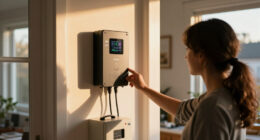
Ring has announced a $249 smart lock with a built-in hand crank that can generate enough electricity to operate the lock briefly if its battery runs out. The company says turning the wheel three or four times provides about 30 seconds of power, allowing users to unlock the door without a spare battery, cable or external power source.
The small wheel is built into the lock’s exterior. According to The Ambient’s report, the mechanism uses a small motor and supercapacitor: several firm turns generate around three volts, letting the lock operate normally for a short period rather than switching to a limited low-power mode. Ring’s description says that window should be enough to use the fingerprint reader, enter a keypad code, unlock through the Ring app or use Alexa.
Ring says the lock’s built-in battery should last up to a year on a single charge. That is the company’s stated estimate, not a guarantee of battery life for every household or use pattern. The hand crank is designed as an emergency fallback for the point when the lock has lost power.
The Smart Lock will use a single-cylinder deadbolt and will not need additional wiring, according to the report. Ring plans to offer it in Black, Silver and Brass, at a planned price of $249. The company has not announced an exact release date; its current window is the first few months of 2027.
A Backup Beyond Batteries
The crank addresses a practical concern for people considering a connected lock: what happens if its power source fails when they need to get inside? Unlike a backup that relies on a replacement battery, charging cable or another power source, this mechanism is designed to produce a short burst of electricity at the door itself.
That could be useful in situations where carrying or accessing a backup battery is difficult. Ring founder Jamie Siminoff also sees a potential use for the technology at places visited infrequently, such as remote cabins, according to The Ambient. The lock’s usefulness will depend on how reliably the crank works in practice and whether users can operate it comfortably, details not established by the announcement.
The feature does not mean the lock can run indefinitely without its regular battery. The reported output is intended to provide roughly 30 seconds of operation—enough for an unlock attempt, not ongoing use. Buyers will still need to understand the lock’s normal battery requirements and follow Ring’s instructions for maintaining it.
How Ring Addresses Lockouts
Smart locks typically depend on batteries to power connected features and electronic entry. A depleted battery can be a particular worry for households that expect to use a fingerprint reader, keypad, app or voice assistant rather than a conventional key. The Ambient reports that Siminoff developed the crank idea in response to concerns about losing access when a smart lock runs out of power.
Ring’s proposed approach is to generate a small amount of electricity mechanically, using a wheel on the lock itself. The report describes it as a way to keep the lock operating normally for a short emergency interval. It is distinct from the lock’s main battery, which Ring says can last up to one year per charge.
The lock was among several products Ring announced. The company is also preparing four 4K cameras and a 2K pan-and-tilt indoor camera, according to The Ambient. Those products are separate from the lock’s power feature; the report provides no further confirmed details about their release timing here.
“Concerns about losing access when a smart lock runs out of power can put people off buying one.”
— Jamie Siminoff, Ring founder, as reported by The Ambient
Release Details Still Pending
Ring has not confirmed a specific launch date. The current schedule is the first few months of 2027, and Siminoff reportedly hopes to release it closer to January than March. That preference is not a firm date or a guarantee that the product will ship then.
The available report also does not provide independent testing of the crank, battery-life estimate or performance under different conditions. It remains unclear how the lock will behave if the mechanism is difficult to turn, if repeated attempts are needed, or if the lock has a fault unrelated to a depleted battery. Ring has not supplied further technical specifications, such as the crank’s durability or details of the lock’s security testing.
Ring’s 2027 Launch Window
Ring’s stated next milestone is the planned release in the first few months of 2027. The company has not set an exact date, and the reported hope for a January launch remains tentative. People interested in the lock can register their interest, according to The Ambient.
Further product information will be needed to assess the lock’s full specifications, compatibility and real-world backup operation. Until Ring publishes those details and the product is available for testing, the crank’s reported performance should be treated as the company’s proposed capability rather than an independently verified result.
Key Questions
How does the Ring Smart Lock hand crank work?
The Ambient reports that turning the wheel on the lock three or four times generates electricity through a small motor and supercapacitor. Ring says the resulting power can operate the lock for about 30 seconds.
Can the crank power the lock for regular use?
No. The reported crank output is an emergency backup for a brief unlocking window, not a replacement for the lock’s built-in battery.
How long is the lock’s battery expected to last?
Ring says the battery should last up to one year on a single charge. That is the company’s estimate, and the report does not specify how usage or conditions affect it.
When will the Ring Smart Lock be available, and how much will it cost?
Ring has a planned price of $249 and a launch window in the first few months of 2027. An exact release date has not been confirmed.
What kind of deadbolt does it use?
The report says the Smart Lock will use a single-cylinder deadbolt and will not require additional wiring. Further installation and compatibility details have not been provided in the source report.
Source: rss
Columbus Day / Indigenous Peoples' Day Picks
long weekend sales
As an affiliate, we earn on qualifying purchases.