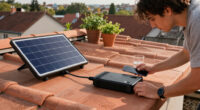
When people compare solar backup power banks, the real choice is usually between a single power bank with a small built-in panel and a power bank used with a separate foldable solar panel. The built-in design is easier to carry and has fewer parts, but its limited panel area means sunlight may add only a slow trickle of power. A separate panel takes more space and costs more, yet it can collect enough energy to make solar recharging useful in camp or during a prolonged outage. Choose A for a compact emergency reserve with occasional sun exposure; choose B if you expect to recharge away from outlets and can carry the panel.

Get backup power and energy gear delivered free with Prime
- Fast, free delivery on millions of items
- Prime Video, Amazon Music and more included
- Member-only deals all year

SolarTred 20,000mAh Solar Power Bank with 4 Panels and 3 Built-In Cables
- ✔ Battery capacity: 20,000mAh
- ✔ Battery type: Lithium polymer
- ✔ Solar panels: 4 integrated panels

BLAVOR 20,000mAh Solar Power Bank with Wireless Charging
- ✔ Battery capacity: 20,000mAh
- ✔ Built-in cables: 4: 2 USB-C, 1 iOS, 1 USB-A
- ✔ Ports: 3

BLAVOR 10,000mAh Solar Power Bank with 20W USB-C and Wireless Charging
- ✔ Battery capacity: 10,000mAh
- ✔ Battery type: Lithium-cobalt
- ✔ USB-C output: 20W
At a Glance
| Criteria | Power bank with a built-in solar panel | Power bank paired with a separate foldable solar panel | Winner |
|---|---|---|---|
| Solar recharge speed | Typically very slow because the built-in panel has little surface area; treat it as a supplement, not a dependable refill method. | Usually faster in direct sun because the larger panel captures more light; actual output varies with weather, angle, and panel rating. | B |
| Portability | One compact item, usually simplest to pack for daily carry or a small emergency kit. | Bulkier and heavier as a kit; the panel may fold for storage but still needs room and setup. | A |
| Ease of use | No separate panel or cable to manage; leave it in sunlight, subject to device placement and conditions. | Requires positioning the panel, connecting it, and sometimes repositioning it as the sun moves. | A |
| Capacity and flexibility | Capacity is fixed in one unit; solar input and stored energy are tied to the product design. | Power bank and panel can be selected or replaced separately; capacity and panel size can match the trip. | B |
| Reliability in changing conditions | Panel and battery travel together, but shaded placement or poor sun sharply limits input; heat can also affect batteries. | Panel can be placed in sun while the power bank stays shaded, though clouds, shade, and setup still constrain charging. | B |
| Upfront value | Often cheaper and more convenient, but the solar feature may contribute little usable energy. | Higher initial cost, but the panel is more likely to provide meaningful solar energy when used regularly. | Depends |
SolarTred 20,000mAh Solar Power Bank with 4 Panels and 3 Built-In Cables
For buyers who want a substantial reserve and an outdoor-oriented build, the SolarTred 20,000mAh makes the strongest all-around case in this group. Its four integrated solar panels give sunlight a larger role in the design than the listings’ panel details do for the BLAVOR models, and the stated IP67 rating is the clearest water and dust protection claim among these three. That combination makes it a practical pick for keeping in a camping kit or emergency bag, where a power bank may be exposed to changing conditions.Its three built-in cables—USB-C, Lightning, and USB-A—reduce the chance of forgetting a lead, and separate ports support connections beyond those cables. The listing says it can charge up to five devices simultaneously, which gives it an edge over the smaller BLAVOR’s three-device limit when a group shares one backup unit. The tradeoff is its 1.4-pound weight: it is much less appealing for a small everyday carry kit than the 9.3-ounce BLAVOR 10,000mAh.The SolarTred also includes both a dual flashlight and a three-level camping light, but these cannot operate at the same time. That constraint matters when we want one device to light a campsite while also serving as a torch. Like the BLAVOR models, it has no listed solar recharge time, so we would choose it for its stored capacity and outdoor features, not on the assumption that sunlight will quickly refill it. Compared with the BLAVOR 20,000mAh, it gives up wireless charging and the compass, but its stated IP67 rating and four-panel setup make its outdoor backup role easier to understand.
Pros:
- 20,000mAh capacity provides more listed reserve than the compact BLAVOR.
- Four integrated solar panels and multiple charging inputs.
- Three built-in cables plus additional ports support a range of devices.
- IP67 rating, dual flashlight, and three-level camping light.
Cons:
- At 1.4 pounds, it is the heaviest listed option.
- Flashlight and camping light cannot operate simultaneously.
- Solar recharge performance and timing are not specified.
Best for: Campers or emergency-kit owners who prioritize 20,000mAh of stored capacity, multiple wired connections, and a clearly stated IP67 rating.
Not ideal for: Light packers, or anyone who needs wireless charging or expects the flashlight and camping light to run at the same time.
Bottom line: We rank the SolarTred first for outdoor backup because its capacity, four-panel design, cable selection, and stated IP67 rating form the most complete match for that role.
“We rank the SolarTred first for outdoor backup because its capacity, four-panel design, cable selection, and stated IP67 rating form the most complete match for that role.”
BLAVOR 20,000mAh Solar Power Bank with Wireless Charging
The BLAVOR 20,000mAh keeps the same headline capacity as our top pick but shifts attention to connection options. Its four built-in cables cover two USB-C connections, iOS, and USB-A, while Qi wireless charging can help with compatible phones and Apple Watch. For a mixed-device group, that flexibility may be more useful than the SolarTred’s stronger stated weather-protection rating. It also includes a flashlight, camping light, compass, and thermometer for users who want several outdoor tools in one unit.There is a specification inconsistency buyers should notice: the listing claims 20W USB-C fast charging, but also lists maximum output power as 18W. We cannot determine from the supplied details which figure applies to a particular output or device, so we would avoid choosing it on the strength of a specific output expectation. The smaller BLAVOR lists 20W USB-C output without that same stated conflict, although it has half the battery capacity.Its flame-retardant shell and waterproof silicone protection are described as resistant to water, shocks, and dust, but no IP rating is supplied here to compare directly with the SolarTred’s IP67 or the compact BLAVOR’s IPX5. The solar charging rate is also unspecified, so its panels remain a supplemental feature rather than a predictable source of replenishment. Choose this BLAVOR when wireless charging and broad cable coverage matter more than a clearly ranked ingress rating; skip it if you need the simplest output specification or a compact unit.
Pros:
- 20,000mAh capacity matches the SolarTred’s listed reserve.
- Qi wireless charging plus four built-in cables.
- Includes flashlight, camping light, compass, and thermometer.
- USB-C fast charging is listed alongside multiple charging options.
Cons:
- The listing conflicts between 20W USB-C fast charging and 18W maximum output.
- Solar charging speed and performance are not specified.
- No IP rating is listed for direct comparison with the other models.
Best for: Buyers carrying several compatible devices who want a 20,000mAh reserve, Qi wireless charging, and multiple built-in cables.
Not ideal for: Anyone who needs an unambiguous maximum output rating, a stated IP protection rating, or the lightest option.
Bottom line: We recommend this BLAVOR for connection flexibility and wireless charging, provided buyers are comfortable with the unresolved output specification.
“We recommend this BLAVOR for connection flexibility and wireless charging, provided buyers are comfortable with the unresolved output specification.”
BLAVOR 10,000mAh Solar Power Bank with 20W USB-C and Wireless Charging
When carrying less matters more than maximizing stored power, the BLAVOR 10,000mAh is the easiest of these three to justify. At 9.3 ounces and 0.87 inches thick, it is substantially lighter and slimmer than the SolarTred, while still offering Qi wireless charging, three-device charging, and stated 20W USB-C output. That makes it a better fit for day hikes or a travel pouch where a 20,000mAh unit would take up too much room.The smaller battery is the clear cost of that portability. It holds half the listed capacity of either larger contender, so buyers planning to share power across several devices or keep phones topped up over a longer outage should look first at the SolarTred or larger BLAVOR. Unlike the BLAVOR 20,000mAh, its stated USB-C output is a straightforward 20W; in turn, it has fewer built-in cable connections listed and no camping light or thermometer.Its IPX5-rated case, dual flashlights, and compass carabiner add practical outdoor touches, and the three-year warranty is longer than the SolarTred’s listed 12 months. However, the supplied details say a full recharge takes about seven hours, and do not provide a solar recharge time. We would treat the solar feature as an occasional supplement and plan around the smaller stored reserve. Choose this model when lower weight and wireless convenience win; skip it when capacity is the main requirement.
Pros:
- At 9.3 ounces, it is lighter than the 20,000mAh models.
- Qi wireless charging and listed 20W USB-C output.
- Can charge up to three devices simultaneously.
- IPX5 case, dual flashlights, compass carabiner, and three-year warranty.
Cons:
- 10,000mAh capacity is half that of the other two options.
- Listed battery recharge time is about seven hours.
- Solar recharge timing and performance are not provided.
Best for: Day hikers and travelers who want a lighter power bank with Qi charging and stated 20W USB-C output.
Not ideal for: Buyers preparing for longer outages, charging a group, or prioritizing the largest reserve capacity.
Bottom line: We favor the compact BLAVOR when pack weight and a clear 20W USB-C specification matter more than the larger models’ greater reserve.
“We favor the compact BLAVOR when pack weight and a clear 20W USB-C specification matter more than the larger models’ greater reserve.”
As an Amazon Associate we earn from qualifying purchases.
Key Differences
The largest practical difference is how much panel area is available. A small integrated panel is convenient, but it cannot collect much energy at once. Product labels may emphasize solar charging without making clear how slowly a phone-sized bank can recharge under real sunlight. That makes A best understood as a power bank that can sip extra energy outdoors, rather than a solar generator. B has more potential because a separate panel can unfold into a larger surface and face the sun, but cloud cover, shade, panel angle, and season all affect its output.
The tradeoff is ease against usable solar input. A is ready to carry and has fewer parts to lose; B asks for setup and more packing space. For a commute or short day hike where the power bank starts charged, A is the simpler choice. For multi-day camping or an outage where wall charging may remain unavailable, B is the stronger approach, provided the panel is sized for the devices and conditions. Neither configuration replaces a larger battery system for appliances or sustained household backup.
Value depends on whether solar recharging is central to the purchase. If the primary need is an emergency phone reserve, a conventional power bank may offer better value than paying extra for a tiny panel. If you will routinely spend hours outdoors or need a way to replenish stored energy, paying more for B can make sense. Check battery capacity, panel output, ports, and manufacturer guidance rather than assuming that the word “solar” means fast or all-weather charging.
Detailed Comparison
Solar recharge speed (Power bank paired with a separate foldable solar panel wins — major)
B wins by a major margin in practical solar input: its larger panel can gather substantially more sunlight than the small surface on A. Actual charging still depends on direct sun, panel orientation, temperature, and the bank’s charging limits. A may gain some charge while clipped to a pack, but users should not count on it to refill a depleted bank quickly. For a trip lasting several days, B is the more credible solar option.
Portability (Power bank with a built-in solar panel wins — moderate)
A wins moderately because it is a single compact unit with no separate panel to pack. B’s foldable design helps, but the extra panel adds bulk and weight and needs space when unfolded. For pockets, a small day bag, or a minimalist kit, A is easier to keep on hand. For a vehicle-based trip or a camp where gear can be spread out, B’s size may be an acceptable cost.
Ease of use (Power bank with a built-in solar panel wins — moderate)
A wins moderately on simplicity: there is no panel to unfold, connect, or reposition. B requires a little more attention, especially if the sun moves or clouds pass. The gap matters most for casual users who want a backup that works with minimal setup. If the user is comfortable placing a panel in direct sun and checking connections, B’s added effort is modest.
Capacity and flexibility (Power bank paired with a separate foldable solar panel wins — moderate)
B wins moderately because the bank and panel can be chosen separately. A buyer can pair a suitable capacity with a larger panel, or replace one part if needs change. With A, capacity and solar input are fixed together. This flexibility is useful for people with multiple devices or changing trip lengths, although it requires checking compatibility and can increase total cost.
Reliability in changing conditions (Power bank paired with a separate foldable solar panel wins — moderate)
B has a moderate advantage when placement matters: its panel can sit in sunlight while the power bank remains protected in shade, reducing exposure of the battery to heat. Both setups lose output under clouds, shade, or poor orientation, and neither guarantees charging in bad weather. A is less dependent on a separate setup, but its small panel cannot overcome weak sunlight. Store either battery within its recommended temperature range.
Upfront value (moderate difference)
This is a genuine tradeoff. A usually costs less and offers a convenient reserve, but paying a premium specifically for its built-in solar panel may not deliver much practical energy. B costs more and takes more room, yet gives buyers more meaningful solar capability. A is better value when convenience and occasional top-ups matter; B is better value when regular off-grid recharging is a real need.
Power bank with a built-in solar panel: Pros and Cons
Pros:
- Compact single item that is easy to carry and store.
- Simple to use without connecting a separate panel.
- Can provide occasional supplemental charging when exposed to strong sunlight.
Cons:
- Small panel area usually means very slow solar charging.
- Limited flexibility to upgrade or replace the panel separately.
- Solar marketing can create expectations beyond what the panel can deliver.
Power bank paired with a separate foldable solar panel: Pros and Cons
Pros:
- Larger panel can gather more sunlight and recharge the bank more usefully.
- Panel and battery can be selected or replaced independently.
- Panel can be placed in sun while the battery stays shaded.
Cons:
- Costs more and adds packing bulk and setup steps.
- Charging still depends on sunlight, placement, and compatible equipment.
- A panel may be inconvenient for quick everyday carry.
Who Should Choose What
Choose Power bank with a built-in solar panel if:
- You want a compact backup for a phone and expect to charge it from an outlet before leaving.
- You value a single, simple device and see solar input as a bonus rather than the main charging method.
- Your outings are short and you can tolerate very slow supplemental charging.
Choose Power bank paired with a separate foldable solar panel if:
- You camp, travel, or work outdoors long enough to make solar replenishment useful.
- You can carry and position a foldable panel in direct sunlight.
- You want to choose battery capacity and panel size separately for your devices and trip length.
Skip both if: You need dependable backup for household appliances, medical equipment, or several days of high-power use. Consider a larger power station with a suitably rated panel, and verify its capacity and output against the actual devices.
Value for Money
Pay more for B only when you expect to use the panel often enough to benefit from its larger collection area. For a power bank that mostly stays in a drawer or serves as an occasional phone reserve, A’s convenience may matter more, though a standard power bank without solar may be a better-value purchase. B costs more upfront, but it is the stronger value for repeat outdoor use or extended outages because its panel is more likely to add meaningful energy. Compare battery capacity in watt-hours, panel output, charging ports, and operating guidance; capacity claims alone do not tell you how quickly the setup will recharge.
Final Verdict
For most buyers choosing specifically for solar backup, B—the power bank paired with a foldable panel—is the more capable option. Its larger panel makes solar charging more plausible, and separate components give you room to match the setup to your needs. Choose A if compactness and simplicity matter more than meaningful solar replenishment, or if you mainly want a charged phone bank with a small sunlight bonus. The deciding question is whether you need solar to do real recharging: if yes, accept B’s added cost and bulk; if no, buy for battery capacity and portability instead.
Frequently Asked Questions
Can a built-in solar panel fully recharge a power bank?
It may eventually add charge under strong, sustained sunlight, but the small panel on many power banks is slow. Treat it as a supplement and check the manufacturer’s stated solar input and recharge conditions.
Is a foldable panel useful on cloudy days?
It can still collect some light in bright overcast conditions, but output usually falls compared with direct sun. Shade and heavy cloud can make charging very slow, so keep another charging option for critical devices.
Which option is better for an emergency kit?
A is easier to store as a compact phone reserve. B is more useful if you expect a prolonged outage and can place the panel outdoors in sunlight. For longer outages or larger devices, neither may provide enough capacity.
Is a higher capacity power bank always the better choice?
No. A larger battery stores more energy but also takes longer to recharge, especially with a small panel. Match capacity and panel output to the devices you need to power and the time available in sunlight.