TL;DR

Get backup power and energy gear delivered free — and shop member deals
- Fast, free delivery on millions of items
- Access to Prime Big Deal Days deals on October 6–7
- Prime Video, Amazon Music and more included
A portable solar generator is a rechargeable battery power station that can recharge from solar panels, a wall outlet, or—in many models—a vehicle. Choose by matching usable watt-hours to the devices and run time you need, then check continuous and surge output, solar input limits, ports, weight, and warranty.
A battery with a “solar generator” label won’t make electricity by itself. It stores power, and sunlight can refill it when the panels get enough sun.
That distinction matters when the lights go out or you’re packing for a weekend at a campsite. You’ll learn how these stations work, how to estimate run time, and which specifications help you choose a unit you can actually use.
A “solar generator” is a battery power station; panels recharge it, and panels may be sold separately.
Use usable watt-hours divided by average device watts for a rough run-time estimate, then allow for losses and changing demand.
Check both continuous and surge output before relying on a station for a refrigerator, CPAP machine, or power tool.
Solar panel ratings are best-case figures; confirm voltage and current limits and expect sunlight to vary.
Use approved transfer equipment and professional installation to connect backup power to household circuits.
What a portable solar generator powers—and how it works
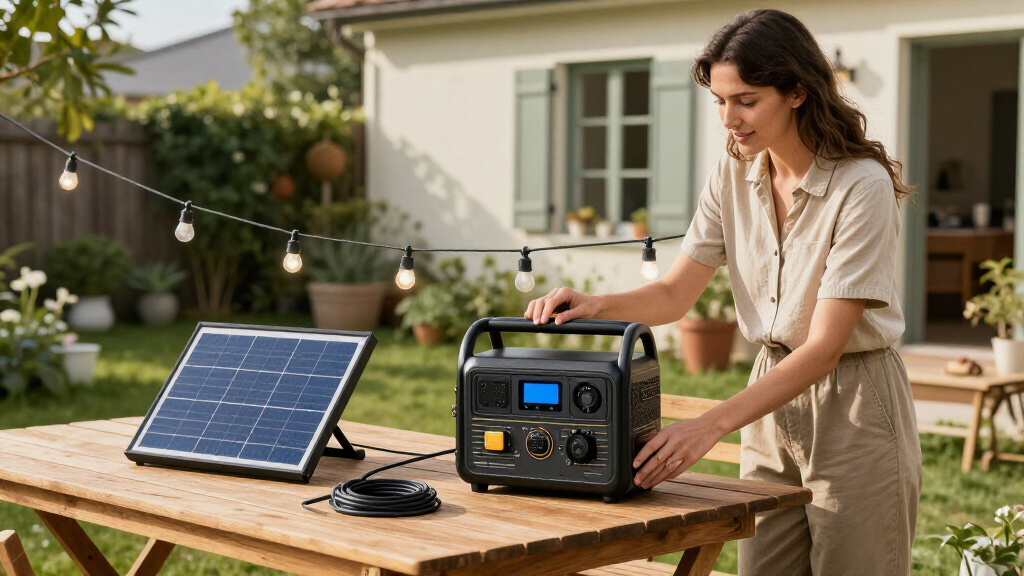
A portable solar generator is a rechargeable battery power station that stores electricity and supplies it through AC outlets, USB ports, or DC outputs. Solar panels recharge the battery; many models also accept power from a wall outlet or vehicle. During normal operation, the battery produces no exhaust and runs quietly, though cooling fans may switch on under load.
The term “solar generator” is mostly marketing shorthand. Think of the battery as a pantry and the panels as a delivery route: the station can serve stored energy, but sunlight has to put it there first. Panels may come in a kit, but manufacturers often sell them separately.
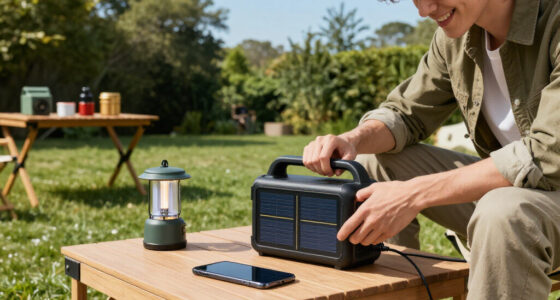
For example, at a campsite, you could use a station to top up two phones, run LED lights, and charge a laptop. A heater or kettle is a very different job; those appliances draw enough power to drain a battery fast.
Pick capacity and output that fit your devices
Choose a portable solar generator by checking capacity in watt-hours (Wh) and output in watts (W). Capacity estimates how much energy the battery stores; output tells you how much power it can supply at once. Check continuous output for normal operation and surge capacity for appliances that briefly demand extra power when starting.
A 1,000 Wh battery could theoretically run a 100 W device for 10 hours, but the real figure will be lower because the inverter uses some energy and the station may reserve part of its charge. A rough estimate is usable battery capacity divided by the device’s average watt draw. A laptop drawing about 60 W from a 900 Wh usable battery might run for roughly 15 hours before losses and other limits.
Portable solar generators can run phones, laptops, lights, and routers with ease when the capacity and ports match. Refrigerators and power tools need closer checks for starting wattage; space heaters often empty batteries quickly. A station that can start a fridge still may not keep it running through a long outage.
Compare the specs that matter before you buy
The right portable solar generators balance battery capacity, output, charging speed, and weight for your actual plans. Compare the label details against your devices, and check the manual for model-specific limits. A big capacity number alone won’t tell you whether a station can start your refrigerator or accept your panels.
| Specification | What it tells you | Example check |
|---|---|---|
| Capacity (Wh) | Stored energy and approximate run time | Will it cover your router and lights overnight? |
| Continuous and surge output (W) | Devices it can run and start | Does the surge rating cover a fridge compressor? |
| Solar input limits | Compatible panel voltage, current, and maximum input | Are your panels within the station’s limits? |
| Ports and charging options | How you connect devices and refill the battery | Does it have the USB-C or AC outlets you need? |
| Weight, warranty, and cycle rating | Portability and manufacturer-stated battery terms | Can you lift it, and what capacity remains at the rated cycles? |
Battery chemistry also affects the comparison. Many newer models use lithium iron phosphate (LFP), which generally supports more charge cycles and has strong thermal stability compared with common nickel manganese cobalt (NMC) batteries. Actual lifespan depends on the manufacturer’s rating, temperature, and how you use the station.
Imagine carrying a station from your car to a tent: a high-capacity unit may power more gear, but its weight can turn that walk into a chore. Check fan noise, operating-temperature limits, weather guidance, and whether the unit must stay dry. Look for protection against overload, overheating, and short circuits, then read the warranty terms.
Recharge from solar, a wall outlet, or your car
A portable solar generator recharges from panels only as quickly as its solar input limit and current sunlight allow. Panel wattage on the label is a best-case rating; clouds, shade, low sun angle, heat, and poor placement cut real output. Wall charging is often faster and more predictable, while a vehicle outlet is usually slower.
Estimate charging time by dividing battery capacity by the charging power the station actually receives. For instance, a 1,000 Wh battery receiving 200 W of solar input has a five-hour best-case arithmetic estimate, but changing sunlight and charging limits make the real session longer. Check both the panel voltage and current against the station’s permitted solar input before connecting a third-party panel.
During a sunny weekend, you might move a folding panel a few times to keep it in direct light while the station runs a phone and a small fridge. A passing cloud can make the charging figure dip; that’s normal. Newer models may offer faster AC charging, higher-wattage USB-C, app monitoring, or expansion batteries, but features and compatibility vary by model.
Use this five-step check to choose a station
To choose a portable solar generator, list your devices, calculate a rough energy budget, and check the station’s output and charging limits. This quick process helps you avoid paying for capacity you won’t use—or buying a unit that can’t start an appliance you depend on.
- List the devices you want to power, such as a phone, router, CPAP machine, or refrigerator.
- Find each device’s watt draw and expected daily hours of use from its label or manual.
- Estimate energy use by multiplying watts by hours, then add a buffer because actual use and inverter losses vary.
- Check continuous and surge output against the highest device demand, especially for motors and compressors.
- Confirm charging and portability: solar input limits, wall or vehicle charging, compatible ports, weight, warranty, and any expansion options.
Say you need a CPAP machine overnight and a phone charger. Start with the CPAP’s stated consumption and the hours you’ll use it, then check whether the station’s usable capacity covers that estimate with room to spare. If you also plan to run a heater, calculate it separately: high-wattage heat can shrink the available run time dramatically.
Keep backup power safe and set realistic limits
A portable solar generator suits selected devices better than a whole house unless the equipment and electrical setup support that job. Most compact stations are for essentials such as lights, phones, a router, or a medical device; powering household circuits may require approved transfer equipment and professional installation. Never connect a power station to home wiring through an ordinary outlet.
For instance, during an outage you could place a station near the router and charge phones in the same room, then keep a fridge on a separate plan based on its starting and running watts. Keep vents unobstructed, follow the manual, and don’t use a damaged or swollen battery. Most power stations should stay dry, even if you use them outdoors.
Before a camping trip or outage, charge the station and try your intended devices at home. Check the manufacturer’s cycle-life rating and the capacity it says will remain at that cycle count; heat, charging habits, and calendar aging all affect battery life. If you plan to fly with one, check current airline and carrier rules for lithium batteries and watt-hour limits before traveling.
Frequently Asked Questions
Can a portable solar generator power a refrigerator?
Sometimes, if its continuous output can handle the refrigerator’s running demand and its surge rating can handle startup. Estimate the desired run time from usable watt-hours and the fridge’s average draw; a station that starts a fridge may still run low before morning.
How many solar panels do I need?
It depends on how quickly you want to recharge, the sunlight available, and the station’s maximum solar input. Check the panels’ voltage and current against the station’s limits, and remember that shade and clouds reduce output.
Can I charge a portable solar generator from a wall outlet or car?
Many models support both, but charging speed and input options vary. Wall charging is often faster and more predictable; a vehicle outlet is typically slower.
Are portable solar generators safe to use indoors?
Battery power stations produce no exhaust during normal use, unlike fuel generators. Follow the manual, leave vents clear, and stop using a unit with a damaged or swollen battery.
Can a portable solar generator run my whole house?
Most portable models are designed for selected devices rather than an entire home. Household circuits need sufficient capacity and output plus safe electrical integration; use approved transfer equipment and a licensed professional for that work.
Conclusion
Choose by the devices you need to run, the hours you need them, and the station’s output and charging limits. Then try your setup at home, while the stakes are low and the sun is still shining.
Fall Picks
fall essentials
As an affiliate, we earn on qualifying purchases.