Dual fuel portable generators let you run on gasoline or propane, trading fuel flexibility for decisions about output, runtime, noise, and portability. My best overall pick is the WEN DF680iX, which pairs inverter power with more capacity than compact models; the Westinghouse WGen11500DFc stands out for larger home-backup loads, while the WEN DF360iX suits buyers prioritizing a quieter, more manageable inverter format. The main tradeoff is straightforward: high-output conventional generators can run heavier loads, while inverter models tend to make more sense for sensitive electronics and quieter settings. I compare all 15 options by their role, strengths, and limits below, then cover what to check before choosing.

Get backup power and energy gear delivered free with Prime
- Fast, free delivery on millions of items
- Prime Video, Amazon Music and more included
- Member-only deals all year
Complete the kit

Key Takeaways
- The lineup splits into two practical groups: inverter models such as the WEN DF680iX and DF360iX favor cleaner power and a more camping-friendly format, while the 8,000- to 13,000-watt conventional models target larger backup loads.
- Rated output matters more than a peak-watt headline: the DuroMax XP13000EH and XP13000HX are the heavy-load picks, but buyers should size around the appliances they will run at the same time.
- Fuel flexibility does not mean equal output on both fuels: compare gasoline and propane ratings separately, especially if propane will be the main supply during an outage.
- Safety features vary even within one product family: several Westinghouse models include CO sensors, but a sensor does not replace outdoor placement, safe distances, or working home alarms.
- Compactness and capacity pull in opposite directions: the PowerSmart 3800W, PowerSmart 4400W, ERAYAK 4500W, and WEN DF360iX suit lighter-duty needs better than the large-frame backup models, but leave less room for simultaneous heavy loads.
| WEN DF680iX 6800-Watt Dual-Fuel Inverter Generator |  | Best Overall for Clean, Versatile Power | Gasoline output: 6,800 surge watts; 5,100 rated watts | Propane output: 6,000 surge watts; 4,500 rated watts | Engine: 224cc | VIEW LATEST PRICE | See Our Full Breakdown |
| PowerSmart 4400-Watt Dual-Fuel Portable Inverter Generator |  | Best for Extended Light-Load Runtime | Gasoline output: 4,400 starting watts; 3,600 running watts | LPG output: 4,000 starting watts; 3,300 running watts | Engine: 223cc, 4-stroke | VIEW LATEST PRICE | See Our Full Breakdown |
| Westinghouse WGen3600DFc Dual Fuel Portable Generator with Remote Electric Start |  | Best for RV Owners Who Want Remote Starting | Peak output: 4,650 watts | Running output: 3,600 watts on gasoline; 3,240 watts on propane | Engine: 212cc, 4-stroke OHV | VIEW LATEST PRICE | See Our Full Breakdown |
| Westinghouse WGen11500DFc Dual-Fuel Portable Generator with CO Sensor | 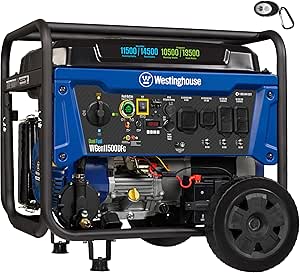 | Best for High-Output Home Backup | Starting wattage: 14,500 watts | Running wattage: 11,500 watts | Engine: 550cc, 4-stroke OHV | VIEW LATEST PRICE | See Our Full Breakdown |
| DuroMax XP13000EH 13,000-Watt Dual-Fuel Portable Generator |  | Best for Heavy-Duty Transfer-Switch Backup | Starting wattage: 13,000 watts | Running wattage: 10,500 watts | Engine: 500cc OHV, 4-stroke | VIEW LATEST PRICE | See Our Full Breakdown |
| ERAYAK 4500W Dual-Fuel Portable Inverter Generator |  | Best Compact Inverter Pick | Fuel: Gasoline and propane | Gasoline output: 4,500W peak; 3,500W rated | Propane output: 4,050W peak; 3,150W rated | VIEW LATEST PRICE | See Our Full Breakdown |
| WEN DF8000X 8000-Watt Dual-Fuel Portable Generator with Electric Start |  | Best Mid-Range Backup Capacity | Fuel: Gasoline and propane | Gasoline output: 8,000 surge watts; 6,500 rated watts | Propane output: 7,200 surge watts; 5,850 rated watts | VIEW LATEST PRICE | See Our Full Breakdown |
| Westinghouse WGen10500DFc Dual Fuel Portable Generator with CO Sensor |  | Best for High-Demand Home Backup | Fuel: Gasoline and propane | Peak output: 13,500 watts | Running output: 10,500 watts | VIEW LATEST PRICE | See Our Full Breakdown |
| Westinghouse WGen3600DFcv Dual-Fuel Portable Generator |  | Best for RV and Essential Loads | Fuel: Gasoline and propane | Gasoline output: 4,650W peak; 3,600W running | Propane output: 4,180W peak; 3,240W running | VIEW LATEST PRICE | See Our Full Breakdown |
| Westinghouse WGen9500DF Dual-Fuel Portable Generator, 12,500-Watt Peak |  | Best for Remote-Start Convenience | Fuel: Gasoline and propane | Gasoline output: 12,500W peak; 9,500W running | Propane output: 11,200W peak; 8,500W running | VIEW LATEST PRICE | See Our Full Breakdown |
| WEN DF360iX Dual-Fuel 3600-Watt Portable Inverter Generator |  | Best for Quiet Camping and Electronics | Fuel: Gasoline or propane | Surge output: 3,600 W gasoline; 3,500 W propane | Engine: 149 cc | VIEW LATEST PRICE | See Our Full Breakdown |
| DuroMax XP13000HX 13,000-Watt Dual-Fuel Portable Generator |  | Best for High-Output Home Backup | Fuel: Gasoline or propane | Power output: Up to 13,000 W | Engine: 500 cc OHV, 4-stroke | VIEW LATEST PRICE | See Our Full Breakdown |
| Westinghouse WGen9500DFc Dual Fuel Portable Generator with CO Sensor |  | Best for Convenient, Flexible Starting | Fuel: Gasoline or propane | Running wattage: 9,500 W gasoline; 8,500 W propane | Peak wattage: 12,500 W gasoline; 11,200 W propane | VIEW LATEST PRICE | See Our Full Breakdown |
| Westinghouse WGen5300DFcv Dual Fuel Portable Generator with CO Sensor |  | Best Mid-Output Backup Value | Fuel: Gasoline or propane | Running wattage: 5,300 W gasoline; 4,800 W propane | Peak wattage: 6,500 W gasoline; 5,800 W propane | VIEW LATEST PRICE | See Our Full Breakdown |
| PowerSmart 3800-Watt Dual-Fuel Inverter Generator |  | Best for Long Propane Runs | Fuel: Gasoline and propane | Starting wattage: 3,800 W gasoline; 3,500 W propane | Running wattage: 3,300 W gasoline; 3,100 W propane | VIEW LATEST PRICE | See Our Full Breakdown |
| dual fuel portable generator | Engine | Runtime | Outlets | Fuel |
|---|---|---|---|---|
| WEN DF680iX 6800-Watt Dual-Fue | 224cc | Up to 6.1 hours at half load on gasoline; up to 9 hours on a 20-pound propane tank | 120V/240V L14-30R, two 120V outlets, TT-30R RV, 12V DC, and two 5V USB ports | — |
| PowerSmart 4400-Watt Dual-Fuel | 223cc, 4-stroke | Up to 8 hours on gasoline or 24 hours on a standard 20-pound propane tank at 25% load | — | — |
| Westinghouse WGen3600DFc Dual | 212cc, 4-stroke OHV | — | 120V 5-20R duplex, 30A TT-30R RV-ready, and 30A L5-30R | — |
| Westinghouse WGen11500DFc Dual | 550cc, 4-stroke OHV | Up to 19 hours at 25% load | — | — |
| DuroMax XP13000EH 13,000-Watt | 500cc OHV, 4-stroke | 3 hours | 2, including a transfer-switch-ready 50-amp outlet | — |
| ERAYAK 4500W Dual-Fuel Portabl | — | Up to 16 hours at 25% load on gasoline | Two 120V/20A outlets, one 30A L5-30P RV outlet, USB-A, and USB-C | Gasoline and propane |
| WEN DF8000X 8000-Watt Dual-Fue | 340 cc | Up to 10.5 hours at half load | Four 120V/20A, one 120V/30A RV, one 120V/240V/30A transfer-switch-ready, and one 12V DC | Gasoline and propane |
| Westinghouse WGen10500DFc Dual | 500 cc 4-stroke OHV | Up to 19 hours on gasoline | — | Gasoline and propane |
| Westinghouse WGen3600DFcv Dual | 212 cc 4-stroke OHV | Up to 14 hours on gasoline; up to 16.5 hours on a 20 lb propane tank | 5-20R 120V duplex, TT-30R 30A, and L5-30R 30A | Gasoline and propane |
| Westinghouse WGen9500DF Dual-F | 457 cc 4-stroke OHV | Up to 12 hours | — | Gasoline and propane |
| WEN DF360iX Dual-Fuel 3600-Wat | 149 cc | Up to 5 hours at half load on gasoline; up to 14 hours at half load on a 20 lb propane tank | Two 120 V 5-20R, one 120 V TT-30R RV, one 12 V DC, two 5 V USB | Gasoline or propane |
| DuroMax XP13000HX 13,000-Watt | 500 cc OHV, 4-stroke | Listed at 17 hours; varies by fuel and load | Four 120 V GFCI, one 120 V 30 A, one 120/240 V 30 A twist-lock, one 120/240 V 50 A | Gasoline or propane |
| Westinghouse WGen9500DFc Dual | 457 cc 4-stroke OHV | Up to 12 hours | — | Gasoline or propane |
| Westinghouse WGen5300DFcv Dual | 274 cc 4-stroke OHV | Up to 14.5 hours | 5-20R 120 V duplex, TT-30R 30 A, L14-30R 30 A | Gasoline or propane |
| PowerSmart 3800-Watt Dual-Fuel | 149 cc 4-stroke | Gasoline runtime is listed as 8 hours at 25% load in the description and 4 hours in the specs; up to 24 hours on a 20 lb propane tank | 120 V 30 A L5-30R, 120 V 20 A 5-20R duplex, 12 V 8 A DC, two 5 V 2.1 A USB | Gasoline and propane |
More Details on Our Top Picks
WEN DF680iX 6800-Watt Dual-Fuel Inverter Generator
The WEN DF680iX is my best all-around pick for buyers who want substantial dual-fuel output without giving up inverter-style power quality. Its gasoline rating of 5,100 running watts and propane rating of 4,500 watts cover more demanding backup needs than the PowerSmart 4400, while its listed THD stays below 1.2% even at full load. That cleaner output is a useful match for sensitive electronics. The 240V outlet, RV connection, wheels, and telescoping handle also give it more flexibility across home backup and travel use than the smaller PowerSmart. The tradeoff is that propane delivers less power than gasoline, and the 2.9-gallon tank means gasoline runtime is limited to 6.1 hours at half load. I’d also factor in the separately sold parallel kit if expansion matters.
Pros:- Strong inverter output, with 5,100 rated watts on gasoline
- Low listed THD suits sensitive electronics
- Includes 120V/240V and RV-ready outlets
- Wheels and telescoping handle help with repositioning
Cons:- Propane rated output drops to 4,500 watts
- Gasoline runtime is up to 6.1 hours at half load
- Parallel connection kit is sold separately
Best for: Buyers seeking one portable dual-fuel inverter for sensitive electronics, RV use, and moderate home backup loads.
Not ideal for: People who need long gasoline run times between refills or want to expand output without buying a separate parallel kit.
- Gasoline output:6,800 surge watts; 5,100 rated watts
- Propane output:6,000 surge watts; 4,500 rated watts
- Engine:224cc
- Fuel types:Gasoline and propane
- Noise level:64 dB at quarter load
- Gasoline tank:2.9 gallons
- Runtime:Up to 6.1 hours at half load on gasoline; up to 9 hours on a 20-pound propane tank
- Outlets:120V/240V L14-30R, two 120V outlets, TT-30R RV, 12V DC, and two 5V USB ports
- Warranty:3 years
Our verdict“Choose the WEN DF680iX if you want clean inverter power and broader outlet options than the PowerSmart 4400, and can accept shorter gasoline run time.”
PowerSmart 4400-Watt Dual-Fuel Portable Inverter Generator
The PowerSmart 4400 makes the most sense when extended light-load operation matters more than high output. Its standout figure is up to 24 hours on a 20-pound propane tank at 25% load, a useful advantage over the WEN DF680iX, whose listed propane runtime is up to 9 hours. It also provides inverter power under 3% THD, eco mode, and a CO sensor in a 68-pound package. The compromise is capacity: 3,600 running watts on gasoline and 3,300 on propane put it below the WEN for heavier simultaneous loads. Its 1.6-gallon gasoline tank also limits fuel-onboard flexibility, even though the stated 25%-load gasoline runtime reaches 8 hours. I’d choose it for restrained loads and long propane intervals, not as the first pick for whole-home backup.
Pros:- Up to 24 hours on a 20-pound propane tank at 25% load
- Inverter output rated under 3% THD
- 68-pound weight supports easier transport than large backup units
- CO sensor, eco mode, and digital display included
Cons:- Running output is lower than the WEN DF680iX
- Small 1.6-gallon gasoline tank
- 120V-only output limits compatibility with 240V loads
Best for: Campers, remote workers, and homeowners powering a modest set of electronics or appliances at light loads for extended periods.
Not ideal for: Buyers who need 240V output, high running wattage, or substantial gasoline capacity for heavier backup loads.
- Gasoline output:4,400 starting watts; 3,600 running watts
- LPG output:4,000 starting watts; 3,300 running watts
- Engine:223cc, 4-stroke
- Fuel types:Gasoline and LPG
- Fuel tank:1.6 gallons
- Runtime:Up to 8 hours on gasoline or 24 hours on a standard 20-pound propane tank at 25% load
- Total harmonic distortion:Under 3%
- Weight:68 pounds
- Warranty:2-year limited manufacturer warranty
Our verdict“Pick the PowerSmart 4400 over the WEN DF680iX when light-load propane endurance and a lighter package matter more than extra wattage or 240V capability.”
Westinghouse WGen3600DFc Dual Fuel Portable Generator with Remote Electric Start
The Westinghouse WGen3600DFc is a practical fit for RV owners who value quick starts and a dedicated RV connection more than inverter-level output. Its TT-30R outlet, push-button start, and wireless remote simplify campsite setup; the remote is a convenience the PowerSmart 4400 does not list. On gasoline, it supplies 3,600 running watts and can run up to 14 hours from its 4-gallon tank, giving it a longer stated gasoline interval than the WEN DF680iX. But this is a conventional generator, and its data does not provide a THD figure, so I would not put it ahead of the WEN for sensitive electronics. Propane output falls to 3,240 running watts, and no propane runtime is specified. Expect some assembly, including wheel installation and battery hookup.
Pros:- TT-30R 30A outlet supports RV connections
- Wireless remote and push-button electric start
- Up to 14 hours of stated gasoline runtime
- CO and low-oil shutdown protection
Cons:- No THD figure is provided for judging sensitive-electronics compatibility
- Propane runtime is not specified
- Wheel installation and battery hookup are required
Best for: RV travelers who want a 30A RV-ready outlet, remote electric starting, and long stated gasoline runtime.
Not ideal for: Buyers prioritizing inverter-class power quality, documented propane runtime, or a setup that needs no assembly.
- Peak output:4,650 watts
- Running output:3,600 watts on gasoline; 3,240 watts on propane
- Engine:212cc, 4-stroke OHV
- Fuel types:Gasoline and propane
- Fuel tank:4 gallons
- Gasoline runtime:Up to 14 hours
- Starting method:Push-button electric start and wireless remote
- Outlets:120V 5-20R duplex, 30A TT-30R RV-ready, and 30A L5-30R
- Warranty:3-year limited
Our verdict“Choose the WGen3600DFc over the PowerSmart 4400 if remote starting and RV connection convenience matter more than inverter-style power specifications.”
Westinghouse WGen11500DFc Dual-Fuel Portable Generator with CO Sensor
When a small portable unit cannot cover the load, the Westinghouse WGen11500DFc brings a much larger output class to this group: 11,500 running watts and 14,500 starting watts. That makes it a more capable home-backup option than the WEN DF680iX or DuroMax XP13000EH, though its stated running output is below the DuroMax’s 10,500 only marginally higher? The DuroMax is actually 10,500 running watts, so the Westinghouse leads by 1,000. Its 9.5-gallon tank and up to 19 hours at 25% load support extended operation, while electric and remote start reduce effort with a 550cc engine. The tradeoffs are substantial size and conventional-generator power quality: THD is listed as less than 5%, not inverter-grade. An automatic transfer switch is sold separately, and the listed fuel types are gasoline and propane, not natural gas.
Pros:- 11,500 running watts for demanding backup loads
- Gasoline and propane fuel options
- Remote and electric starting
- 9.5-gallon tank and up to 19 hours at 25% load
Cons:- Listed THD is under 5%, higher than the inverter models here
- Automatic transfer switch is sold separately
- Large engine and output class make it a poor fit for casual portable use
Best for: Homeowners who need high running wattage for multiple household circuits or demanding backup loads and want remote starting.
Not ideal for: Campers, buyers needing a light transportable generator, or users who require inverter-grade power quality for sensitive equipment.
- Starting wattage:14,500 watts
- Running wattage:11,500 watts
- Engine:550cc, 4-stroke OHV
- Fuel types:Gasoline and propane
- Fuel tank:9.5 gallons
- Runtime:Up to 19 hours at 25% load
- Total harmonic distortion:Less than 5%
- Starting system:Electric start with remote start
- Warranty:3-year limited residential warranty
Our verdict“Choose the WGen11500DFc over the WEN DF680iX when home-backup capacity outweighs portability and cleaner inverter power.”
DuroMax XP13000EH 13,000-Watt Dual-Fuel Portable Generator
The DuroMax XP13000EH is aimed at buyers who want high-output power with a 50-amp transfer-switch-ready outlet and a rugged frame. Its 10,500 running watts sit below the Westinghouse WGen11500DFc’s 11,500, but the DuroMax still offers substantial capacity for home backup, RV use, or a jobsite. Electric start and no-flat tires help make this 234-pound unit more manageable than its weight suggests, though they do not make it easy to move alone. The frame is a strength for rougher handling, not a substitute for a compact design. I would be cautious about the listed three-hour runtime: the supplied data gives no load condition or fuel-tank capacity, making endurance harder to judge than on the Westinghouse. Choose it for output and connection options, not extended run time or easy transport.
Pros:- 10,500 running watts and 13,000 starting watts
- 50-amp transfer-switch-ready outlet
- Heavy-duty all-metal frame with no-flat tires
- Electric start, CO sensor, and low-oil shutdown
Cons:- 234-pound weight makes transport difficult
- Listed runtime is only 3 hours, with no load condition specified
- Only two outlets are listed in the supplied specifications
Best for: Homeowners or contractors who need high-output gasoline-or-propane power and a 50A transfer-switch-ready connection.
Not ideal for: People who need a lightweight portable unit or dependable long-duration operation based on clearly stated runtime conditions.
- Starting wattage:13,000 watts
- Running wattage:10,500 watts
- Engine:500cc OHV, 4-stroke
- Fuel types:Gasoline and propane
- Voltage:240 volts
- Outlets:2, including a transfer-switch-ready 50-amp outlet
- Runtime:3 hours
- Weight:234 pounds
- Dimensions:30 × 29 × 26 inches
Our verdict“Pick the XP13000EH over the WGen11500DFc if its 50A-ready connection and rugged frame matter more than a higher running-watt rating or clearer runtime details.”
ERAYAK 4500W Dual-Fuel Portable Inverter Generator
The ERAYAK pairs gasoline and propane flexibility with a 54-pound frame, making it a more manageable option for RV trips and light home backup than the wheeled, high-output WEN DF8000X. Its 3,500 rated watts on gasoline can cover common essentials, while the 30A RV outlet and USB-A and USB-C ports give it useful connection options for camping. A 2.25-gallon tank is listed for up to 16 hours at 25% load, and automatic switching to gasoline when propane runs out can keep power going without a manual fuel change. The tradeoff is limited capacity: rated output falls to 3,150 watts on propane, and runtime depends on load and fuel. Choose a larger conventional generator if you need substantial 240V or whole-home backup; the ERAYAK is better suited to smaller loads and portability.
Pros:- Runs on gasoline or propane, with automatic switching to gasoline when propane runs out
- 54-pound weight is easier to manage than the larger wheeled generators in this lineup
- 30A RV outlet plus USB-A and USB-C ports suit camping and RV connections
- CO sensor and circuit-breaker protection add safety features
Cons:- Gasoline rated output is 3,500 watts, with lower rated output on propane
- The 2.25-gallon tank’s stated runtime applies at only 25% load
- Listed 120V output does not suit buyers who need 240V power
Best for: RV owners and campers who want a relatively light dual-fuel inverter for modest loads, device charging, and occasional essential backup.
Not ideal for: Households planning to power several high-draw appliances or 240V equipment, since its listed output is 120V and its rated wattage is modest beside larger models.
- Fuel:Gasoline and propane
- Gasoline output:4,500W peak; 3,500W rated
- Propane output:4,050W peak; 3,150W rated
- Voltage:120V
- Weight:54 lb
- Fuel tank:2.25 gal
- Runtime:Up to 16 hours at 25% load on gasoline
- Noise:58 dBA at 23 ft and quarter load
- Outlets:Two 120V/20A outlets, one 30A L5-30P RV outlet, USB-A, and USB-C
Our verdict“Choose the ERAYAK for portable, lower-load RV or camping power, not for high-capacity home backup.”
WEN DF8000X 8000-Watt Dual-Fuel Portable Generator with Electric Start
The WEN DF8000X is a practical step up from compact picks such as the ERAYAK 4500W: it supplies 6,500 rated watts on gasoline and includes a 120V/240V transfer-switch-ready outlet for compatible home backup setups. Electric start makes routine starts easier, while recoil backup gives another way to get it running. Its 6.7-gallon tank is rated for up to 10.5 hours at half load, a useful balance for sustained outages without the enormous fuel capacity of the Westinghouse WGen10500DFc. The WEN also has propane capability, though its listed output drops to 5,850 rated watts on that fuel. This is still a heavy-duty generator rather than a grab-and-go camping unit; the wheel kit helps with movement but does not make it light. Buyers needing more capacity should compare it with the larger Westinghouse models.
Pros:- Provides 6,500 rated watts on gasoline and 5,850 on propane
- 120V/240V transfer-switch-ready outlet supports compatible backup connections
- Electric start is backed by recoil starting
- Wheel kit and RV-ready outlet add transport and recreational utility
Cons:- Heavy-duty size and weight make transport cumbersome despite the wheel kit
- Up to 10.5 hours of runtime is specified at half load, so heavier loads shorten operating time
- Propane rated output is lower than gasoline output
Best for: Homeowners who need 120V/240V backup capability and a substantial but not maximum-capacity generator with electric start.
Not ideal for: Campers or buyers who need a generator they can lift and load easily, or households whose loads exceed its 6,500-watt gasoline rating.
- Fuel:Gasoline and propane
- Gasoline output:8,000 surge watts; 6,500 rated watts
- Propane output:7,200 surge watts; 5,850 rated watts
- Engine:340 cc
- Starting system:Electric start with recoil backup
- Fuel tank:6.7 gal
- Runtime:Up to 10.5 hours at half load
- Voltage:120V/240V
- Outlets:Four 120V/20A, one 120V/30A RV, one 120V/240V/30A transfer-switch-ready, and one 12V DC
Our verdict“Pick the WEN DF8000X for moderate home backup with 240V capability, but choose a smaller inverter for easier transport or a larger unit for heavier loads.”
Westinghouse WGen10500DFc Dual Fuel Portable Generator with CO Sensor
With 10,500 running watts on gasoline and 8,500 on propane, the WGen10500DFc is the strongest fit here for households with heavier backup demands. Its 9.5-gallon tank supports up to 19 hours of stated gasoline runtime, offering longer intervals between refueling than the WGen9500DF’s up-to-12-hour figure. Remote and push-button electric starting also make it more convenient to start than a recoil-only option, and the CO sensor and low-oil shutdown add useful safeguards. Those advantages come with a size penalty: this is a heavy-duty portable generator, not an easy choice for frequent loading or solo handling. The transfer-switch connection is useful for home backup, but the automatic transfer switch itself is sold separately. Compared with the WEN DF8000X, this Westinghouse provides substantially more rated power, while demanding more storage space and effort to move.
Pros:- High output of 10,500 rated watts on gasoline and 8,500 on propane
- Remote, push-button electric, and recoil starting options
- 9.5-gallon tank supports up to 19 hours of stated gasoline runtime
- CO sensor and low-oil shutdown provide safety protections
Cons:- Heavy-duty portable design can be difficult to move and store
- Automatic transfer switch is sold separately
- The stated 19-hour runtime is a maximum figure, not a guarantee under heavier loads
Best for: Homeowners with several high-demand circuits who want strong gasoline and propane output, remote starting, and extended fuel capacity.
Not ideal for: Campers, apartment dwellers, or anyone who needs a compact unit that can be moved often; its heavy-duty build and size are better suited to a fixed home-backup location.
- Fuel:Gasoline and propane
- Peak output:13,500 watts
- Running output:10,500 watts
- Engine:500 cc 4-stroke OHV
- Fuel tank:9.5 gal
- Runtime:Up to 19 hours on gasoline
- Voltage:240V
- Starting system:Push-button electric, remote, and recoil
- Warranty:3-year limited residential warranty
Our verdict“Choose the WGen10500DFc when high backup output and longer gasoline runtime matter more than easy transport.”
Westinghouse WGen3600DFcv Dual-Fuel Portable Generator
The WGen3600DFcv suits buyers who want dual-fuel RV and household power without stepping up to the larger WEN DF8000X. It delivers 3,600 running watts on gasoline and 3,240 on propane, with both a TT-30R RV outlet and an L5-30R outlet for compatible connections. Its up to 14 hours on gasoline or 16.5 hours on a 20-pound propane tank can support a long stretch of lighter use, though the four-gallon gasoline tank and actual load determine real runtime. Low-oil and CO shutdown, voltage regulation, and overload protection round out the safety features. Unlike the ERAYAK inverter, this model is a conventional generator, so buyers prioritizing an inverter design should compare carefully. It also requires minimal assembly, and its output is better for essentials than for running multiple large appliances.
Pros:- Runs on gasoline or propane, with different runtime options for each fuel
- Includes TT-30R and L5-30R 30A outlets alongside a household duplex outlet
- Up to 14 hours of stated gasoline runtime or 16.5 hours on a 20-pound propane tank
- Low-oil and CO shutdown, voltage regulation, and overload protection
Cons:- Rated output is limited to 3,600 watts on gasoline and 3,240 watts on propane
- Listed voltage is 120V, so it does not meet 240V backup needs
- Requires minimal assembly, and runtime varies with load
Best for: RV owners and households seeking a conventional dual-fuel generator for an RV connection and a limited set of essential 120V loads.
Not ideal for: Buyers needing 240V output, inverter-generator operation, or enough rated capacity for several large appliances at once.
- Fuel:Gasoline and propane
- Gasoline output:4,650W peak; 3,600W running
- Propane output:4,180W peak; 3,240W running
- Engine:212 cc 4-stroke OHV
- Fuel tank:4 gal
- Runtime:Up to 14 hours on gasoline; up to 16.5 hours on a 20 lb propane tank
- Voltage:120V
- Outlets:5-20R 120V duplex, TT-30R 30A, and L5-30R 30A
- Safety features:Low-oil shutdown, CO shutdown, voltage regulation, and overload protection
Our verdict“Choose the WGen3600DFcv for basic RV and essential-load power on either fuel, not for 240V or high-demand household backup.”
Westinghouse WGen9500DF Dual-Fuel Portable Generator, 12,500-Watt Peak
The WGen9500DF delivers a useful middle ground between the WEN DF8000X and the higher-output WGen10500DFc: 9,500 rated watts on gasoline, 8,500 on propane, and 120/240V output for compatible home backup connections. Its remote, electric, and recoil starting gives buyers several ways to start it, while the included remote key fob, battery charger, oil, and tools help cover setup needs. The listed gasoline runtime reaches up to 12 hours from a 6.6-gallon tank, shorter than the WGen10500DFc’s stated 19 hours, but this model also has a lower gasoline running rating. It is still a large, heavy-duty generator, so the word portable should not be mistaken for easy solo handling. Minimal assembly is required, and buyers should check their planned loads against the lower propane rating before relying on it for backup.
Pros:- Provides 9,500 rated watts on gasoline and 8,500 on propane
- Remote, electric, and recoil starting offer flexible startup options
- 120/240V output and transfer-switch-ready and RV-ready connections support varied uses
- Includes remote key fob, battery charger, oil, and tools
Cons:- Heavy-duty build can be difficult to move
- Up to 12 hours of runtime is shorter than the WGen10500DFc’s stated maximum
- Minimal assembly is required
Best for: Homeowners who want high-capacity 120/240V backup with remote starting and the option to switch between gasoline and propane.
Not ideal for: Buyers who need a light generator for frequent transport or who want the longer stated gasoline runtime and higher gasoline output of the WGen10500DFc.
- Fuel:Gasoline and propane
- Gasoline output:12,500W peak; 9,500W running
- Propane output:11,200W peak; 8,500W running
- Engine:457 cc 4-stroke OHV
- Fuel tank:6.6 gal
- Runtime:Up to 12 hours
- Voltage:120/240V
- Starting methods:Remote, electric, and recoil
- Warranty:3-year limited
Our verdict“Pick the WGen9500DF for substantial dual-fuel backup with remote starting, while favoring the WGen10500DFc for more gasoline output and longer stated runtime.”
WEN DF360iX Dual-Fuel 3600-Watt Portable Inverter Generator
The WEN DF360iX suits buyers who need inverter-style clean power and a manageable carry weight more than whole-home output. At 49 pounds, it is far easier to move than the 212-pound Westinghouse WGen9500DFc, while its TT-30R outlet supports RV use and USB ports cover small devices. Its gasoline output is 2,900 rated watts, dropping to 2,600 on propane, so it is aimed at campsite loads and selected essentials rather than several large household appliances. Propane can stretch to a listed 14 hours at half load, but gasoline runtime is only up to five hours at the same load. The CO shutdown and fuel shutoff add practical safeguards; the tradeoff is limited gasoline endurance, and parallel capability requires a separately sold kit.
Pros:- Light 49-pound design is easier to transport than the large-frame Westinghouse WGen9500DFc.
- Clean inverter power is suited to sensitive electronics.
- TT-30R RV outlet and USB ports support common camping needs.
- CO shutdown protection and fuel shutoff add useful safety features.
Cons:- Five-hour maximum listed gasoline runtime at half load means more frequent refueling.
- Rated output falls to 2,600 watts on propane.
- Parallel connection kit is sold separately.
Best for: Campers and RV owners who want a relatively light dual-fuel generator for electronics, modest appliances, and occasional backup.
Not ideal for: Households seeking to run multiple high-draw appliances through a long outage, or buyers who need extended gasoline runtime without refueling.
- Fuel:Gasoline or propane
- Surge output:3,600 W gasoline; 3,500 W propane
- Engine:149 cc
- Noise level:65 dB at quarter load
- Runtime:Up to 5 hours at half load on gasoline; up to 14 hours at half load on a 20 lb propane tank
- Outlets:Two 120 V 5-20R, one 120 V TT-30R RV, one 12 V DC, two 5 V USB
- Weight:49 lb
- Warranty:3-year limited
Our verdict“Choose the WEN DF360iX for portable, electronics-friendly campsite power, but look to a larger generator for sustained household backup.”
DuroMax XP13000HX 13,000-Watt Dual-Fuel Portable Generator
When the main priority is connecting substantial household loads, the DuroMax XP13000HX brings a 50-amp outlet and 240-volt capability to a dual-fuel package. That makes it a more natural fit for transfer-switch-ready home backup than the compact WEN DF360iX, which is better suited to RV and smaller-load use. The 500 cc engine and electric start support its high-output role, while CO Alert and copper windings add useful features for emergency operation. The tradeoff is physical: at 245 pounds, this is not a generator to move casually, despite its portable designation. Its listed 17-hour runtime also needs context because fuel type and electrical load affect actual run time, and the supplied data gives a tank volume of only 0.5 gallons, so buyers should verify that figure before relying on it.
Pros:- High 13,000-watt output is suited to demanding backup loads.
- 120/240 V 50 A outlet supports transfer-switch-ready setups.
- Electric start avoids relying on recoil starting alone.
- CO Alert and copper windings are useful features for backup use.
Cons:- At 245 pounds, moving it requires planning and likely assistance.
- Listed runtime varies with fuel and load, so it is not a fixed outage-duration guarantee.
- The supplied 0.5-gallon tank-volume specification appears inconsistent with the stated runtime and should be verified.
Best for: Homeowners who need high-output gasoline-or-propane backup with a 50-amp connection and have a suitable place to position the generator.
Not ideal for: Campers, renters, or anyone who needs to lift and move a generator frequently; its 245-pound weight makes portability a major compromise.
- Fuel:Gasoline or propane
- Power output:Up to 13,000 W
- Engine:500 cc OHV, 4-stroke
- Starting system:Electric start
- Voltage:120/240 V
- Runtime:Listed at 17 hours; varies by fuel and load
- Outlets:Four 120 V GFCI, one 120 V 30 A, one 120/240 V 30 A twist-lock, one 120/240 V 50 A
- Weight:245 lb
- Dimensions:30 × 29 × 26 in
Our verdict“Pick the XP13000HX when high output and a 50-amp connection matter more than easy movement or compact storage.”
Westinghouse WGen9500DFc Dual Fuel Portable Generator with CO Sensor
The Westinghouse WGen9500DFc pairs substantial backup capacity with three ways to start: remote, electric, or recoil. That flexibility is its clearest distinction from the DuroMax XP13000HX, which offers more stated output but is heavier and lists electric start only. With 9,500 running watts on gasoline and 8,500 on propane, this Westinghouse can serve larger home loads while keeping fuel choice open. Its 6.6-gallon tank is listed for up to 12 hours of runtime, giving buyers a useful planning figure, though actual endurance depends on load and fuel. Transfer-switch-ready and RV-ready connections broaden its use, but the 212.1-pound frame is still a serious handling challenge. The CO sensor and low-oil shutdown add protections, while assembly is required before use.
Pros:- Remote, electric, and recoil starting offer flexibility during outages.
- Strong running output on both gasoline and propane.
- 6.6-gallon tank is listed for up to 12 hours of runtime.
- CO shutdown and automatic low-oil shutdown add safety protections.
Cons:- 212.1-pound weight limits practical portability.
- Some assembly is required before operation.
- Propane running output is lower than gasoline output.
Best for: Homeowners who want high-output dual-fuel backup with remote starting and enough outlet flexibility for home or RV connections.
Not ideal for: Buyers who need a generator they can carry or reposition alone; its 212.1-pound weight calls for a planned location and handling help.
- Fuel:Gasoline or propane
- Running wattage:9,500 W gasoline; 8,500 W propane
- Peak wattage:12,500 W gasoline; 11,200 W propane
- Engine:457 cc 4-stroke OHV
- Fuel tank capacity:6.6 gallons
- Runtime:Up to 12 hours
- Starting methods:Remote, electric, and recoil
- Weight:212.1 lb
- Safety features:CO sensor with shutdown; automatic low-oil shutdown
Our verdict“Choose the WGen9500DFc for robust backup power with remote-start convenience, provided its weight and setup demands fit your space.”
Westinghouse WGen5300DFcv Dual Fuel Portable Generator with CO Sensor
The Westinghouse WGen5300DFcv occupies the middle ground between small inverter models like the WEN DF360iX and heavy high-output units such as the WGen9500DFc. Its 5,300 running watts on gasoline and 4,800 on propane can cover a useful set of household essentials, while the 30-amp RV-ready and transfer-switch-ready outlets serve two distinct backup setups. A 4.7-gallon tank is listed for up to 14.5 hours, a longer stated runtime than the WGen9500DFc’s 12 hours, though the different outputs and loads make those figures unsuitable for a direct endurance comparison. CO shutdown and low-oil protection support safer operation. This is still a framed generator rather than a lightweight inverter, and minimal assembly is required; buyers should also expect gasoline runtime to shift with their load.
Pros:- 30 A RV-ready and transfer-switch-ready outlets suit both recreation and home backup.
- Up to 14.5 hours of listed runtime on a 4.7-gallon gasoline tank.
- CO automatic shutdown and low-oil shutdown provide useful protections.
- Propane hose and wheel kit are included.
Cons:- Requires minimal assembly before use.
- Gasoline runtime changes with electrical load.
- Its output is below the WGen9500DFc for households with heavier backup demands.
Best for: RV owners and households seeking moderate dual-fuel backup for essential circuits without stepping up to a very heavy 9,500-watt model.
Not ideal for: Buyers who need inverter portability, quiet campsite operation, or enough output for many large appliances running at once.
- Fuel:Gasoline or propane
- Running wattage:5,300 W gasoline; 4,800 W propane
- Peak wattage:6,500 W gasoline; 5,800 W propane
- Engine:274 cc 4-stroke OHV
- Fuel tank capacity:4.7 gallons
- Runtime:Up to 14.5 hours
- Voltage:120/240 V
- Outlets:5-20R 120 V duplex, TT-30R 30 A, L14-30R 30 A
- Safety features:CO sensor with automatic shutdown; low-oil shutdown
Our verdict“Pick the WGen5300DFcv for RV or essential-circuit backup when a mid-output frame makes more sense than a large, heavy home generator.”
PowerSmart 3800-Watt Dual-Fuel Inverter Generator
The PowerSmart 3800-Watt inverter generator is a compact dual-fuel option for buyers who value low-noise operation and long propane use more than large gasoline capacity. Its listed 59 dBA at 25% load in Eco Mode is quieter on paper than the WEN DF360iX’s 65 dB at quarter load, while its 30 A L5-30R outlet gives it a different connection option from the WEN’s TT-30R RV receptacle. Output is close to the WEN’s, with 3,300 running watts on gasoline and 3,100 on propane, so neither is a stand-in for a high-output home unit like the Westinghouse WGen5300DFcv. The propane runtime claim reaches 24 hours on a 20-pound tank, but gasoline runtime information conflicts across the supplied data. That uncertainty, plus a small 1.3-gallon tank and two-year warranty, calls for careful checking before purchase.
Pros:- 59 dBA listed noise level at 25% load in Eco Mode.
- Propane runtime is listed at up to 24 hours with a 20-pound tank.
- L5-30R, duplex AC, DC, and USB outlets cover varied small-load needs.
- CO, overload, short-circuit, and low-oil protections are listed.
Cons:- Gasoline runtime data conflicts: the description lists 8 hours at 25% load while the supplied specs list 4 hours.
- The 1.3-gallon gasoline tank limits fuel reserve.
- Two-year warranty is shorter than the WEN DF360iX’s three-year limited warranty.
Best for: Campers and homeowners seeking a quiet, modest-output inverter generator who expect to rely mainly on propane and want USB and DC connections.
Not ideal for: Buyers who need predictable gasoline runtime, higher household backup capacity, or the longer warranty offered by the WEN DF360iX.
- Fuel:Gasoline and propane
- Starting wattage:3,800 W gasoline; 3,500 W propane
- Running wattage:3,300 W gasoline; 3,100 W propane
- Noise level:59 dBA at 25% load in Eco Mode
- Engine:149 cc 4-stroke
- Gas tank capacity:1.3 gallons
- Runtime:Gasoline runtime is listed as 8 hours at 25% load in the description and 4 hours in the specs; up to 24 hours on a 20 lb propane tank
- Outlets:120 V 30 A L5-30R, 120 V 20 A 5-20R duplex, 12 V 8 A DC, two 5 V 2.1 A USB
- Weight and dimensions:50.7 lb; 21.9 × 13.4 × 19.5 in
Our verdict“Choose the PowerSmart for quiet, propane-focused inverter use, but verify its gasoline runtime before depending on it for extended backup.”
How We Picked
I ranked these 15 dual fuel generators around the jobs buyers are most likely to have: home outage backup, RV or campsite use, and portable power for tools or events. I weighed stated running output more heavily than peak output, then compared inverter design, starting method, fuel choice, portability, and listed safety features. Those criteria help distinguish a high-output backup unit from a smaller model that is easier to place and better suited to sensitive electronics.
The order reflects useful balance, not one universal winner. The WEN DF680iX leads because its inverter format and mid-to-high capacity cover a broad range of needs; larger conventional generators rank higher for buyers whose priority is running substantial loads, but lower for portability and quieter use. Compact options rank well for targeted lighter-duty use, while models with similar output are separated by practical differences such as controls, CO sensing, and starting features. I did not treat fuel choice alone as a performance advantage, and buyers should verify current manufacturer specifications for exact output, runtime, dimensions, and included equipment before purchase.
| dual fuel portable generator | Fuel |
|---|---|
| WEN DF680iX 6800-Watt Dual-Fue | — |
| PowerSmart 4400-Watt Dual-Fuel | — |
| Westinghouse WGen3600DFc Dual | — |
| Westinghouse WGen11500DFc Dual | — |
| DuroMax XP13000EH 13,000-Watt | — |
| ERAYAK 4500W Dual-Fuel Portabl | Gasoline and propane |
| WEN DF8000X 8000-Watt Dual-Fue | Gasoline and propane |
| Westinghouse WGen10500DFc Dual | Gasoline and propane |
| Westinghouse WGen3600DFcv Dual | Gasoline and propane |
| Westinghouse WGen9500DF Dual-F | Gasoline and propane |
| WEN DF360iX Dual-Fuel 3600-Wat | Gasoline or propane |
| DuroMax XP13000HX 13,000-Watt | Gasoline or propane |
| Westinghouse WGen9500DFc Dual | Gasoline or propane |
| Westinghouse WGen5300DFcv Dual | Gasoline or propane |
| PowerSmart 3800-Watt Dual-Fuel | Gasoline and propane |
Factors to Consider When Choosing Dual Fuel Portable Generators
Before choosing among these dual fuel portable generators, start with the loads and location you need to support. Fuel flexibility is useful, but it does not answer whether a generator can start your well pump, run an air conditioner, fit in storage, or operate safely where you plan to use it. These factors can prevent a mismatch that a wattage headline alone will not reveal.
Size for starting watts and the loads you will run together
Make a list of the appliances you want powered, then separate their running watts from their starting surges. Motors in refrigerators, pumps, and air conditioners can briefly demand much more power at startup, so a generator that appears adequate on running watts may still trip when several loads start together. Avoid adding every appliance’s peak rating as if all motors will start at once; instead, plan a realistic sequence and leave headroom for unexpected loads. For whole-home backup, choose the specific circuits you need rather than assuming a portable generator will power the entire house. A transfer switch or approved interlock also affects how you connect the generator, so include that equipment and installation in the plan. This calculation may point toward a large conventional model—or show that a smaller inverter is enough.
Compare fuel-specific output and plan your supply
Gasoline and propane can produce different output and runtime, so check the separate ratings rather than assuming the advertised maximum applies equally to both. Propane can be stored for longer periods than gasoline when handled correctly, while gasoline is often easier to find quickly during a disruption. Your choice also depends on tank size, hose and regulator compatibility, and how much fuel you can store safely under local rules. A large generator may use fuel quickly under heavy load, making fuel logistics as important as its wattage. If you expect to depend on propane, calculate how many cylinders or a bulk tank you will need for the runtime you want. Treat dual-fuel capability as a backup plan, not a guarantee that either fuel will meet every load equally.
Choose inverter or conventional output for the setting
Inverter models are often the better fit for camping, recreation, and powering electronics, where noise and power quality matter alongside capacity. Conventional generators commonly provide more output for their size and are a natural match for heavier home-backup loads, but their larger frames and operating sound can make them less convenient near people. Do not assume every inverter model is silent or that every electronic device automatically needs one; check the generator’s specifications and the device maker’s guidance. Think about where the generator will sit, how far the cable run will be, and whether neighbors or campsite rules limit sound. If you need both high output and quieter operation, compare the compromises carefully rather than buying on inverter labeling alone. A lower-capacity inverter can be the wrong choice if it cannot start the equipment you need.
Check portability as a complete setup, not a product label
“Portable” can describe anything from a compact inverter to a heavy, wheeled backup unit that still needs two people or careful handling. Check the listed weight, wheel and handle arrangement, overall dimensions, and whether the generator can pass through your storage doorway. Also account for the weight and space of fuel, cords, covers, and any transfer equipment. A model that is easy to roll across a garage floor may be difficult to lift into a truck or move over gravel. If you plan to camp, prioritize manageable size and transport; if the unit will stay parked beside the house, capacity may matter more than lifting convenience. Buying a generator that cannot be moved to its safe operating location can undermine its usefulness.
Treat safety features as one layer of a safe setup
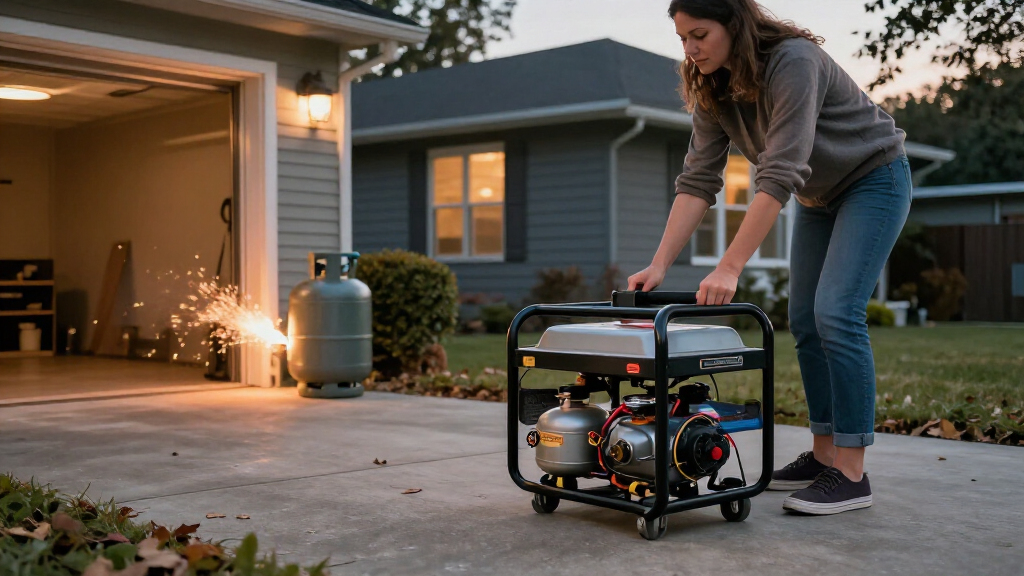
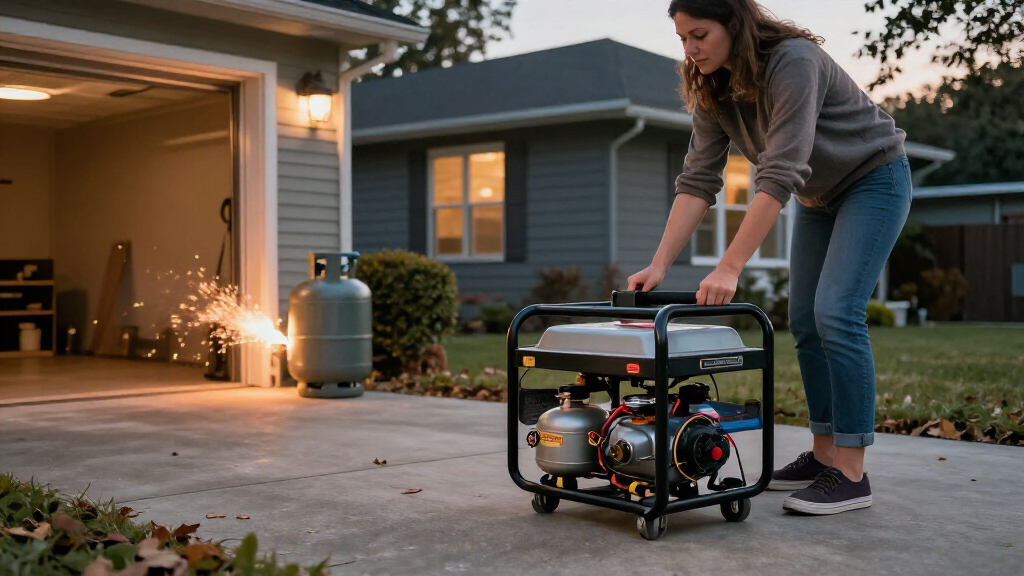
A built-in carbon monoxide sensor can add protection, but it does not make indoor or enclosed operation safe. Operate a portable generator outdoors, well away from doors, windows, and vents, following the manufacturer’s placement instructions and local safety guidance. Keep working carbon monoxide alarms inside the home, and never run the generator in a garage, even with the door open. Check whether the model has low-oil shutdown, overload protection, and clear operating controls, but do not treat those features as substitutes for careful use. Plan for rain protection that does not enclose the generator or block airflow. The safest purchase is one you can place, connect, and refuel without bringing exhaust near occupied spaces.
Match starting and maintenance demands to your routine
Electric or remote start can make operation easier, especially during an outage, but buyers should check whether a battery is included and how it is charged or maintained. Recoil start keeps the setup simpler but may be less convenient for anyone who has difficulty pulling a starter cord. All gasoline engines need scheduled care, including oil checks and changes, while fuel left in a carburetor can cause problems after storage. Follow the manual’s directions for storage, fuel stabilization or draining, and periodic exercise under load. If you expect to switch fuels, learn the required shutoff and changeover steps before an emergency. A generator with appealing output is a poor fit if its upkeep and controls do not match the way you will actually use it.
Frequently Asked Questions
Can a dual fuel generator run my home during a power outage?
It can power selected household circuits if its running and starting output match those loads, but a portable generator is not automatically a whole-home solution. Identify the appliances you need, including motor-driven equipment with high startup demand, and total the loads you expect to use at once. A transfer switch or approved interlock is needed for a safe connection to household wiring; never connect a generator directly to a wall outlet. A qualified electrician can help size the generator and connection around your panel and essential circuits. Also plan fuel supply for the expected outage duration.
Will these generators produce the same power on propane as on gasoline?
Not necessarily. Many dual fuel generators have different output ratings for each fuel, and propane output may be lower than gasoline output. Check the manufacturer’s fuel-specific running and peak ratings for the exact model, then size around the fuel you expect to use most. If you need propane for an air conditioner or pump, confirm that the propane rating covers both its running load and startup surge. Fuel availability and storage can also affect which option is practical during an extended outage.
Is an inverter generator worth choosing over a higher-wattage conventional model?
It depends on which limitation would cause more trouble in your use case. An inverter model is often a better match for camping, noise-sensitive settings, and electronics, while a conventional generator can deliver more capacity for demanding home-backup loads. Do not pay for an inverter design if its output cannot start the equipment you need. Conversely, a high-wattage unit may be cumbersome and unnecessarily loud for light recreational use. Compare rated output, sound information, size, and your actual load list as a group.
Is a carbon monoxide sensor enough to make generator placement safe?
No. A built-in CO sensor is an added safeguard, not permission to run a generator indoors, in a garage, or near openings into the home. Place it outdoors at the distance and orientation specified by the manufacturer and follow public safety guidance for exhaust clearance. Keep working CO alarms inside the home as another layer of protection. Check the sensor’s operating instructions and know how the unit signals or shuts down if it detects a hazard. Safe location and ventilation remain the buyer’s responsibility.
What should I check before relying on a generator for an outage?
Read the manual, confirm the generator starts, and test the connection method you plan to use before an emergency. Verify oil level, battery condition for electric-start models, fuel supply, and any extension cords or transfer equipment. Run the unit outdoors under a suitable load following the manufacturer’s guidance, and learn the fuel changeover procedure if you may switch between gasoline and propane. Store fuel safely and keep a maintenance schedule, since stale fuel and neglected service can prevent starting. A written list of essential loads and startup order can make operation less stressful when the power is out.
Conclusion
For the best overall balance, I’d choose the WEN DF680iX for buyers who want inverter operation with more capacity than the smallest options. For best value in a lighter-duty role, compare the PowerSmart 3800W and 4400W models against the loads you actually need; they make more sense when portability matters more than powering several heavy appliances. For a premium, high-output backup setup, the DuroMax XP13000EH or XP13000HX is the better direction, while buyers who want a major Westinghouse option with CO sensing can look at the WGen11500DFc. For beginners, a model with electric start and straightforward controls—such as the Westinghouse WGen3600DFc—may be easier to operate, though it is not the pick for large loads. For camping and electronics, prioritize inverter models such as the WEN DF360iX or ERAYAK 4500W; for heavy home loads, prioritize rated output, safe household connection, and fuel planning. Match the generator to your load list and operating location before choosing by headline wattage.