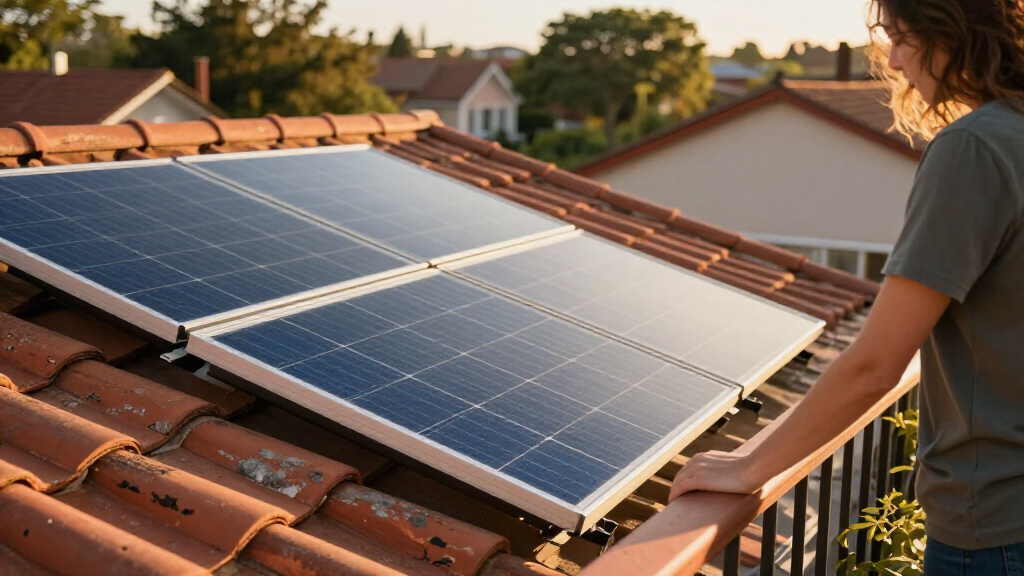

If you’re exploring home solar panels, you’re likely weighing performance, cost, and installation complexity. The best overall pick offers a balance of efficiency and reliability, ideal for most homeowners. The best value option minimizes upfront costs without sacrificing durability, while the best premium models deliver top-tier efficiency and longevity for larger or demanding systems. The main tradeoffs involve balancing initial investment against long-term savings and energy output. Keep reading for a detailed breakdown of the top choices and what each brings to the table.

Get backup power and energy gear delivered free with Prime
- Fast, free delivery on millions of items
- Prime Video, Amazon Music and more included
- Member-only deals all year
Key Takeaways
- High-efficiency monocrystalline panels dominate the top of the list, providing better energy output per square foot.
- Bifacial designs are increasingly popular for maximizing power generation from reflected sunlight, especially in larger systems.
- Off-grid kits are best suited for remote or backup power needs, but they come with higher costs and installation complexity.
- Durability ratings like IP68 and UL certifications are critical for longevity and safety in diverse weather conditions.
- Tradeoffs often involve balancing upfront costs with long-term savings, especially when considering premium vs. budget options.


| home solar panel | Dimensions |
|---|---|
| ECO-WORTHY 400W Monocrystallin | 35.63 × 23.03 × 1.18 in per panel |
| JJN 1100W Bifacial Solar Panel | 89.61 × 44.65 × 1.38 in |
| JJN Bifacial 2-Pack 425W N-Typ | 44.7 × 1.2 × 67.8 in |
| Renogy 400W Premium Solar Kit | — |
| N-Type 16BB 400W Bifacial Sola | 51.3 × 30.3 × 1.4 in |
| DOKIO 800W Solar Panels | — |
| ECO-WORTHY 10,000W Off-Grid So | — |
| ECO-WORTHY 10KW Off Grid Solar | — |
| ECO WORTHY 10kW Off-Grid Solar | — |
| Star 990W Bifacial Solar Panel | 77.2"L x 44.6"W x 1.1"H |
| 450W Bifacial Solar Panel 2-Pa | 69.37 L x 44.65 W x 1.18 H inches |
More Details on Our Top Picks
ECO-WORTHY 400W Monocrystalline Solar Panel Kit, 4 Pack, 100W Each, 18V, IP68 Waterproof, N-Type Bifacial
Four separate 100W panels make this set easier to arrange around roof sections, sheds, or an off-grid setup than the much larger JJN 1100W pair. That modularity helps when a single broad mounting area is unavailable, and the listed IP68 protection suits exposed installations. The tradeoff is more panels and connections to mount: each weighs 23.8 pounds, so installation still needs careful support and planning. At 400W total, this kit is better suited to building a modest system in stages than covering whole-home demand; buyers seeking a higher-output panel set should compare it with the JJN 850W pair. It includes panels rather than a complete power system, so mounting and system components need separate planning.
Pros:- Four 100W panels allow flexible placement across separate mounting areas
- IP68 waterproof rating is suited to outdoor exposure
- Pre-drilled holes and plug-and-play connectors simplify panel mounting and wiring
- Monocrystalline construction is listed at up to 25% conversion efficiency
Cons:- Four modules mean more mounting points and electrical connections than larger-panel sets
- Each panel weighs 23.8 pounds, which can complicate rooftop handling
- The 400W total is modest for buyers aiming to supply substantial household loads
Best for: Off-grid homeowners or shed owners who need several smaller panels to fit around a segmented mounting area
Not ideal for: Buyers seeking a high-output rooftop array with fewer modules or a complete kit with controller and system components
- Total panel count:4
- Power output:100W per panel
- Voltage:18V
- Maximum voltage:25.2V
- Amperage:4.96A
- Dimensions:35.63 × 23.03 × 1.18 in per panel
- Weight:23.8 lb per panel
- Materials:Monocrystalline silicon, low iron glass, anodized aluminum
Our verdict“Choose this set if you need four flexible 100W modules for a modest off-grid system and can supply the mounting and power equipment separately.”
JJN 1100W Bifacial Solar Panel, 2 Pack 550W Module, 23% High-Efficiency
For buyers who can mount large modules, this pair delivers the lineup’s highest stated combined output: 1,100W from two 550W panels. Compared with the ECO-WORTHY four-panel 400W kit, it uses fewer modules to reach a much higher rated output, which can reduce the number of mounting positions and connections in a suitably sized installation. Its bifacial design can collect light from the rear as well, though the benefit depends on how the panels are mounted and the surface beneath them. Each panel measures about 90 by 45 inches and weighs heavily, so roof access and structural support matter. The JJN 850W pair is smaller and lighter overall, but gives up 250W of combined rated output.
Pros:- Two 550W modules provide 1,100W combined rated output
- Bifacial construction can gather light from the rear when mounting conditions support it
- 23% stated efficiency
- Pre-drilled mounting holes support installation flexibility
Cons:- Each panel’s large dimensions limit placement options
- The stated 123.4-pound weight calls for substantial handling and mounting support
- Bifacial output depends on rear-side exposure and installation conditions
Best for: Homeowners with a large, structurally suitable roof or ground mount who want high rated output from two modules
Not ideal for: Buyers with limited mounting area, lightweight structures, or no way to handle very large panels
- Panel count:2
- Maximum power:1,100W total; 550W per module
- Efficiency:23%
- Output voltage:41.96V
- Maximum voltage:49.5V
- Amperage capacity:14A
- Dimensions:89.61 × 44.65 × 1.38 in
- Weight:123.4 lb
- Materials:Aluminum, monocrystalline silicon, tempered glass
Our verdict“Pick this pair when a large, well-supported mounting area can accommodate its size and you want the lineup’s greatest stated panel output.”
JJN Bifacial 2-Pack 425W N-Type Solar Panel, Total 850W, UL 61730, 16BB
The JJN 850W pair balances substantial output with a stated 30-year warranty and detailed weather-resistance figures, giving it a stronger long-term case than the Renogy 400W kit’s five-year materials and workmanship warranty. Its N-type monocrystalline cells and 25% listed efficiency offer strong rated conversion, while the bifacial design may collect additional light when the rear side is exposed. At 94.6 pounds for the pair, it is lighter overall than the JJN 1100W set, although each panel still takes considerable space and handling effort. The main compromise for a home project is that this is a panel-only package: unlike Renogy, it does not include a controller, cables, or mounting hardware.
Pros:- 30-year stated warranty
- 25% stated efficiency with N-type monocrystalline cells
- Weather-resistance details include IP65 junction box, IP68 connectors, wind, and snow load figures
- 850W combined output from two panels
Cons:- Large panels need ample mounting space
- No mounting hardware, inverter, or charge controller is included
- Bifacial gains depend on rear-side exposure and mounting setup
Best for: Homeowners building a long-lived roof or ground-mounted system who value a long stated warranty and can source balance-of-system parts
Not ideal for: Beginners who want panels, controller, cables, and mounting hardware bundled together
- Panel count:2
- Combined power output:850W (2 × 425W)
- Cell type:N-type monocrystalline silicon
- Efficiency:25%
- Maximum voltage:31.05V
- Amperage:13.78A
- Dimensions:44.7 × 1.2 × 67.8 in
- Weight:94.6 lb
- Warranty:30 years
Our verdict“Choose this pair for a durable, high-efficiency panel foundation if you are prepared to source the controller, inverter, and mounting parts separately.”
Renogy 400W Premium Solar Kit with 40A MPPT Charge Controller
Among these five choices, Renogy is the most straightforward starting point for an off-grid build because it bundles four 100W panels, a 40A MPPT controller, brackets, cables, and an adaptor kit. That reduces the separate component sourcing required by the JJN 850W panel-only package. Bluetooth monitoring adds a way to check system status without visiting the controller. The tradeoff is a 12V system focus and 400W of panel output, which limits its fit for larger household loads compared with the two JJN sets. Its stated five-year materials and workmanship warranty is also shorter than JJN’s 30-year panel warranty. This kit suits a small off-grid setup, but buyers should confirm that its voltage and capacity match their battery and intended loads.
Pros:- Includes four 100W panels, a 40A MPPT controller, cables, adaptor kit, and Z-brackets
- Bluetooth module supports remote monitoring
- Bundled components reduce separate sourcing for a basic off-grid setup
- Five-year materials and workmanship warranty
Cons:- 400W of panel output is limited for substantial household loads
- Designed for 12V system applications
- Stated warranty is shorter than the JJN 850W pair’s 30-year panel warranty
Best for: First-time off-grid buyers assembling a small 12V system who want the core controller, wiring, and brackets in one package
Not ideal for: Homeowners planning a larger household array, a system outside the listed 12V application, or a long panel warranty
- Panel count:4 × 100W
- Controller:40A MPPT
- Listed maximum battery voltage:32V
- Listed maximum voltage:12V
- Panel dimensions:41.8 × 20.9 × 1.38 in
- Listed item weight:56.4 lb
- Materials:Monocrystalline silicon
- Included components:Bluetooth module, Z-brackets, cables, adaptor kit
- Warranty:5 years on materials and workmanship
Our verdict“Choose Renogy for a modest 12V off-grid project if a bundled controller and mounting accessories matter more than higher output or a longer panel warranty.”
N-Type 16BB 400W Bifacial Solar Panel, 2Pcs 200 Watt for 12V/24V Systems
This two-panel set is a middle ground for buyers who want more output than the ECO-WORTHY 400W kit’s individual 100W modules provide, while still working with listed 12V/24V systems. The 200W-per-panel format cuts the number of modules and mounting points, and 25.6% stated efficiency makes it appealing where roof area is constrained. Its bifacial design and anti-shade claim may help in variable light, but neither removes the need for careful placement; rear-side gains depend on the installation. At 23.8 pounds per panel, rooftop handling also takes planning. The JJN 850W pair offers more total output and a longer stated warranty, while this set’s 400W total is the better match for smaller off-grid, RV, or van systems.
Pros:- Two 200W panels provide 400W combined output with fewer modules than four 100W panels
- 25.6% stated efficiency suits installations with limited panel area
- Listed for 12V/24V systems
- Tempered glass and aluminum frame are suited to outdoor installation
Cons:- Bifacial performance depends on mounting and rear-side light exposure
- Each panel weighs 23.8 pounds, which adds rooftop handling effort
- No controller or mounting hardware is listed as included
Best for: RV, van, marine, and small off-grid owners who need a two-panel 12V/24V array with limited mounting area
Not ideal for: Homeowners seeking high total output or a bundled controller and mounting system
- Panel count:2
- Power:200W per panel; 400W series connection total
- Voltage:27.31V DC
- Current:8.43A
- Efficiency:25.6%
- Dimensions:51.3 × 30.3 × 1.4 in
- Weight:23.8 lb per panel
- Cell type:N-type monocrystalline
- Warranty:10 years support; 25 years performance
Our verdict“Pick this set for a compact 400W RV or small off-grid build that needs 12V/24V compatibility and can accommodate the panels’ weight.”
DOKIO 800W Solar Panels, 2-Pack of 400W, 31V, for 12V/24V Systems
This set of two 400W monocrystalline panels excels in outdoor environments where durability and flexibility are key. Compared with the larger, more complex off-grid kits like ECO-WORTHY 10,000W, the DOKIO 800W provides a straightforward solution for smaller-scale off-grid setups. Its tempered glass and waterproof junction boxes ensure long-lasting outdoor performance, but its weight—over 44 kg—demands sturdy mounting. The panels’ high efficiency boosts energy output, yet their limited system compatibility means you need to verify your controller matches. While not ideal for large, integrated home systems, this option offers reliable outdoor solar for DIYers or small cabins.
Pros:- High-efficiency monocrystalline cells for better energy conversion
- Durable tempered glass and waterproof junction boxes for outdoor reliability
- Long cables allow flexible installation and wiring
Cons:- Heavy weight requires sturdy mounting solutions
- Limited to 12V/24V system compatibility, restricting scalability
Best for: Homeowners seeking durable, outdoor solar panels for off-grid cabins or small renewable setups
Not ideal for: Large-scale grid-tie systems or those wanting plug-and-play simplicity, due to weight and system compatibility limitations
- Maximum Voltage:24 volts
- Maximum Power:800 watts
- Output Voltage:31 volts
- Item Dimensions:67.8″L x 44.6″W x 2.4″H
- Item Weight:44.45 kg
- Material Type:Aluminum, Monocrystalline Silicon, Tempered Glass
Our verdict“This set suits outdoor enthusiasts and off-grid users who prioritize durability and efficiency over ease of handling or large system integration.”
ECO-WORTHY 10,000W Off-Grid Solar Panel Kit for Home with 10kW Inverter and High Capacity Battery
This comprehensive kit is ideal for homeowners aiming to run large appliances off-grid, with a combined 10kW inverter and 32.2 kWh battery capacity. Compared to the smaller ECO-WORTHY 10KW kit, this setup offers scaled-up power and storage, supporting split-phase output for more complex home needs. Its 18 high-efficiency 590W panels deliver substantial energy, but the system’s complexity necessitates professional installation. Heavy and sizable components mean logistics can be challenging, and initial costs will likely be high. If you want a fully autonomous, large-capacity system, this kit provides a robust, scalable solution, though it demands technical expertise.
Pros:- High-capacity 10kW inverter supports large power loads
- Expandable battery system with real-time monitoring
- Efficient 590W monocrystalline panels with shading tolerance
Cons:- Requires professional installation, increasing upfront costs
- Large and heavy components may complicate setup and logistics
Best for: Large households or off-grid homesteads needing substantial power and storage capacity
Not ideal for: Small homes or DIYers without technical skills, due to the system’s complexity and installation requirements
- System Power Output:10,000W
- PV Capacity:10,620W
- Battery Capacity:2 × 48V 314Ah (32.2 kWh)
- Inverter Support:120V/240V split-phase
- Number of Solar Panels:18
- Panel Power:590W each
Our verdict“This kit is designed for those seeking a powerful, scalable off-grid solution who can handle the complexity and installation demands.”
ECO-WORTHY 10KW Off Grid Solar System Complete Kit with 2340W Solar Panels, 10KW Inverter, and Lithium Batteries
This kit delivers a daily output of nearly 9.36 kWh, making it suitable for powering essential home appliances. Its high-efficiency bifacial panels outperform standard mono panels like Star 990W, especially in conditions with reflective surfaces, thanks to its 25% conversion efficiency. The inclusion of lithium batteries and a 10kW inverter supports safe, reliable energy storage and use, with real-time monitoring for peace of mind. However, installation is complex and best suited for experienced technicians, and the system’s size may require significant space. It’s a solid choice for those seeking a self-sufficient off-grid setup with advanced features but not for casual DIYers.
Pros:- High efficiency with bifacial design and 25% conversion rate
- Supports parallel operation up to 60kW for high-power needs
- Includes mobile app for real-time battery monitoring
Cons:- Requires professional installation due to system complexity
- No transparent pricing details may limit budget planning
Best for: Homeowners wanting a fully integrated, efficient off-grid system with real-time monitoring
Not ideal for: Users seeking a simple plug-and-play solution or those with limited technical experience
- Maximum Power:10,000 watts
- Number of Cells:2
- Output Voltage:120V/240V
- Item Dimensions:58.86 x 26.18 x 1.18 inches
- Item Weight:21.9 pounds
- Warranty & Support:30-Day Return Guarantee
Our verdict“This all-in-one kit suits serious off-grid users who value high efficiency and monitoring, but demands technical expertise for setup.”
ECO WORTHY 10kW Off-Grid Solar Panel Kit for Home with 48V 314Ah Battery and 10kW Inverter
This kit provides a robust 16.1 kWh storage capacity, supporting large, continuous power needs with five 590W panels and a 10kW inverter. Compared with the smaller 10KW kit, this setup offers more battery storage and scalability, making it suitable for bigger households or those planning future expansion. The high-quality components, including LiFePO₄ batteries and shading-tolerant panels, enhance reliability. Still, installation is best handled by professionals due to system size, and initial costs are substantial. This solution is ideal for buyers who need substantial, dependable off-grid power and can manage its complexity.
Pros:- High-capacity 16.1 kWh lithium battery for reliable power
- Scalable system supports multiple inverters and battery units
- Efficient 590W panels with shading tolerance
Cons:- Complex installation requiring technical expertise
- Significant initial investment and space requirements
Best for: Large households or remote locations requiring extensive, scalable off-grid energy storage
Not ideal for: Casual users or small homes without capacity for professional installation and maintenance
- Maximum Power:2950W
- Output Voltage:120V/240V
- Battery Capacity:16.1 kWh
- Battery Voltage:48V
- Solar Panel Power:590W each
- Inverter Power:10,000W continuous
Our verdict“This high-capacity, scalable off-grid system is best suited for those with large energy demands and the ability to support complex setups.”
Star 990W Bifacial Solar Panel, 2 Pack, 495W Each, UL61730 Certified N-Type Monocrystalline
This pair of high-efficiency 495W bifacial panels is tailored for mobile or flexible installations like RVs, boats, or DIY setups. Their frameless, weather-resistant design minimizes maintenance, and the bifacial technology captures reflected light to increase output—outperforming traditional mono panels like ECO-WORTHY 400W kits. The high efficiency of 25.6% makes them ideal where space is limited, but their heavier weight and fragile frameless construction demand careful handling and sturdy mounting. This product suits experienced users who want maximum power in a compact, portable package, though it isn’t suited for fixed, large-scale grid-tie systems.
Pros:- High efficiency of 25.6% with N-type monocrystalline cells
- Durable, weather-resistant frameless and self-cleaning surface
- Bifacial design increases total energy yield
Cons:- Heavy panels requiring sturdy mounting support
- Fragile frameless design can be more delicate during handling
- Higher initial cost compared to standard framed panels
Best for: DIY enthusiasts, RV owners, and marine users seeking high-efficiency, portable solar panels
Not ideal for: Large, fixed residential systems or users who prefer framed panels for easier installation
- Power:990W
- Voltage:38.68 volts
- Efficiency:25.6%
- Dimensions:77.2″L x 44.6″W x 1.1″H
- Weight:58.2 pounds
- Warranty:12-year product, 30-year power output
Our verdict“This set is designed for mobile or specialized applications where high efficiency and durability in a compact form are priorities, with handling care needed during installation.”
450W Bifacial Solar Panel 2-Pack (900W Total), N-Type 16BB Monocrystalline, Double-Glass, Dual-Module Parallel Anti-Shade Design, 25.6% Efficiency
I place this 450W bifacial 2-pack in the high-efficiency seat because its 25.6% cell efficiency and anti-shade dual-module design aim to squeeze more usable power from limited roof area. Compared with the JJN 1100W Bifacial Solar Panel 2-pack, it gives up total wattage but leans on higher module efficiency and double-glass durability, which can matter more on roofs where space and reflected light are limited. Against the Star 990W Bifacial Solar Panel, this set stays close on output while making a stronger case for partial-shade tolerance. I’d still pause before recommending it to beginners: the panels need a compatible high-voltage MPPT setup, and the 69-inch length demands solid mounting room.
Pros:- 25.6% efficiency supports strong output from limited roof area
- Bifacial design can harvest reflected light from the rear side
- Double-glass construction improves durability in harsh weather
- Dual-module anti-shade architecture helps limit power loss from partial shading
Cons:- Large 69-inch panels require generous, sturdy mounting space
- Needs a compatible high-voltage MPPT controller to reach full output potential
- Higher upfront outlay than basic monofacial panels
Best for: Homeowners or serious DIY installers with room for two large panels and an existing high-voltage MPPT setup who want efficient, shade-tolerant rooftop production.
Not ideal for: First-time buyers or small-cabin users who want a compact, controller-included kit that can be mounted quickly.
- Efficiency:25.6%
- Output Power:450 W per panel, 900 W total
- Maximum Voltage:30.08 V
- Amperage Capacity:14.97 A
- Dimensions:69.37 L x 44.65 W x 1.18 H inches
- Cell Design:N-Type 16BB monocrystalline
- Construction:Double-glass bifacial module
- Materials:Anodized aluminum alloy, low-iron tempered glass, N-type monocrystalline silicon
Our verdict“I’d choose this 900W bifacial pair when roof space is limited and the system already supports high-voltage MPPT; I’d pass if I wanted a compact beginner kit.”

How We Picked
The products were evaluated based on a combination of performance metrics, build quality, efficiency ratings, and usability. Key factors included the panels’ wattage, efficiency percentage, durability certifications, and suitability for different system types (grid-tied vs. off-grid). We also considered value for money, ease of installation, and manufacturer reputation. The ranking reflects which panels deliver the best balance of quality, performance, and long-term reliability for typical home installations, while also highlighting specialized options for unique needs.Factors to Consider When Choosing Home Solar Panels
Choosing the right home solar panels involves more than just wattage ratings. Homeowners should consider efficiency, durability, system compatibility, and long-term performance. Understanding these factors helps avoid costly mistakes like overspending on unnecessary capacity or selecting panels that won’t withstand local weather conditions. A well-chosen system can significantly reduce energy bills and provide reliable power for decades, but it requires careful evaluation of tradeoffs such as upfront costs versus long-term savings. Here’s what to keep in mind when selecting panels.Efficiency and Wattage
Efficiency determines how well a panel converts sunlight into electricity, which directly impacts the space needed for your system. Higher efficiency panels like N-type monocrystalline options are ideal for limited roof space or maximizing output in smaller areas. Wattage indicates the total power a panel can produce under optimal conditions. For most homes, selecting panels with at least 300W per module balances performance and affordability, but larger or more demanding setups may benefit from higher wattage options for faster amortization.
Durability and Certifications
Durability ratings such as IP68 waterproofing and UL certification ensure panels can withstand harsh weather, including rain, snow, and wind. Look for panels with a robust frame and tempered glass—these features extend lifespan and reduce maintenance. Certifications also indicate the panel meets safety standards, which is crucial for long-term reliability. Investing in certified, weather-resistant panels can prevent premature failures and protect your investment over decades.
System Compatibility
Matching panels to your existing or planned system is essential. Grid-tied systems require panels compatible with your inverter’s voltage and current ratings, while off-grid setups demand panels that work seamlessly with batteries and charge controllers. Bifacial panels can boost energy output but may need specific mounting setups to maximize reflected sunlight. Ensuring compatibility helps avoid costly modifications and optimizes overall system efficiency.
Cost and Return on Investment
Higher efficiency and premium materials often come with increased upfront costs, but they can yield better long-term savings through higher energy production and durability. Budget panels may suffice for small or backup systems but could require replacement sooner in harsh conditions. Balancing initial expenditure with projected lifetime savings is vital—sometimes investing more initially results in greater savings over 20-30 years.
Installation and Maintenance
Ease of installation can significantly affect overall project costs. Some panels come with integrated mounting systems or plug-and-play features, reducing labor time. Maintenance requirements vary; panels with anti-shade coatings and robust frames tend to require less cleaning and repairs. Proper installation, including secure mounting and wiring, ensures optimal performance and safety. Consider hiring qualified installers to maximize system lifespan and efficiency.
Frequently Asked Questions
How much space do I need for a typical home solar panel system?
The space required depends on your energy needs and the wattage of the panels chosen. Most average homes need around 300 to 600 square feet of roof space for a standard 5-10kW system. Higher efficiency panels reduce space requirements, making them suitable for limited roof areas. It’s important to evaluate your home’s available roof area and sunlight exposure to determine the optimal panel count and layout.
Are bifacial solar panels worth the extra cost?
Bifacial panels can produce more energy by capturing sunlight from both sides, especially in reflective environments like snow or light-colored roofs. They tend to have higher efficiencies and can improve the return on investment over time. However, they come at a premium price and may require specific mounting setups to maximize their benefits. For larger systems or locations with reflective surfaces, bifacial panels often justify the additional expense.
How long do home solar panels typically last?
Most panels are designed to last 25-30 years, with many manufacturers offering warranties that cover performance for at least 25 years. Durability depends on build quality, weather conditions, and maintenance. Regular cleaning and inspections can extend their lifespan, and choosing panels with high-quality certifications can reduce the risk of early failure. After this period, panels usually continue to produce some power but at decreasing efficiency.
Can I install solar panels myself, or should I hire a professional?
While DIY installation is possible for those with technical skills, most homeowners benefit from professional installation due to electrical complexity and safety concerns. Proper wiring, mounting, and inverter setup are critical for performance and compliance with local codes. Professional installers also ensure warranties remain valid and that the system is optimized for maximum output. Skipping expert help might save money upfront but can lead to costly mistakes or safety issues.
What should I consider when choosing between grid-tied and off-grid systems?
Grid-tied systems are generally more affordable and easier to install, allowing excess energy to be fed back into the grid for credits. Off-grid systems, however, are ideal for remote locations or backup power, requiring batteries and more substantial equipment. They involve higher costs and maintenance but provide independence from the utility grid. Your choice depends on your location, energy needs, and whether backup power is a priority.
Conclusion
For most homeowners seeking a reliable, cost-effective solution, the best overall pick balances efficiency, durability, and value. If you aim to maximize energy output and long-term savings, a premium model offers the best performance. Those on a budget should consider value-oriented panels that still deliver decent efficiency and lifespan. Beginners or those installing on limited roof space will benefit from simplified, easy-to-install kits. For remote locations or off-grid needs, specialized systems with batteries provide independence but require careful planning and higher investment. Your choice should align with your energy goals, budget, and property conditions.