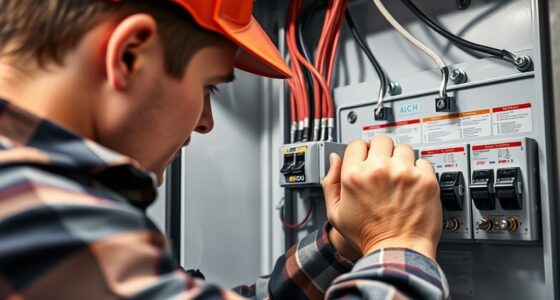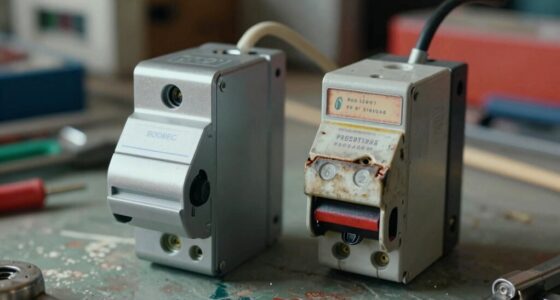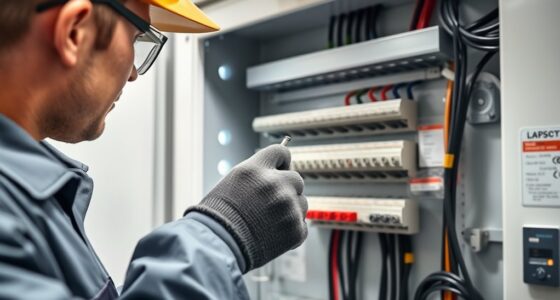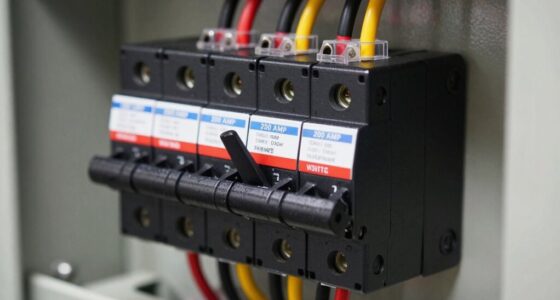
To size your transfer switch correctly, you need to analyze your essential load by listing critical appliances and calculating their total wattage. Match the switch’s capacity to your generator’s output, typically ranging from 30A to 200A for homes. Proper sizing guarantees safe, reliable power transfer, preventing overloads and damage. Taking these steps helps optimize your backup system. Keep exploring to learn how to accurately determine your load and choose the right switch size for your setup.
Key Takeaways
- Calculate the total wattage of essential appliances and circuits to determine your load requirements.
- Match the transfer switch’s amperage rating with your generator’s maximum output capacity.
- Consider future expansion needs to select a switch size that accommodates potential load increases.
- Consult electrical codes and manufacturer guidelines to ensure compliant and safe sizing.
- Seek professional electrician advice for accurate load assessment and proper transfer switch selection.
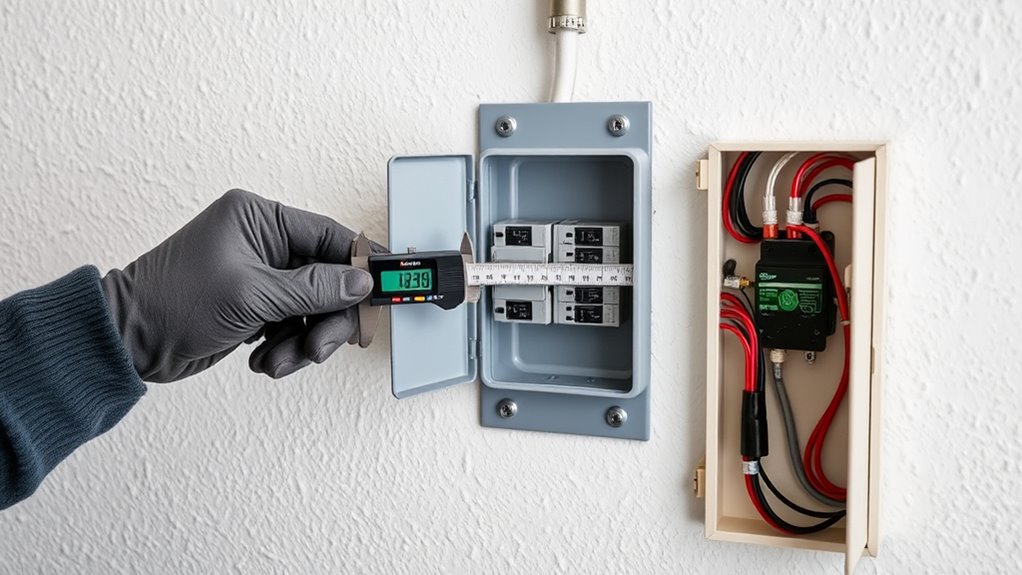
Choosing the right transfer switch size for your generator is essential to guarantee safe and reliable power transfer during outages. The key to selecting the proper size lies in understanding your home’s electrical demands and confirming the transfer switch can handle the circuit capacity you require. Before making a decision, you need to perform a thorough load analysis to determine how much power your essential appliances and circuits will draw during an outage. This process involves listing out all critical devices—like refrigerators, heating systems, lights, and medical equipment—and calculating their total wattage. Once you have this information, you can assess the total load and confirm the transfer switch you choose can accommodate it comfortably without risking overload.
Your load analysis is a crucial step because it provides a clear picture of your power needs. It helps you avoid selecting a transfer switch that’s too small, which could lead to frequent tripping or damage, or one that’s excessively large, which might be unnecessarily expensive and more complex to install. When considering the circuit capacity, you should look at the maximum expected load during peak usage times. This capacity must align with your generator’s output, ensuring the transfer switch can handle the combined electrical demands without limiting performance or safety.
Perform a load analysis to match your transfer switch size with your generator’s capacity.
Another important aspect is understanding the electrical codes and manufacturer recommendations. Transfer switches come in various sizes, typically ranging from 30A to 200A, with the size directly correlating to the circuit capacity they can support. For most residential applications, a transfer switch rated between 30A and 60A suffices, but larger homes or those with extensive backup loads may require higher ratings. When in doubt, consult a qualified electrician who can perform an accurate load calculation and recommend the appropriate transfer switch size based on your specific needs.
Choosing a transfer switch that’s correctly sized also ensures your generator operates efficiently and safely. An undersized switch can limit your generator’s ability to power essential circuits, while an oversized switch may lead to unnecessary costs and complexity. By thoroughly analyzing your load and matching it with the circuit capacity of the transfer switch, you ensure a seamless transition during outages, protect your electrical system, and extend the lifespan of your generator. Remember, investing the time to select the right size now will save you headaches and potential hazards later, providing peace of mind when you need backup power the most.
Additionally, understanding the top portable options for backup power can help you choose a transfer switch that complements your existing setup effectively.

Porch Shield Generator Cover for 5000-10000W, 32 x 24 x 24 inch, Black
- Compatible - More sizes for 5000w -10000w gas...
- Upgrade Material - Made of 600D polyester fabric...
- Tear Resistant & Waterproof - The high-level double...
As an affiliate, we earn on qualifying purchases.
Frequently Asked Questions
Can I Install a Transfer Switch Myself?
You can attempt a DIY installation of a transfer switch, but it’s not always recommended. Make sure you comprehend the electrical codes in your area and follow them strictly. If you’re comfortable with electrical work and have experience, you might handle it safely. However, for most homeowners, hiring a licensed electrician ensures the installation is done correctly, safely, and in compliance with all local regulations.
How Often Should I Test My Transfer Switch?
Imagine flickering lights signaling the need for a quick check—you should test your transfer switch at least once a year. During your maintenance schedule, testing frequency guarantees reliable operation, especially before storm seasons or power outages. Regular testing helps catch issues early, preventing surprises when you need backup power. So, mark your calendar annually to verify your transfer switch’s functionality and keep your home ready for any outage.
What Is the Lifespan of a Transfer Switch?
Your transfer switch typically lasts 10 to 30 years, depending on maintenance and usage. Regular transfer switch maintenance helps extend its lifespan, ensuring it stays compatible with your generator. Keep an eye on signs of wear and schedule inspections to prevent failures. Proper maintenance and choosing a transfer switch compatible with your generator’s power needs will maximize its longevity and reliable performance during outages.
Are There Portable Transfer Switches Available?
You’ll be glad to know that portable transfer switches are available, offering flexible power solutions during outages. About 60% of homeowners prefer portable options for their convenience. These switches come in manual and automatic types, so you can choose based on your needs. Manual switches require you to operate them yourself, while automatic ones switch seamlessly during power loss. Both are compact, making them easy to store and transport.
How Does Outdoor Installation Affect Transfer Switch Sizing?
Outdoor installation requires you to take into account weatherproof enclosures to protect your transfer switch from the elements. This affects sizing because you need a switch that fits within these enclosures and meets electrical codes for outdoor use. Make sure the switch has proper insulation and ventilation, and that it can handle your generator’s power capacity. Always follow electrical codes to ensure safety and compliance in outdoor setups.
Porch Shield Generator Cover for 5500-15000W, 38 x 28 x 30 inch, Black
- Compatible - More sizes for 5500w -15000w gas...
- Upgrade Material - Made of 600D polyester fabric...
- Tear Resistant & Waterproof - The high-level double...
As an affiliate, we earn on qualifying purchases.
Conclusion
By choosing the perfect transfer switch size, you’re not just preparing for a power outage—you’re fundamentally building a fortress that withstands the fiercest storms and darkest nights. With the right switch, your home becomes an unstoppable sanctuary, powered through any disaster with the confidence of a king. Don’t settle for less; size up your transfer switch and turn your generator into an impenetrable force of reliable energy. Power like this isn’t just a backup—it’s your ultimate safeguard.
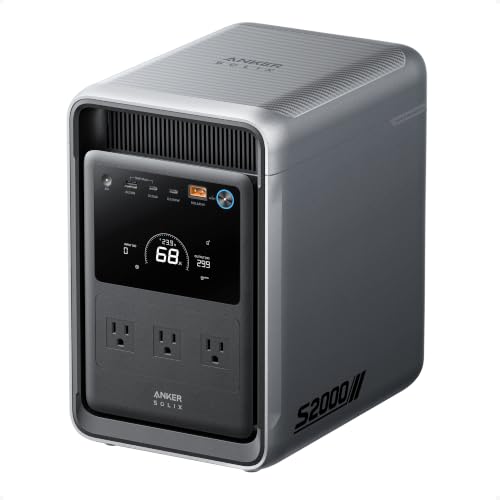
Anker SOLIX S2000 Portable Power Station, 2,010Wh, 1,500W, Home Backup, UPS
- Up to 35-Hour Fridge Backup: With 6W idle power draw...
- 10,000-Cycle LFP Battery: Powered by 314Ah LFP cells,...
- Smallest and Lightest 2kWh Power Station: 30% smaller and 25% lighter...
As an affiliate, we earn on qualifying purchases.

Generator Cover Portable Waterproof,Generator Rain Cover for Outside,Universal Generator Cover for Most Portable Generators 5000-10000 Watt(32"L x 24"W x 24"H)
- 【Dimensions】Generator Covers for outside 32x24x24 inch Fits Most...
- 【Windproof Design】This generator covers for outside features an...
- 【Side Ventilation Openings】This portable generator cover features side...
As an affiliate, we earn on qualifying purchases.