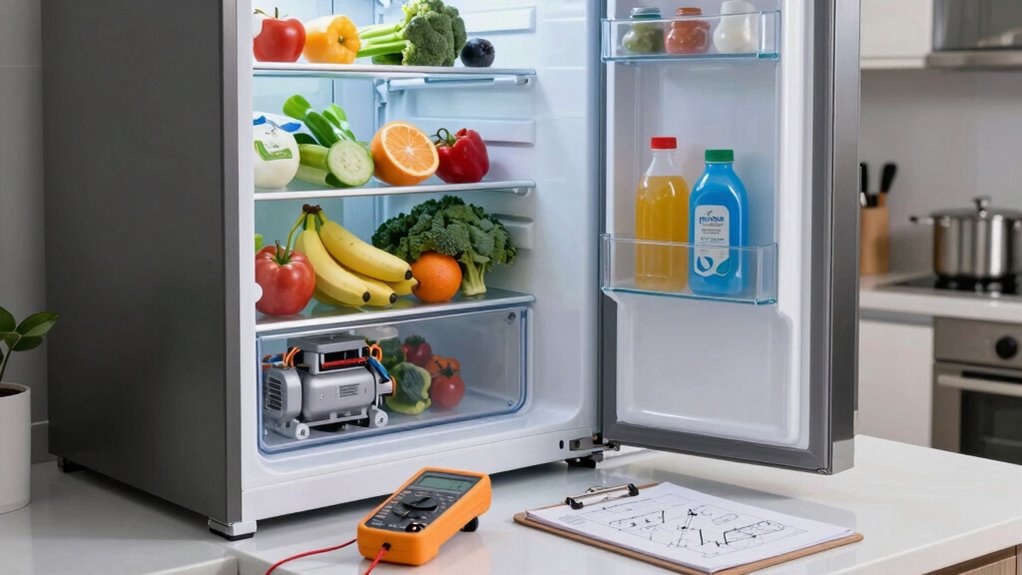

To calculate your refrigerator and freezer backup loads, start by checking their labels or manuals for wattage or amperage ratings. If only amperage is given, multiply it by the voltage (usually 120V) to find the wattage. Remember, startup wattage can be 2-3 times higher due to compressor surges. Add these figures together, include a safety margin of 25-30%, and you’ll know the total backup capacity needed. Keep going to discover more about ensuring your appliances stay powered during outages.
Open a free Amazon Business account
Business pricing, bulk buying and tax-exempt orders.
As an affiliate, we earn on qualifying purchases.
Key Takeaways
- Check appliance labels or manuals for wattage or amperage ratings; multiply amperage by voltage if needed.
- Account for startup surge wattage, which can be 2-3 times the running wattage.
- Sum the wattages of refrigerators and freezers to determine total load.
- Add a safety margin of 25-30% to accommodate startup surges and future expansion.
- Include protective devices to handle power surges during compressor startup.
Calculating the backup loads for your refrigerator and freezer is vital to guarantee they stay operational during power outages. When determining these loads, you need to consider both energy efficiency and temperature regulation. Energy-efficient appliances consume less power, which means your backup system can be smaller and more cost-effective. Proper temperature regulation ensures your food stays safe and fresh, preventing spoilage during blackouts. Understanding how much power your refrigerator and freezer require helps you select the right backup power source, whether it’s a generator, battery system, or an uninterruptible power supply (UPS).
Start by checking the appliance labels or user manuals, where the wattage or amperage ratings are usually listed. If only amperage is provided, multiply that number by the voltage (typically 120V in North America) to get the wattage. For example, a refrigerator with a 3-amp draw at 120V uses about 360 watts. Keep in mind that refrigerators and freezers don’t run constantly; they cycle on and off, with their compressor running intermittently. To estimate the actual energy consumption, look for the appliance’s energy efficiency ratings or average daily power usage, often expressed in kilowatt-hours (kWh). This will give you a more accurate picture of how much energy is needed to keep the appliance running under normal conditions. Additionally, understanding the power surges that can occur during outages helps you select protective devices to safeguard your appliances.
Check appliance labels for wattage or amperage; multiply amperage by voltage for wattage estimates.
Next, consider the startup wattage, which can be notably higher than the running wattage. When the compressor kicks on, it may draw two to three times the regular power. Make sure your backup system can handle this surge without overloading. For cold storage appliances, maintaining a stable temperature is vital, so your backup system must provide consistent power to prevent temperature fluctuations that could spoil your food. Proper insulation and placement also support temperature regulation, reducing the energy needed to keep the contents cool. Additionally, understanding appliance energy ratings and how they impact backup sizing can help you plan more efficiently. Being aware of potential power surges and their effects can help you select protective devices to safeguard your appliances during outages. It’s also helpful to consider long-term energy consumption to ensure your backup system remains effective over time without excessive costs.
Finally, add up the total wattage of all appliances you want to back up simultaneously, then factor in safety margins. It’s advisable to include a 25-30% buffer to account for startup surges and future expansion. Incorporating backup power options such as portable generators or battery systems can significantly enhance your preparedness. By carefully calculating these loads with attention to energy efficiency and temperature regulation, you’ll guarantee your backup system is well-sized and reliable, keeping your refrigerator and freezer operational and your food safe during outages.
Frequently Asked Questions
How Often Should Backup Loads Be Recalculated for Accuracy?
You should recalculate backup loads regularly, ideally annually, to maintain accuracy. Conduct load testing and power monitoring during these updates to identify any changes in appliance efficiency or power consumption. Regularly reviewing your backup loads guarantees your system can handle current demands, preventing outages or failures. Staying proactive with these assessments helps you adjust for any fluctuations, keeping your backup power reliable and effective over time.
What Tools Are Best for Measuring Appliance Power Consumption?
You should use a power monitoring tool like a Kill-A-Watt meter to measure appliance power consumption accurately. These devices help you assess energy efficiency by providing real-time data on how much power your refrigerator or freezer uses. With precise readings, you can identify inefficiencies, plan backup loads better, and optimize energy use, making sure your appliances run efficiently without wasting electricity.
How Do Seasonal Temperature Changes Affect Backup Load Calculations?
Temperature fluctuations and seasonal adjustments considerably impact backup load calculations. As seasons change, your refrigerator and freezer work harder during hotter months, increasing energy use. You should account for these seasonal adjustments by increasing your backup load estimates during warmer periods to guarantee reliable operation. Monitoring local temperature trends helps you refine your calculations, making sure your backup system can handle variations caused by seasonal temperature fluctuations efficiently.
Can Backup Loads Be Estimated Without Detailed Appliance Specifications?
You can estimate backup loads without detailed appliance specs by referencing appliance labeling and power efficiency ratings. Look for energy labels or efficiency certifications, which provide general power consumption estimates. Use these figures to approximate your refrigerator or freezer’s backup load, adjusting for size and usage patterns. This approach offers a practical estimate, helping you plan backup power needs effectively, even without detailed technical specifications.
What Safety Considerations Are Important During Backup Power Setup?
During backup power setup, safety is vital, especially in emergency planning during power outages. For example, you should guarantee all connections are properly grounded to prevent electric shocks. Use surge protectors to guard appliances, and avoid overloaded circuits. Always turn off appliances before plugging in. Prioritize safety by following electrical codes, and consider consulting a professional to minimize risks and ensure your backup system operates safely during emergencies.
Conclusion
And there you have it—by carefully calculating your refrigerator and freezer loads, you’ve become a master of preparedness. Ironically, while everyone worries about fancy gadgets and big plans, it’s often these simple calculations that keep the food fresh and your stress levels low. So next time you think about skipping the details, remember: a little effort now saves a lot of spoiled food—and headaches—later. Who knew that math could be so deliciously practical?
Fall Picks
fall essentials
As an affiliate, we earn on qualifying purchases.