TL;DR

Get backup power and energy gear delivered free with Prime
- Fast, free delivery on millions of items
- Prime Video, Amazon Music and more included
- Member-only deals all year
A GreenBuildingAdvisor response says a membrane used beneath blown-in cellulose must be selected for the climate and designed to carry the insulation’s weight. It points to reinforced poly or added strapping as possible support, while noting that the right vapor-control layer and installation details depend on the attic and project.
A GreenBuildingAdvisor response says homeowners planning to use a membrane to hold blown-in cellulose in an attic need to account for both climate-specific vapor control and the insulation’s weight. It identifies reinforced polyethylene or strapping beneath the membrane as possible support approaches, but does not prescribe one solution for every attic.
The response first clarifies the attic description: if an attic is vented to the outdoors, it is generally an outside, unconditioned space, rather than a vented conditioned space. It says the ceiling’s air- and vapor-control layer depends on the local climate. The responder gives 6-mil polyethylene as an option used in their own Climate Zone 7 area, while suggesting a Class II vapor retarder, such as Intello or Membrain, may be worth considering in warmer, more humid locations.
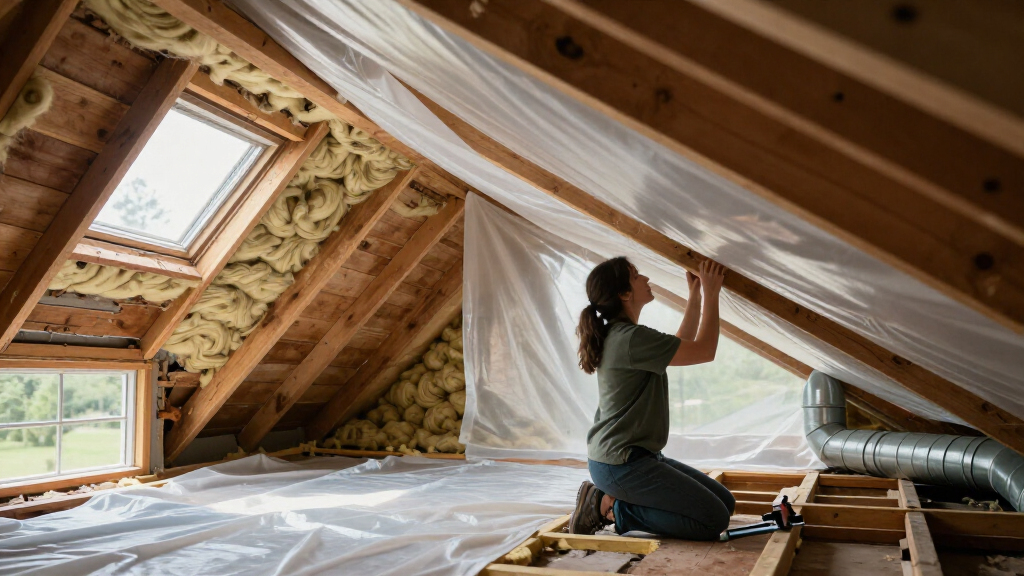
The answer also raises a separate question: whether the cellulose will be installed after the finished ceiling is in place and supported by a membrane. It describes cellulose at R-60 as fairly heavy. If the membrane must carry that load, the responder says reinforced material such as Dura-Skrim reinforced poly may be appropriate, or that 1-by or 2-by strapping could be added below the membrane to help support it.
A Kraft-faced insulation product is mentioned as another possible option, but the response says it would require a different way to make the ceiling airtight. It links to a separate GreenBuildingAdvisor article on ceiling air sealing. The answer does not provide a load rating, fastening schedule or project-specific design for any of the approaches.
Supporting the Insulation Load
The practical issue is not just whether a product is called a vapor barrier. A ceiling layer may also need to control air movement and moisture, while physically supporting a substantial depth of loose-fill insulation. Choosing for vapor control alone could leave the assembly without adequate mechanical support; choosing a strong membrane without appropriate air sealing may leave gaps in the ceiling boundary.
The response’s advice matters because these functions depend on the actual building conditions. Climate affects the recommended vapor-control strategy, while the installation sequence and insulation quantity affect how the ceiling assembly is supported. The answer therefore points readers toward treating climate, airtightness and load as linked questions, rather than assuming one sheet product solves all three.
For homeowners, an incorrect assumption about whether the attic is conditioned can also lead to a mismatched assembly. The response’s clarification helps frame the project, but it is not a substitute for checking local conditions, applicable building requirements and the specific product instructions.
Climate and Attic Conditions
The supplied report is a response to a homeowner’s question about using a vapor barrier to support blown-in cellulose. Its central correction is terminology: an attic vented to outdoors is, in the responder’s framing, vented and unconditioned. That distinction helps establish which surfaces separate indoor space from the outdoors and where air and vapor control are being considered.
The answer does not give a universal material recommendation. It contrasts the responder’s experience in Climate Zone 7, where 6-mil poly may be used, with warmer, more humid areas, where a Class II retarder may be considered. It also mentions Kraft facing only alongside the need for another method of making the ceiling airtight. These are examples from the response, not a complete climate-zone specification or an endorsement for every building.
The report refers readers to GreenBuildingAdvisor’s ceiling air-sealing article for additional information. No construction date, project location, existing ceiling assembly or local code details are included in the supplied source.
“If the attic is vented to the outside, the attic is also outside.”
— GreenBuildingAdvisor response
Project Details Still Missing
The supplied response does not identify the homeowner’s climate zone, exact attic design or installation plan. It is not clear whether the cellulose will rest directly on a membrane, how the membrane would be attached, what span it would cover or whether framing will provide additional support. Those details affect whether a proposed material and support arrangement is suitable.
The source also gives no product-specific load limits, fastening requirements, code review or engineering assessment. Its climate examples should not be read as a complete prescription for all regions. The appropriate vapor-control layer and air-sealing details remain dependent on the building and local conditions.
Confirm the Assembly Before Installation
Before installing the cellulose, the homeowner would need to establish whether the attic is vented and unconditioned, identify the local climate conditions and decide whether insulation will be installed above a finished ceiling or held by a membrane. The response recommends considering reinforced poly or added strapping if the membrane is expected to carry the insulation, and directs readers to its ceiling air-sealing guidance.
The supplied material does not report a follow-up decision or completed installation. The next step is therefore project-specific: confirm the ceiling assembly, material instructions and applicable local requirements before choosing a support method.
Key Questions
Can a vapor-control membrane support blown-in cellulose?
The GreenBuildingAdvisor response says a membrane may be used to hold cellulose, but warns that R-60 cellulose is fairly heavy. It suggests reinforced poly or strapping below the membrane as possible ways to help support the load. It does not provide a universal load rating or design.
Is 6-mil polyethylene right for every attic?
No universal recommendation is given. The responder says 6-mil poly can be used in their Climate Zone 7 area and says a Class II vapor retarder may be considered in warmer, more humid areas. The right layer depends on local climate and the specific assembly.
What does it mean if an attic is vented to the outdoors?
The response describes such an attic as outside and unconditioned, rather than a vented conditioned space. That distinction helps clarify where the ceiling separates the indoor space from the attic.
Can Kraft-faced insulation replace a ceiling air barrier?
The answer mentions Kraft-faced insulation as a possible option only if another method makes the ceiling airtight. It does not say that the facing alone will provide the needed air sealing.
What information is needed before choosing a membrane?
Relevant details include the climate, attic ventilation and conditioning, ceiling assembly, installation sequence and how the insulation load will be supported. The supplied response does not replace product instructions or local building requirements.
Source: rss
Fall Picks
fall essentials
As an affiliate, we earn on qualifying purchases.