
To estimate your equipment’s runtime from fuel supply, start by knowing its fuel consumption rate—such as gallons per hour—and the total fuel available. Divide the total fuel by the consumption rate to find the approximate hours it can run. Keep in mind, real-world factors like load or weather can increase fuel use, so adding a safety margin helps. For more accurate predictions, tracking usage over time and adjusting your estimates accordingly can really make a difference.
Key Takeaways
- Determine the total fuel amount available before starting calculations.
- Find the equipment’s fuel consumption rate from manuals or operational data.
- Divide the total fuel supply by the consumption rate to estimate runtime.
- Adjust estimates for real-world conditions like load, temperature, and maintenance.
- Add a safety margin (10-15%) to account for variable factors affecting fuel use.
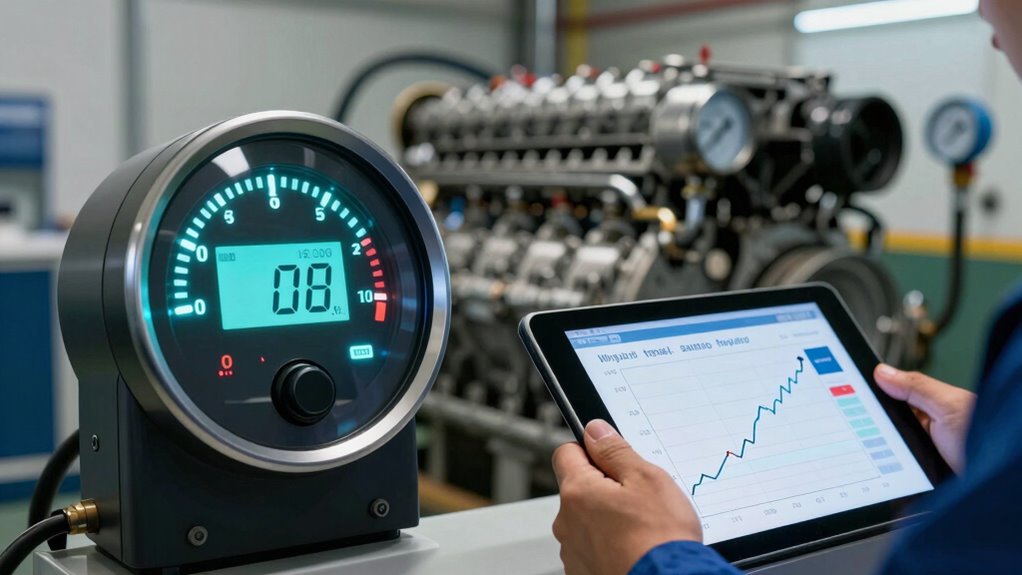
Ever wondered how long your vehicle or generator will run on a given fuel supply? Estimating runtime starts with understanding your equipment’s fuel efficiency and consumption rate. Fuel efficiency refers to how well your engine converts fuel into usable energy, typically measured in miles per gallon (mpg) or liters per hour. The consumption rate indicates how much fuel your machine uses over a specific period, often expressed in gallons or liters per hour. Knowing these two factors helps you predict how long your fuel will last, whether you’re planning a trip or managing a backup power supply.
To begin, determine your equipment’s fuel efficiency and consumption rate. For vehicles, check the manufacturer’s specifications or your recent fuel logs to find the average miles per gallon. For generators and other machinery, look at the user manual or run a test to measure how much fuel it consumes over a set period under normal operating conditions. Once you have these numbers, the calculation becomes straightforward. Divide the total amount of fuel you have by the consumption rate to find the approximate runtime. For example, if your generator holds 10 gallons of fuel and consumes 1 gallon per hour, it should run for about 10 hours on a full tank.
However, keep in mind that real-world conditions can affect fuel consumption. Factors like load, altitude, temperature, and maintenance status influence fuel efficiency. If your equipment is under heavy load or operating in extreme weather, it might consume more fuel than the standard rate. To account for this, add a safety margin—perhaps 10-15%—to your estimated runtime to avoid surprises. Additionally, consistent fuel tracking can help improve the accuracy of your estimates, especially if your equipment’s efficiency varies over time. Regularly monitoring fuel consumption also helps you identify changes that could impact your fuel efficiency, allowing for more accurate predictions. Moreover, understanding the various factors that influence fuel consumption can help you optimize your equipment’s operation for better efficiency. Incorporating data from reliable sources can further refine your estimates and ensure more precise planning. If your equipment’s efficiency varies, consider recalculating periodically to refine your predictions.
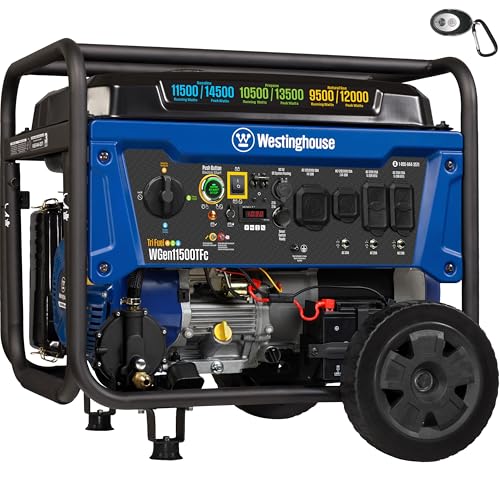
Westinghouse 14500 Peak Watt Tri-Fuel Home Backup Portable Generator, Remote Electric Start, Transfer Switch Ready, Gas, Propane, and Natural Gas Powered
Perfect as a backup power source for larger homes or a dependable source of portable power
As an affiliate, we earn on qualifying purchases.
Frequently Asked Questions
How Accurate Are Fuel-Based Runtime Estimates?
Fuel-based runtime estimates can be fairly accurate if you consider fuel efficiency, but consumption variability can affect precision. Your vehicle’s actual fuel efficiency may change with driving conditions, load, or maintenance, causing the estimate to fluctuate. To improve accuracy, track your real-world fuel consumption over time and adjust your calculations accordingly. Remember, factors like terrain and driving style play a significant role in how long your fuel lasts.
Can Weather Conditions Affect Fuel Consumption Estimates?
Weather conditions definitely impact fuel consumption estimates. For example, wind resistance, temperature, and precipitation can reduce your vehicle’s fuel efficiency, making your actual runtime shorter than predicted. If it’s cold or windy, your engine might work harder, burning more fuel. So, when estimating runtime, consider weather impact, as it can cause deviations from your initial fuel-based calculations. Adjust your estimates accordingly for more accurate planning.
What Tools Are Best for Measuring Fuel Levels?
Think of your tools as your fuel detectives. Fuel sensors are your best allies—they provide real-time, precise readings of fuel levels. Measurement devices, like dipsticks and flow meters, also work well for quick checks or more detailed assessments. These tools help you stay ahead of the game, ensuring you never run dry unexpectedly. With reliable fuel sensors and measurement devices, you’ll always know exactly how much fuel you have on hand.
How Often Should I Recalibrate My Estimates?
You should recalibrate your estimates regularly, ideally every few months or after significant changes in fuel consumption patterns. Calibration frequency depends on factors like equipment age, usage intensity, and environmental conditions. By consistently checking and adjusting your calculations, you guarantee more accurate runtime estimates, preventing unexpected fuel shortages. Monitoring fuel consumption closely helps you identify discrepancies early, allowing timely recalibration for reliable and precise fuel supply management.
Is Fuel Quality a Factor in Runtime Estimation?
Fuel quality definitely impacts your runtime estimate, acting like a hidden hand guiding your engine’s performance. Poor-quality fuel, mixed with additives that aren’t up to par, can lower engine efficiency, causing it to burn more fuel and reducing runtime. To get accurate estimates, consider fuel additives and always use high-quality fuel. This way, your engine runs smoothly, and your calculations stay reliable, avoiding surprises on the road.

Generac Guardian 10kW Home Standby Generator with 100 Amp Transfer Switch - Automatic Whole House Backup Power for Storms, Emergencies, and Outages, WiFi Enabled, Runs on Natural Gas or Liquid Propane
Remote Monitoring Anywhere: With Generac 7172 10kW Mobile Link Wi-Fi connectivity, effortlessly track generator performance from anywhere. Stay...
As an affiliate, we earn on qualifying purchases.
Conclusion
Just as Icarus relied on the sun’s warmth to reach new heights, your understanding of fuel estimates fuels your confidence in planning. Remember, accurate calculations keep your journey grounded and safe, preventing unexpected descents. By mastering these methods, you harness the power to predict your runtime precisely, much like a seasoned navigator reading the stars. Keep honing this skill, and you’ll navigate any trip with the assuredness of a sailor guided by the constellations.

Westinghouse 12500 Watt Dual Fuel Home Backup Portable Generator, Remote Electric Start, Transfer Switch Ready, Gas and Propane Powered
9500 Running Watts and 12500 Peak Watts (Gasoline); 8500 Running Watts, 11200 Peak Watts (Propane); Remote Start with...
As an affiliate, we earn on qualifying purchases.

Honeywell 14kW Home Standby Generator
PrecisionPower Technology delivers best-in-class power quality with less than 5 percent total harmonic distortion for clean, smooth operation...
As an affiliate, we earn on qualifying purchases.