Solar generator bundles pair a portable battery station with solar panels, but the right kit depends on whether you value capacity, portability, or a faster solar recharge. I rank the OUPES Mega 1 with 240W panel as the best overall balance here, while the Jackery Solar Generator 1000 v2 stands out for a larger panel and the BLUETTI Elite 100 V2 with 200W panel for buyers seeking a more substantial kit. Smaller 40W and 60W bundles are easier to carry but can take much longer to replenish their batteries from sunlight. Battery capacity alone does not tell you how long a panel will take to recharge a station, so panel output and your daily power needs matter just as much. Read on for the full breakdown, buying guidance, and picks for different kinds of use.

Get backup power and energy gear delivered free with Prime
- Fast, free delivery on millions of items
- Prime Video, Amazon Music and more included
- Member-only deals all year
Complete the kit


Key Takeaways
- Panel wattage separates the larger kits: the OUPES Mega 1 includes a 240W panel, while the Jackery 1000 v2 and one BLUETTI Elite 100 V2 bundle include 200W panels; these provide more solar input potential than the 40W to 120W panels in several other kits.
- Matching battery and panel size matters: the 1024Wh OUPES and BLUETTI bundles have far more stored energy than the 237Wh MARBERO M823, but their larger batteries need more solar input to recharge in a practical time.
- Several bundles share the 300W class but differ in what comes with them: the ZeroKor, EnginStar, Apowking, and Jackery Explorer 300 kits pair compact stations with smaller panels, making them better suited to modest loads than extended backup.
- BLUETTI appears in two distinct bundle configurations: its 100W-panel kit favors a lighter solar setup, while the 200W-panel version offers more panel capacity for the same named station family.
- Small-panel bundles trade recharge speed for easier carrying: 40W and 60W panels fit portable, low-demand plans, but buyers expecting frequent high-output use should compare panel wattage with battery capacity before choosing.
| Apowking 300W Portable Power Station with 40W Solar Panel |  | Best Lightweight Camping Bundle | Battery capacity: 220Wh | Battery type: Lithium-ion | Included solar panel: 40W monocrystalline | VIEW LATEST PRICE | See Our Full Breakdown |
| Jackery Solar Generator 1000 v2 with 200W Solar Panel |  | Best for Long-Term Battery Life | Battery capacity: 1,070Wh | AC output / surge: 1,500W / 3,000W | Battery type: LFP | VIEW LATEST PRICE | See Our Full Breakdown |
| OUPES Mega 1 Solar Generator with 240W Solar Panel, 1024Wh LiFePO4 Battery |  | Best Expandable Solar Bundle | Battery capacity: 1,024Wh | Battery chemistry: LiFePO4 | AC output: 2,000W | VIEW LATEST PRICE | See Our Full Breakdown |
| BLUETTI Elite 100 V2 Portable Power Station with 100W Solar Panel |  | Best for Fast Home-Backup Switching | Battery capacity: 1,024Wh | Battery type: LiFePO4 | AC output / surge: 1,800W / 3,600W | VIEW LATEST PRICE | See Our Full Breakdown |
| DaranEner Cubus 600L Portable Power Station with 100W Solar Panel |  | Best Mid-Size Value Bundle | Battery capacity: 576Wh | Battery chemistry: LiFePO4 | Continuous / peak output: 600W / 1,200W | VIEW LATEST PRICE | See Our Full Breakdown |
| Solar Powered Generator 100W with 40W Solar Panels – Portable Power Station |  | Best for Lightweight Essentials | Battery capacity: 146Wh / 39,600mAh | Running output: 100W | Starting wattage: 200W | VIEW LATEST PRICE | See Our Full Breakdown |
| Jackery Explorer 300 Portable Power Station with 40W Solar Panel |  | Best Compact LiFePO4 Bundle | Battery capacity: 292Wh | Battery chemistry: LiFePO4 | Peak output: 600W | VIEW LATEST PRICE | See Our Full Breakdown |
| UDPOWER S1200 1190Wh Portable Power Station with 120W Solar Panel |  | Best for Home Backup | Battery capacity: 1,190Wh | Battery type: LiFePO4 | Output / peak output: 1,200W / 1,800W | VIEW LATEST PRICE | See Our Full Breakdown |
| ZeroKor 300W Portable Power Station with 60W Solar Panel | 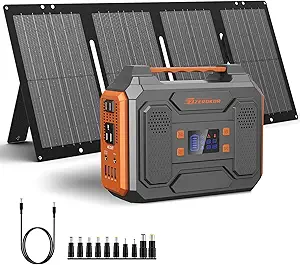 | Best Solar Panel Value for Small Devices | Maximum power station output: 300W | Solar panel output: 60W | Solar cell type and efficiency: Monocrystalline; 20.5% | VIEW LATEST PRICE | See Our Full Breakdown |
| MARBERO M823 Portable Power Station with 60W Solar Panel, 237Wh, 300W |  | Best for Clearly Specified Compact Capacity | Battery capacity: 237Wh / 64,000mAh | Peak output: 375W | Solar panel: 60W foldable | VIEW LATEST PRICE | See Our Full Breakdown |
| ZeroKor 300W Portable Power Station Kit with 40W Solar Panel and 100W Power Bank |  | Best for a Two-Part Portable Kit | Power station capacity: 280Wh | Maximum power station output: 300W | Solar panel: 40W | VIEW LATEST PRICE | See Our Full Breakdown |
| EnginStar 300W Portable Power Station with 60W Foldable Solar Panel |  | Best Value for a Stronger Small-Panel Bundle | Battery capacity: 296Wh (80,000mAh) | AC output: 300W pure sine wave | Solar panel: 60W monocrystalline, 23% conversion efficiency | VIEW LATEST PRICE | See Our Full Breakdown |
| ZeroKor 300W Portable Power Station with 40W Solar Panel |  | Best for Simple, Small-Device Camping | Model: R200 | Battery capacity: 280Wh | Maximum output: 300W | VIEW LATEST PRICE | See Our Full Breakdown |
| BLUETTI Elite 100 V2 Solar Generator with 200W Solar Panel, 1024Wh |  | Best Premium High-Capacity Bundle | Battery capacity: 1024Wh | Battery type: LiFePO₄ | AC output: 1800W rated; 2700W Power Lifting | VIEW LATEST PRICE | See Our Full Breakdown |
| solar generator bundle | Battery capacity | Weight | Solar panel |
|---|---|---|---|
| Apowking 300W Portable Power S | 220Wh | 5 lb | — |
| Jackery Solar Generator 1000 v | 1,070Wh | 23.8 lb | — |
| OUPES Mega 1 Solar Generator w | 1,024Wh | 27.8 lb | — |
| BLUETTI Elite 100 V2 Portable | 1,024Wh | 25 lb | — |
| DaranEner Cubus 600L Portable | 576Wh | 13.67 lb | — |
| Solar Powered Generator 100W w | 146Wh / 39,600mAh | — | 40W |
| Jackery Explorer 300 Portable | 292Wh | 12.9 lb | 40W |
| UDPOWER S1200 1190Wh Portable | 1,190Wh | 25.8 lb | 120W foldable, IP65-rated |
| ZeroKor 300W Portable Power St | — | — | — |
| MARBERO M823 Portable Power St | 237Wh / 64,000mAh | — | 60W foldable |
| ZeroKor 300W Portable Power St | — | — | 40W |
| EnginStar 300W Portable Power | 296Wh (80,000mAh) | — | 60W monocrystalline, 23% conversion efficiency |
| ZeroKor 300W Portable Power St | 280Wh | — | 40W foldable |
| BLUETTI Elite 100 V2 Solar Gen | 1024Wh | — | — |
More Details on Our Top Picks
Apowking 300W Portable Power Station with 40W Solar Panel
At 5 lb, the Apowking is the easiest bundle here to carry from the car to a campsite or keep ready for small-device outages. Its 220Wh battery and 40W panel suit phones, lights, and other modest loads, while two pure sine wave AC outlets add flexibility beyond USB charging. Compared with the DaranEner Cubus 600L, it is much lighter but gives up battery capacity and continuous output, so it is a better fit for short trips than powering several appliances. The panel supports topping up away from an outlet, but 40W solar input is limited; replenishing the battery will take patience and good sunlight. Its 300W rated output also rules out many high-draw appliances. I’d choose it for portability, not as a home-backup workhorse.
Pros:- Five-pound power station is easy to carry and store
- Includes a 40W monocrystalline solar panel for off-grid recharging
- Two pure sine wave AC outlets plus USB-C, USB-A, and DC ports
- Built-in LED light and battery protections add practical campsite utility
Cons:- 220Wh capacity limits runtime for devices beyond small electronics
- 40W panel provides slow solar replenishment
- 300W rated output cannot handle many higher-power appliances
Best for: Campers, day-trip travelers, and emergency-kit owners who want a light bundle for phones, lights, and small electronics.
Not ideal for: RV users or households seeking longer backup runtimes or power for appliances above its 300W rated output.
- Battery capacity:220Wh
- Battery type:Lithium-ion
- Included solar panel:40W monocrystalline
- AC outlets:2 × 110V pure sine wave
- Ports:2 USB-C PD, 3 USB-A, 1 DC car port
- Weight:5 lb
- Dimensions:8.5 × 6.7 × 4.1 in
Our verdict“Choose the Apowking for a light, simple camping bundle for small electronics, not for substantial appliance backup.”
Jackery Solar Generator 1000 v2 with 200W Solar Panel
The Jackery bundle pairs a useful 1,070Wh capacity with a 200W solar panel and an LFP battery rated for over 4,000 charge cycles. That combination suits frequent campers and buyers who expect to use their station regularly, rather than saving it for occasional emergencies. Its 1,500W AC output gives it a wider appliance range than the Apowking or DaranEner Cubus 600L, while the 23.8 lb unit remains manageable for car-based trips. App-controlled charging modes add flexibility, though its fastest emergency charging requires enabling that mode in the app. The included panel is a stronger solar starting point than the BLUETTI Elite 100 V2’s 100W panel, but the station and panel ship separately, which can complicate delivery and setup. It offers a strong balance of capacity, output, and cycle life, with less emphasis on expandability than the OUPES Mega 1.
Pros:- 1,070Wh capacity and 1,500W AC output cover a broad range of portable-power needs
- Included 200W solar panel supports meaningful off-grid charging
- LFP battery is rated for over 4,000 charge cycles while retaining over 70% capacity
- App offers fast, quiet, and energy-saving charging modes
Cons:- Station and solar panel ship separately
- One-hour charging requires enabling emergency charging in the app
- No stated battery expansion path in the supplied product data
Best for: Frequent car campers and road-trip travelers who want a roughly 1kWh bundle with durable LFP chemistry and substantial AC output.
Not ideal for: Buyers who need a single shipment, expandable battery capacity, or a panel larger than the included 200W unit.
- Battery capacity:1,070Wh
- AC output / surge:1,500W / 3,000W
- Battery type:LFP
- Battery lifespan:Over 4,000 charge cycles; retains over 70% capacity
- Included solar panel:200W
- Charging ports:3 AC ports, 2 USB-C, 1 USB-A, 1 DC car port
- USB-C output:100W
- Weight:23.8 lb
- Warranty coverage:5 years
Our verdict“Pick the Jackery for a frequent-use, 1kWh-class solar bundle where battery longevity and strong AC output matter most.”
OUPES Mega 1 Solar Generator with 240W Solar Panel, 1024Wh LiFePO4 Battery
The OUPES Mega 1 is the most flexible choice here for buyers who may need more stored power later. It starts with a 1,024Wh LiFePO4 battery and a comparatively substantial 240W solar panel, then can expand to 5,120Wh with an additional B2 battery. That upgrade path separates it from the Jackery 1000 v2, which offers higher stated capacity but no expansion option in the supplied data. At 2,000W AC output, the OUPES also outruns the DaranEner Cubus 600L for appliance loads, while its 20ms UPS switch and app monitoring add useful home-backup features. The tradeoff is that expansion requires a separate battery, and the stated 5–8-hour solar recharge depends on sunlight. At 27.8 lb, it is less convenient to carry than compact camping bundles, so I see it as a flexible RV or backup setup rather than a lightweight travel pick.
Pros:- Included 240W monocrystalline panel is the largest panel in this five-product group
- 2,000W AC output supports more demanding loads than the smaller-output bundles
- Expandable from 1,024Wh to 5,120Wh with an additional B2 battery
- 20ms UPS switch, app monitoring, and simultaneous solar and AC charging
Cons:- Reaching the maximum capacity requires buying a separate B2 battery
- Solar recharge time depends on sunlight and site conditions
- At 27.8 lb, it is less convenient for frequent carrying
Best for: RV owners and home-backup planners who want a high-output solar bundle with a defined path to much greater battery capacity.
Not ideal for: Hikers or lightweight campers, and buyers who need the expansion battery included in the initial bundle.
- Battery capacity:1,024Wh
- Battery chemistry:LiFePO4
- AC output:2,000W
- Included solar panel:240W monocrystalline, waterproof
- Solar recharge time:5–8 hours, depending on sunlight conditions
- Expandable capacity:Up to 5,120Wh with an additional B2 battery
- UPS switch time:20ms
- Battery lifespan:3,500+ cycles
- Weight:27.8 lb
Our verdict“Choose the OUPES Mega 1 if you want strong output now and the option to expand storage for RV or backup use later.”
BLUETTI Elite 100 V2 Portable Power Station with 100W Solar Panel
For backup use, the BLUETTI Elite 100 V2 stands out for its UPS transfer time of 10ms or less, paired with 1,024Wh of LiFePO4 storage and 1,800W AC output. That quick switchover is the key difference from the OUPES Mega 1’s 20ms switch, making the BLUETTI the more compelling fit for equipment that benefits from a shorter interruption. It is also rated for over 4,000 cycles and has four AC outlets, giving it practical staying power for a home or RV setup. The compromise is the included 100W solar panel: it is half the Jackery’s panel rating and is stated to take about seven hours for a full charge. At 25 lb, the station is portable by car, but its solar replenishment is slower than the OUPES bundle. I’d prioritize its backup switching over fast solar recovery.
Pros:- UPS transfer time of 10ms or less supports quick backup switching
- 1,024Wh LiFePO4 battery is rated for over 4,000 cycles
- 1,800W AC output with four AC outlets
- Compact 25 lb design with a hidden carry handle
Cons:- Included 100W panel is smaller than the 200W Jackery and 240W OUPES panels
- A full solar charge takes about seven hours with the included panel
- Station and solar panel ship separately
Best for: Households or RV users who want a 1kWh-class station for backup loads and value a short UPS transfer time.
Not ideal for: Off-grid users who need faster solar replenishment from the included panel or travelers seeking a very light station.
- Battery capacity:1,024Wh
- Battery type:LiFePO4
- AC output / surge:1,800W / 3,600W
- Power Lifting output:2,700W
- Included solar panel:100W
- UPS transfer time:≤10ms
- Ports / AC outlets:11 total ports; 4 AC outlets
- Weight:25 lb
- Battery cycle life:4,000+ cycles
Our verdict“Choose the BLUETTI bundle for backup setups where rapid UPS switching matters more than quick solar charging.”
DaranEner Cubus 600L Portable Power Station with 100W Solar Panel
The DaranEner Cubus 600L fills the gap between the Apowking’s small 220Wh setup and the roughly 1kWh stations in this roundup. Its 576Wh LiFePO4 battery and 600W continuous output offer more room for several devices or modest appliances, while its 13.67 lb weight stays easier to manage than the Jackery 1000 v2 or OUPES Mega 1. The included 100W solar panel and seven total ports make it a sensible mid-size bundle for car camping and shorter outages. A 100W USB-C PD port can also serve compatible laptops without tying up an AC outlet. But its 600W ceiling still excludes many high-draw appliances, and the panel is smaller than the Jackery’s and OUPES’s. Car cables are sold separately, so buyers planning vehicle charging need to account for that missing accessory.
Pros:- 576Wh LiFePO4 battery offers a useful middle ground between compact and 1kWh-class stations
- Included 100W solar panel and MPPT solar input support off-grid charging
- 100W USB-C PD output can charge compatible laptops
- Pass-through charging lets connected devices stay powered while the station recharges
Cons:- 600W continuous output limits use with higher-wattage appliances
- 100W panel is smaller than the panels included with the Jackery and OUPES bundles
- Car cables are sold separately
Best for: Car campers and outage-prepared households who want more capacity than a compact power bank without carrying a 1kWh-class station.
Not ideal for: Buyers who need to run high-wattage appliances, want the largest included solar panel, or require car-charging cables in the bundle.
- Battery capacity:576Wh
- Battery chemistry:LiFePO4
- Continuous / peak output:600W / 1,200W
- Solar input:100W MPPT
- Included solar panel:100W
- AC charging:130W
- Car charging:120W; car cables sold separately
- Ports:3 AC outlets, 1 USB-C, 2 USB-A, 1 car socket
- Weight:13.67 lb
Our verdict“Pick the Cubus 600L for a portable mid-capacity bundle that supports modest loads but not demanding appliances.”
Solar Powered Generator 100W with 40W Solar Panels – Portable Power Station
This bundle is the light-duty choice in this group: its 146Wh battery and 100W output suit phones, lights, and other small electronics, not demanding appliances. The included 40W solar panel gives campers a way to replenish the station away from an outlet, though its modest capacity means long use depends on access to sunlight. Compared with the Jackery Explorer 300, it offers less stored energy and lower output, but its stated compact dimensions make it a simpler fit for buyers prioritizing a small setup. Multiple AC, USB, and DC outputs help accommodate different devices, while the emergency flashlight adds practical utility. I would skip it for multi-day backup or anyone who expects to run higher-wattage gear.
Pros:- Includes a 40W solar panel for off-grid charging
- AC, USB, and DC outputs accommodate a range of small electronics
- Compact stated dimensions suit portable outdoor setups
- Built-in LED flashlight includes emergency modes
Cons:- 100W output cannot handle many appliances or higher-draw gear
- 146Wh capacity may run short during extended use without sunlight
- Outlet count and capacity are limited for larger group setups
Best for: Solo campers and day-trip users who mainly need to recharge phones, lights, and other small devices.
Not ideal for: Buyers planning to power appliances over 100W or run several devices through an extended outage; the 146Wh capacity and 100W output are limiting.
- Battery capacity:146Wh / 39,600mAh
- Running output:100W
- Starting wattage:200W
- Solar panel:40W
- Total power outlets:7
- Dimensions:7.5 × 3.7 × 6.1 in
- Materials:Aluminum, monocrystalline silicon, and tempered glass
Our verdict“Choose this bundle for lightweight camping and essential device charging, not as a substitute for a higher-capacity backup station.”
Jackery Explorer 300 Portable Power Station with 40W Solar Panel
The 292Wh capacity and 300W rated output make this a more flexible small-system bundle than the 100W Solar Powered Generator above: it can support a broader range of camping electronics while remaining portable at a listed 12.9 lb. Its included 40W panel is relatively modest for the battery size, so solar replenishment may take time when conditions are weak. The standout distinction is its LiFePO4 battery rated for over 4,000 cycles, a useful fit for repeat use rather than occasional emergency storage. A 100W USB-C PD port and two AC outlets help when several devices need power. Compared with the larger UDPOWER S1200, this Jackery is easier to carry but stores far less energy and cannot support comparable loads.
Pros:- LiFePO4 battery is rated for over 4,000 charge cycles
- 300W rated output is more capable than 100W compact bundles
- 100W USB-C PD port can serve compatible higher-power devices
- Includes a 40W solar panel, AC adapter, and car charging cable
Cons:- 40W panel is modest relative to the 292Wh battery capacity
- Listed weight is 12.9 lb, which may be heavier than some buyers expect
- Power station and solar panel may ship separately
Best for: Campers and frequent weekend travelers who want a portable station with a cycle-life-rated LiFePO4 battery for phones, laptops, and modest gear.
Not ideal for: Buyers needing extended home backup or fast solar replenishment; the 292Wh battery and 40W panel are a small combination for those jobs.
- Battery capacity:292Wh
- Battery chemistry:LiFePO4
- Peak output:600W
- Solar panel:40W
- Ports:2 AC, 1 USB-C PD (100W), 2 USB-A, 1 car port (120W)
- Weight:12.9 lb
- Dimensions:15.43 × 9.92 × 11.89 in
Our verdict“Pick the Explorer 300 for portable, repeat-use camping power, but choose a larger-capacity bundle for home backup or longer off-grid stays.”
UDPOWER S1200 1190Wh Portable Power Station with 120W Solar Panel
For buyers who need a bundle for more than phones and campsite lights, the UDPOWER S1200 brings a substantial 1,190Wh LiFePO4 battery and 1,200W output. That capacity sharply separates it from the Jackery Explorer 300 and the smaller 237Wh MARBERO M823, making the UDPOWER better suited to longer backup sessions and a wider set of devices. Its 120W foldable, IP65-rated panel is the largest included panel in this five-product group, though it is still modest relative to the station’s storage capacity. Five AC outlets and several USB ports help serve multiple users, while the stated sub-0.01-second UPS switching targets backup use. The tradeoff is bulk: at 25.8 pounds, this is a less appealing carry-on camping choice.
Pros:- 1,190Wh LiFePO4 battery provides far more stored energy than compact bundles
- 1,200W output and 1,800W peak output support a broader range of equipment
- Includes a foldable 120W IP65-rated solar panel
- Five AC outlets and multiple USB and DC ports support several devices
Cons:- 25.8 lb weight makes it cumbersome for frequent carrying
- 120W panel may recharge the large battery slowly
- Power station and solar panel may ship separately
Best for: Households, RV owners, and outdoor crews seeking a higher-capacity bundle for backup power and multiple devices.
Not ideal for: Minimalist campers or buyers who need a lightweight setup; the 25.8 lb station is much less portable than the Jackery Explorer 300.
- Battery capacity:1,190Wh
- Battery type:LiFePO4
- Output / peak output:1,200W / 1,800W
- Solar panel:120W foldable, IP65-rated
- AC outlets:5
- Other ports:2 USB-C (100W), 4 USB-A, 1 car port, 2 DC5521
- Weight:25.8 lb
- Battery cycle life:Rated for 4,000+ cycles
Our verdict“Choose the UDPOWER S1200 when capacity and backup flexibility matter more than carrying weight or fast solar recharging.”
ZeroKor 300W Portable Power Station with 60W Solar Panel
The ZeroKor’s bundle centers on a 60W monocrystalline panel, a step up in panel wattage from the 40W kits supplied with the Jackery Explorer 300 and the 100W Solar Powered Generator. That can make it a more appealing small-device charging kit for buyers who want a little more panel capacity, though the station is still limited to 300W maximum output. Its AC, USB, DC, and car charging options cover common camping electronics, and the reading and SOS flashlight modes add useful emergency functions. The key gap is that the supplied information does not state battery capacity, so I can’t compare stored energy or estimate runtimes against the MARBERO M823’s listed 237Wh. Also, the panel junction box is not waterproof, which calls for care outdoors.
Pros:- Includes a 60W monocrystalline solar panel
- Supports AC, solar, and 12V car charging
- Several USB ports plus DC output serve common small devices
- Flashlight includes reading and SOS modes, with multiple protection features
Cons:- 300W maximum output excludes higher-wattage appliances
- Battery capacity is not specified in the supplied product details
- Solar panel junction box is not waterproof
Best for: Campers who want a 60W-panel bundle for small electronics and value multiple charging inputs over a stated battery-capacity comparison.
Not ideal for: Buyers needing reliable runtimes for a specific device, waterproof solar hardware, or appliances drawing more than 300W.
- Maximum power station output:300W
- Solar panel output:60W
- Solar cell type and efficiency:Monocrystalline; 20.5%
- AC outlets:2, 300W maximum
- USB ports:3 USB-A (up to 5V/3A) and 1 quick-charge USB port
- DC output:9V–12.6V, up to 10A
- Solar panel outputs:USB-A, USB-C, and DC (18V/3.3A, up to 60W)
- Charging methods:AC outlet, solar panel, and 12V car outlet
Our verdict“Choose the ZeroKor for a small-device camping kit with a comparatively strong included panel, but skip it if you need known capacity or weatherproof panel components.”
MARBERO M823 Portable Power Station with 60W Solar Panel, 237Wh, 300W
The MARBERO M823 earns its place as a compact bundle with a clearly stated 237Wh battery and 60W foldable panel. That capacity gives buyers a better basis for planning small-device use than the ZeroKor 300W bundle, whose supplied details omit battery capacity. With a 300W rated output, two pure sine wave AC outlets, and USB-A, USB-C, and DC connections, the M823 is designed for phones, laptops, and modest camping gear rather than high-draw appliances. Its LED flashlight with strobe and SOS modes adds emergency utility without requiring another accessory. The stated one-hour runtime is not a useful general runtime promise without a specified load, and the 60W panel remains limited for replenishing the battery quickly. I’d choose the UDPOWER S1200 instead for extended backup.
Pros:- 237Wh capacity is specified, unlike the supplied ZeroKor product details
- Includes a foldable 60W solar panel
- Two pure sine wave AC outlets plus USB-A, USB-C, and DC outputs
- Flashlight offers flashlight, strobe, and SOS modes
Cons:- 300W rated output rules out many higher-wattage appliances
- 60W panel may recharge the battery slowly in limited sunlight
- Listed one-hour runtime lacks a stated load, limiting its usefulness for planning
Best for: Campers and emergency-kit buyers who want a small bundle with a stated battery capacity and several device-charging options.
Not ideal for: People planning to power appliances above 300W or seeking long runtimes and substantial solar replenishment.
- Battery capacity:237Wh / 64,000mAh
- Peak output:375W
- Solar panel:60W foldable
- AC outlets:2 pure sine wave outlets
- USB ports:4 USB-A (2 QC3.0, 2 standard) and 1 USB-C PD up to 18W
- DC output:12–16.8V, up to 14A
- Solar conversion rate:21.5–23.5%
Our verdict“Pick the M823 for compact, small-device power with a stated 237Wh capacity, not for high-draw appliances or extended backup.”
ZeroKor 300W Portable Power Station Kit with 40W Solar Panel and 100W Power Bank
I’d pick this bundle for buyers who value having a separate power bank as well as a small solar generator. The 280Wh station and 40W panel cover light-duty charging, while the included 100W power bank offers another option for taking power away from the station. That setup is more flexible for personal devices than the EnginStar 300W, which instead pairs its station with a larger 60W panel. The tradeoff is limited appliance support: the station’s 300W maximum output rules out common high-draw equipment such as coffee makers, hair dryers, and water pumps. I’d treat its two AC outlets as useful for small electronics, not a sign that it can run larger household gear. The flashlight’s SOS and reading modes add practical campsite utility, but the bundle’s solar replenishment will be slow compared with larger-panel options.
Pros:- Includes both a 280Wh power station and a separate 100W power bank.
- Two 110V AC outlets plus USB and DC ports support several small devices.
- 40W solar panel provides an off-grid charging option.
- Flashlight includes reading and SOS modes, with listed electrical protections.
Cons:- 300W maximum output excludes appliances such as coffee makers, hair dryers, and water pumps.
- The 40W panel is a modest source for replenishing the station.
- The listed runtime is seven hours, but the data does not specify the load behind that figure.
Best for: Campers and emergency-kit planners who want a compact station plus a separate power bank for phones and other small electronics.
Not ideal for: Buyers who need to run high-wattage appliances or want faster solar recharging; the 300W output and 40W panel are limiting.
- Power station capacity:280Wh
- Maximum power station output:300W
- Solar panel:40W
- Included power bank output:100W maximum
- Power station AC outlets:2 × 110V
- Power bank AC outlets:2 × 110V
- Dimensions:8.5 × 4.1 × 6.7 inches
- Listed runtime:7 hours
Our verdict“Choose this ZeroKor bundle if a separate power bank matters more than faster solar charging or appliance-level output.”
EnginStar 300W Portable Power Station with 60W Foldable Solar Panel
Among the compact bundles here, I’d favor the EnginStar when panel size and charging flexibility matter more than extra accessories. Its 60W monocrystalline panel is larger than the 40W panels in both ZeroKor kits, giving it a better starting point for solar replenishment, though sunlight and conditions still affect output. The station’s 296Wh capacity and 300W pure sine wave AC output suit phones, lights, and other modest loads; they do not turn it into an appliance-running system. Eight output ports and charging from solar, a wall outlet, or a 12V car socket make it adaptable for trips and short outages. Compared with the ZeroKor kit that includes a separate power bank, EnginStar puts its bundle emphasis on the panel and charging options instead. Its 300W ceiling remains the main constraint.
Pros:- Includes a foldable 60W monocrystalline solar panel, larger than the 40W panels in the listed ZeroKor kits.
- Pure sine wave 300W AC output is suited to compatible sensitive electronics.
- Can recharge through solar, a wall outlet, or a 12V car socket.
- Eight output ports and a stated battery life of more than 1,000 cycles add flexibility.
Cons:- 300W output limits the size of appliances it can run.
- Solar output may be restricted in low-light conditions.
- The listed 65W maximum charging input limits how much benefit a higher-output source can provide.
Best for: Campers and short-outage planners who want a small station with a 60W panel, multiple charging methods, and pure sine wave AC output.
Not ideal for: Buyers who need to power appliances above 300W or expect dependable solar charging in low-light conditions.
- Battery capacity:296Wh (80,000mAh)
- AC output:300W pure sine wave
- Solar panel:60W monocrystalline, 23% conversion efficiency
- Output ports:8
- Charging methods:Solar panel, wall outlet, 12V car socket
- Maximum charging input:65W
- Power station weight:6.5 lbs
- Battery cycle life:More than 1,000 charge cycles
Our verdict“Pick the EnginStar if you want a compact 300W bundle with a comparatively larger panel and several ways to recharge.”
ZeroKor 300W Portable Power Station with 40W Solar Panel
This ZeroKor is the simpler choice for campers who want a station-and-panel bundle without the separate power bank included with the other ZeroKor kit. It combines a 280Wh battery and 40W foldable panel with AC, DC, standard USB, and QC3.0 charging, so a mix of small devices can draw power through familiar connections. Its 300W maximum output puts it in the same light-duty class as the EnginStar, but EnginStar includes a 60W panel and specifies pure sine wave AC output. That makes the EnginStar the more appealing option when panel capacity or AC output details lead the decision. Here, the selling point is a straightforward camping setup with a built-in SOS and reading flashlight. Skip it for compressor-driven equipment or loads over 300W; the listing warns those can damage the station.
Pros:- Pairs a 280Wh station with a 40W foldable solar panel.
- Offers two AC outlets, DC output, three USB ports, and one QC3.0 port.
- Built-in flashlight has reading and SOS modes.
- Includes listed short-circuit, over-current, over-voltage, and overload protection.
Cons:- Loads above 300W may damage the station, and compressor-based appliances are not recommended.
- The 40W panel is smaller than the EnginStar bundle’s 60W panel.
- The product data does not list the station’s weight.
Best for: Campers who need a basic solar bundle for phones, lights, and other small electronics, with several port types and a built-in flashlight.
Not ideal for: Buyers who need to run appliances over 300W, compressor-based equipment, or want a larger included panel.
- Model:R200
- Battery capacity:280Wh
- Maximum output:300W
- Solar panel:40W foldable
- AC outlets:2 × 110V, 300W maximum
- DC output:9–12.6V, 10A maximum
- USB ports:3 × 5V/3A maximum; 1 × QC3.0
- Starting wattage:550W
Our verdict“Choose this model for straightforward small-device camping, but favor the EnginStar if you want a larger panel and specified pure sine wave AC output.”
BLUETTI Elite 100 V2 Solar Generator with 200W Solar Panel, 1024Wh
For buyers whose bundle needs to cover more than phones and campsite lighting, the BLUETTI is the clear step up in this group. Its 1024Wh LiFePO₄ battery and 1800W rated output offer far more stored energy and appliance support than the 280–296Wh, 300W ZeroKor and EnginStar options. The included 200W solar panel is also a substantially larger starting point for off-grid recharging, and the station accepts up to 1000W of solar input if paired with suitable additional panels. Fast AC charging, app connectivity, and a 10ms UPS switchover make it more adaptable for home backup. There are caveats: the panel ships separately, and the stated 70-minute AC recharge uses higher-power charging than the included panel. I’d choose it for capability, not compact simplicity.
Pros:- 1024Wh LiFePO₄ battery and 1800W rated AC output exceed the capacity and output of the compact bundles in this group.
- Includes a 200W solar panel and supports up to 1000W solar input.
- 10ms UPS switchover, app connectivity, and 11 ports support home-backup use.
- Battery is rated for over 4,000 cycles to 80% capacity.
Cons:- The solar panel ships separately rather than in the same shipment as the station.
- The stated 70-minute AC recharge depends on higher-power charging, not the included 200W panel.
- Its greater capacity and output may be unnecessary for buyers who only need to charge small personal devices.
Best for: Households and RV users who need a higher-capacity solar bundle for everyday devices and compatible appliances, plus UPS-style backup.
Not ideal for: Minimalist campers or buyers seeking a single compact package; the station is much more capable than the small 300W bundles, and the panel ships separately.
- Battery capacity:1024Wh
- Battery type:LiFePO₄
- AC output:1800W rated; 2700W Power Lifting
- Ports:11
- Included solar panel:200W
- Maximum solar input:1000W
- AC charging power:1200W TurboBoost
- UPS switchover:10ms
- Battery lifespan:Over 4,000 cycles to 80%
Our verdict“Choose the BLUETTI when you need a substantial battery, higher appliance output, and backup features; skip it for a lightweight small-device kit.”

How We Picked
I compared these solar generator bundles as complete kits, not just as power stations. The main factors were stated battery capacity, inverter output where provided, included panel wattage, portability, and whether the battery-and-panel pairing seems suited to the likely use. I also looked at differences that affect day-to-day planning, such as whether a bundle is aimed at small devices or can support a broader range of backup loads.
The ranking favors kits that offer a useful balance of stored energy and solar input, then separates compact, lower-capacity options by their fit for lighter use and ease of carrying. The OUPES Mega 1 ranks highest for its 1024Wh LiFePO4 battery and 240W panel combination; the Jackery 1000 v2 and BLUETTI 200W bundle are strong alternatives with larger panels. Smaller bundles rank lower for extended backup because their panels provide less solar input and their stations hold less energy. Product names and listed specifications alone do not establish real-world recharge time, so I avoid treating panel wattage as a guarantee of a particular charging speed.
Factors to Consider When Choosing Solar Generator Bundles
Before choosing among these bundled kits, work backward from the devices you need to power and how often sunlight will be available. A bundle can look convenient yet leave you short on stored energy, panel capacity, or usable output for your plans.
Estimate Your Loads Before Comparing Capacity
Write down the devices you expect to run, their wattage, and how many hours you need them powered. Add up the energy use in watt-hours rather than relying on a list of device names, since a small light and a refrigerator have very different demands. Leave room for conversion losses and changing conditions instead of treating the station’s full listed capacity as usable for every device. A compact 237Wh-class station can make sense for phones and small electronics but is a different proposition from a 1024Wh unit intended to support more substantial loads. The common mistake is choosing a battery by headline capacity without checking whether the inverter output can run the intended appliance. If your needs include startup surges from motor-driven equipment, check that rating separately before buying.
Match Panel Wattage to the Battery You Are Buying
A solar panel’s rated wattage describes its output under specified conditions, not a guaranteed daily energy total. Shade, panel angle, season, and cloud cover all affect how much energy reaches the station. A 40W or 60W panel paired with a larger battery may keep small devices topped up, yet be a slow way to refill a depleted station. Larger panels, such as the 200W and 240W options in this roundup, give a bigger solar-input ceiling, but they still need suitable sunlight and compatible charging limits. Check the station’s supported solar input as well as the panel rating; buying a larger panel does not help if the station cannot accept its full output. For trips with limited sun, plan around the energy you can reliably collect rather than the panel’s best-case label.
Decide Whether Portability or Longer Runtime Comes First
Battery capacity, panel size, and carrying burden tend to rise together, so a bundle that provides more stored energy may be less convenient to move and set up. Compact 300W-class stations with small panels are easier to take on short outings, particularly when the job is charging phones, lights, or other modest electronics. Larger stations can support a broader backup plan, but you may need more space in a vehicle and a practical way to position the panel in the sun. Think about the full kit, not only the station: a foldable panel still takes up room, and a longer cable run or a separate stand may affect setup. For frequent transport, prioritize manageable weight and simple deployment over maximum capacity. For a stationary backup spot, a larger battery and panel may justify the added bulk.
Check Chemistry, Cycle Life, and Storage Habits
Battery chemistry affects how a station handles repeated charging and how it fits into a long-term backup routine. The OUPES Mega 1 listing specifies a LiFePO4 battery, while buyers should verify the chemistry and cycle-life details for other models rather than assume they match. For a station used often, compare the manufacturer’s cycle-life information and warranty terms alongside capacity. For emergency storage, follow the maker’s instructions for charge level, temperature, and periodic maintenance; a battery left unattended for long periods may not be ready when needed. Store panels so their surfaces and connectors stay protected, and check cables for wear before trips. These upkeep details can matter more over time than a small difference in the panel’s rated output.
Verify Ports, Output Limits, and Solar Compatibility
Make a list of the plugs and power types your devices require, then compare it with the station’s AC outlets, USB ports, and DC connections. A bundle is not a fit just because its capacity looks adequate: the inverter’s continuous output and surge rating also set limits on what it can run. Confirm the included panel uses a compatible connector and falls within the station’s supported solar-input voltage and current range. If you already own panels, check whether they can be connected safely and whether doing so affects the included kit or warranty. Do not assume that two products with similar names have identical ports or charging limits; compare the exact version and bundle contents. This step can prevent buying a kit that stores enough energy but cannot supply it in the form your devices need.
Choose a Bundle for Your Actual Sun and Backup Plan
Solar charging works best when you can place the panel in direct sun and adjust its angle during the day. A camping setup with frequent shade or a home backup location near a window may collect less energy than the panel rating suggests. Decide whether the generator is meant to supplement grid power, cover a short outage, or operate away from outlets for several days; each plan calls for different capacity and recharging expectations. For outages, a wall outlet or vehicle charging option can be a useful second route when sunlight is poor, so check which charging methods the station supports. Avoid treating a solar generator as a whole-home solution unless its output, transfer arrangements, and permitted use support that role. A realistic backup list helps prevent paying for capacity you will not use—or buying too little for the loads that matter.
Frequently Asked Questions
Is a 40W or 60W panel enough to recharge a portable power station?
It can add energy for small, occasional loads, but it may be a poor match for quickly refilling a large battery. Actual output varies with sunlight, panel angle, shade, and the station’s charging limits, so rated wattage is not a promise of a set recharge time. A 40W or 60W bundle makes more sense when portability and low-power use matter more than fast recovery. For frequent use or a larger battery, compare the station’s solar-input limit and consider a higher-wattage compatible panel. Check whether the kit allows additional panels before assuming you can expand it later.
Should I pick the 1024Wh bundle or a smaller 300W-class kit?
Choose based on the devices and runtime you need, not the station class alone. A 1024Wh model can store substantially more energy than a small portable station, which can help with longer backup periods or several devices. It is also larger to carry and takes more panel input to recharge in a useful timeframe. A smaller 300W-class bundle is better suited to lighter loads and short trips, provided its inverter output meets your device requirements. Check both watt-hours and continuous output: capacity affects runtime, while output determines what the station can power at once.
Does a larger included panel guarantee faster solar charging?
A larger panel raises the potential solar input, but it does not guarantee a particular charging time. Sun intensity, shading, temperature, panel direction, and the station’s maximum solar-input rating all affect the result. The station may limit incoming power even if the panel can produce more, so verify compatibility before upgrading. A larger panel is most useful when it is paired with a station that accepts its output and when you can place it in strong sunlight. For dependable planning, treat the panel rating as a ceiling under favorable conditions, not as a daily energy forecast.
Can these solar generator bundles run a refrigerator during an outage?
Some may support a refrigerator, but the product names and battery capacity alone are not enough to confirm a safe fit. Check the refrigerator’s running wattage, startup surge, and energy use over the number of hours you need. Then compare those figures with the station’s continuous AC output, surge rating, and usable battery energy. Solar input can extend runtime, but a small included panel may not replace the energy a refrigerator consumes, especially in weak sunlight. If refrigeration is a priority, verify the exact model specifications and plan for a backup charging method or a larger compatible panel.
Is the included solar panel always the best one to use with the station?
Not necessarily; the included panel is a convenient starting point, but it may be sized for portability rather than fast recharging. Before adding or replacing a panel, confirm the station’s supported voltage, current, connector, and maximum solar input. A panel that exceeds the station’s limits or uses an incompatible connection can be unusable or unsafe. Also consider how often you can set the panel in direct sun and whether its size suits your transport and storage space. If you already own compatible panels, compare their specifications with the station’s limits before buying a second panel.
Conclusion
For most buyers seeking a balanced solar generator bundle, I recommend the OUPES Mega 1 with 240W panel as the best overall pick because its 1024Wh LiFePO4 battery is paired with the lineup’s largest included panel. The best premium direction is the Jackery Solar Generator 1000 v2 or the BLUETTI Elite 100 V2 bundle with a 200W panel; compare their exact output, ports, and charging limits before choosing between them. For best value, consider a compact 300W-class kit if your needs are limited to smaller devices and you do not expect fast solar recovery. The best choice for beginners is a straightforward smaller bundle such as the Jackery Explorer 300 with 40W panel, provided its capacity matches your modest load plan. For specific low-power, easy-to-carry needs, the MARBERO M823 or another 40W–60W kit suits lighter outings better than extended outage duty. If regular backup or faster solar replenishment is the goal, favor a larger battery with a higher-wattage compatible panel and verify the station’s output limits before deciding.