
TL;DR
A homeowner has mounted her television from the ceiling instead of the wall to maximize space. This unconventional setup addresses space constraints and offers a new approach to home design. The story explores the installation process and potential benefits.
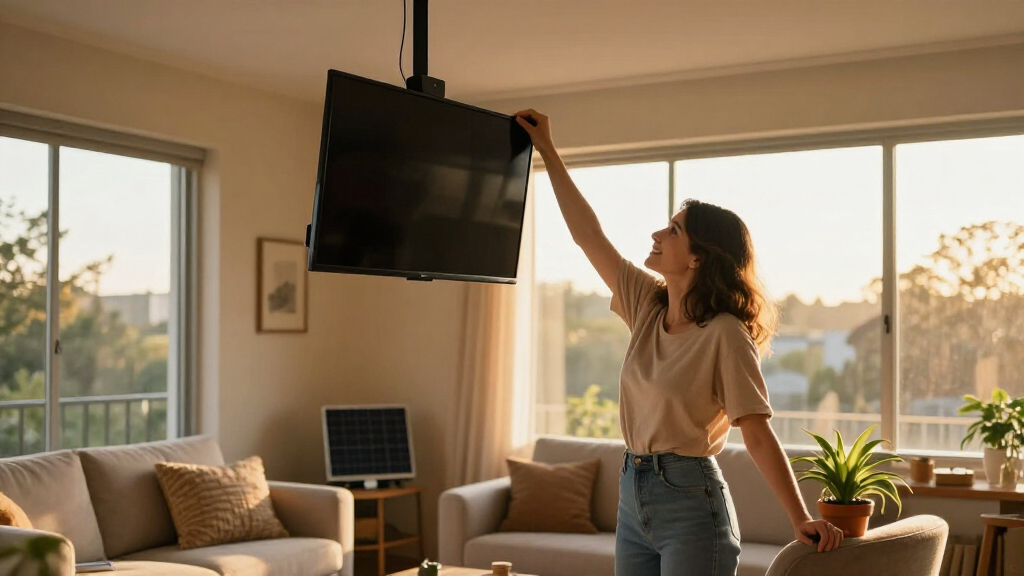
A woman has installed her television from the ceiling instead of traditional wall mounting, aiming to save wall space and create a unique aesthetic. This unconventional approach highlights innovative home design ideas that address space limitations.

Get backup power and energy gear delivered free with Prime
- Fast, free delivery on millions of items
- Prime Video, Amazon Music and more included
- Member-only deals all year
The homeowner, whose identity has not been disclosed, mounted her TV from the ceiling using custom brackets and a pulley system. She stated that the decision was driven by limited wall space in her living room, which made traditional mounting impractical. The setup allows her to lower or raise the TV as needed, providing flexibility and freeing up wall area for other uses.
Experts say ceiling-mounted TVs are rare but feasible with proper hardware and installation. The homeowner consulted with a professional to ensure safety and stability. The project involved reinforcing the ceiling structure and selecting a suitable mounting mechanism to support the TV’s weight.
While the installation is functional, questions remain about long-term durability, safety, and whether this approach is suitable for all types of homes. No accidents or technical issues have been reported so far, and the homeowner reports satisfaction with the result.
Innovative Space-Saving Home Design Solution
This development demonstrates a creative response to space constraints, especially in urban or small homes. It offers an alternative to traditional wall mounting, potentially inspiring others to explore unconventional home modifications. The approach also raises discussions about safety, practicality, and aesthetic appeal in modern interior design.
Products Worth Considering

eufy Security SoloCam S340 3K Dual-Lens Solar Security Camera

Sonos One (Gen 2) Two-Room Set Voice-Controlled Smart Speaker with Alexa (2-Pack, Black)

Shark PowerPro Reveal Plus Cordless Stick Vacuum, Charcoal (IZ376H)
As an affiliate, we earn on qualifying purchases.
Emergence of Unconventional TV Mounting Techniques
Traditional wall mounting has been the standard for decades, but recent trends show homeowners experimenting with different methods to optimize space. Ceiling-mounted TVs are uncommon but have appeared in specific cases, such as in commercial settings or for aesthetic reasons. This latest example reflects a broader interest in personalized and space-efficient home solutions.
Previous innovations include retractable or motorized mounts, but ceiling mounting remains relatively rare due to installation complexity. The trend aligns with increased demand for versatile and functional home environments, especially as more people work and relax in smaller spaces.
“I didn’t want my TV taking up wall space, so I decided to hang it from the ceiling. It’s been a game-changer for my living room layout.”
— Homeowner
Long-Term Safety and Practicality of Ceiling Mounts
It is unclear how durable and safe the ceiling-mounted TV will be over time, especially with regular use or potential structural shifts. No long-term testing or safety assessments have been publicly reported, and the homeowner has not disclosed whether she plans to make further modifications.
Potential for Broader Adoption and Professional Guidelines
As more homeowners experiment with ceiling mounting, industry professionals may develop guidelines and specialized hardware for safe installation. Further studies or case reports could emerge to evaluate long-term safety and practicality, influencing future home design trends.
Key Questions
Is ceiling mounting a safe option for TVs?
Ceiling mounting can be safe if installed with proper hardware and structural reinforcement, ideally by professionals. It is not recommended for DIY unless experienced in structural work.
What are the advantages of ceiling-mounted TVs?
This approach frees up wall space, offers flexible viewing angles, and can enhance the aesthetic of small or uniquely designed rooms.
Are there any risks associated with ceiling mounting?
The main risks include structural failure, instability, or damage to the ceiling. Proper installation and regular safety checks are essential.
Can this setup be used in any home?
Not necessarily. Homes with reinforced ceilings and sufficient structural support are better suited. Consultation with a professional is recommended before attempting ceiling mounting.
Source: rss