TL;DR

Get backup power and energy gear delivered free with Prime
- Fast, free delivery on millions of items
- Prime Video, Amazon Music and more included
- Member-only deals all year
Chicago’s Safer Foundation trains people with criminal justice involvement for solar and other clean-energy work, combining technical instruction with employment support and social services. The organization says more than 100 people earned clean-energy certifications in the past three years and 79 obtained jobs; the source does not specify how many placements were in solar roles.
The Safer Foundation is training people with criminal justice involvement in Chicago for solar and other clean-energy jobs, pairing hands-on instruction with job placement help and social services. The nonprofit says that in the past three years, more than 100 people earned clean-energy industry certifications through its training and 79 got jobs, though it did not specify how many were hired into solar positions.
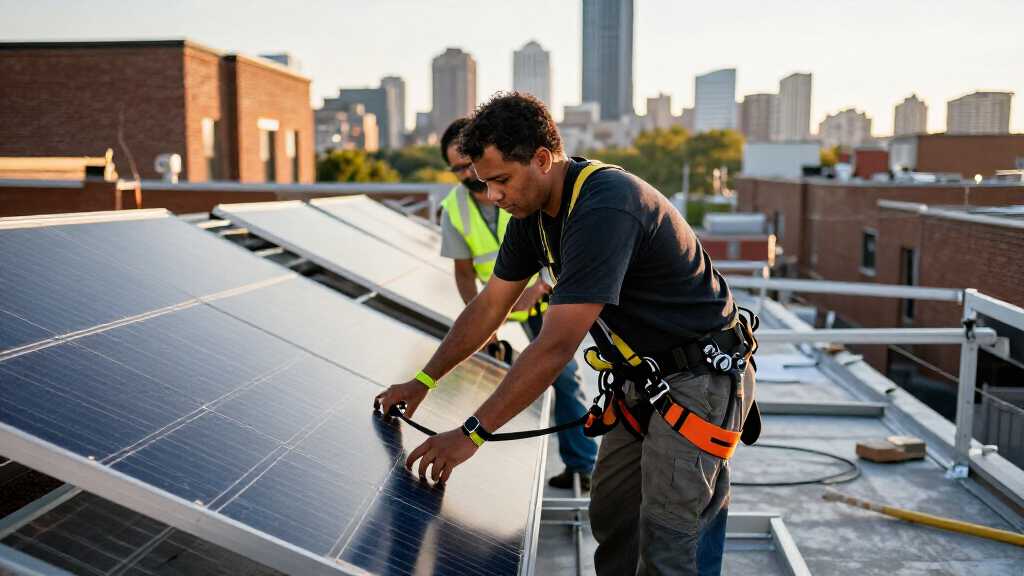
Training takes place at Safer’s headquarters on Chicago’s West Side, inside a building that also houses an adult transitional center. In a former gymnasium, trainees work in a two-story model home under construction, where exposed insulation and electrical fixtures provide a setting for practical instruction. Participants include residents of the transitional center and other men and women who have been involved with the criminal justice system.
The program combines job-related preparation with support intended to address obstacles to employment. Safer offers instruction in workplace and diversity skills, financial literacy, and interpersonal skills, as well as access to counseling and substance-use treatment. The source says some participants also need services such as recovery support or anger management for personal health needs or to meet court requirements.
Safer’s training and employment account executive, Katrice Harris, said the foundation’s job development team builds relationships with employers and negotiates memorandums of understanding in which companies agree to consider or hire participants. The report identifies utility-scale developer Millennium Solar Electric and residential installer Sunrun among employers connected to Safer. It does not give a breakdown of placements by employer, job title, wage, or length of employment.
A Route Into Clean-Energy Work
The program links two challenges: helping people return to work after incarceration and filling jobs in a growing clean-energy sector. For participants, solar training can provide a route to paid work and experience in construction-related tasks. Safer President and CEO Mark Yates said entry-level clean-energy positions can offer opportunities to advance, while skills such as carpentry and electrical work may also apply in other industries.
Employment support is central to the model because a technical credential alone may not address barriers such as limited recent work history, criminal-record screening, transportation, childcare, or health needs. Safer says it works with employers to create hiring pathways and provides wraparound assistance. The reported figures—more than 100 certifications and 79 jobs over three years—offer a snapshot of the program’s reach, but do not establish that every certification led to a job or that every placement was in solar.
The approach also matters to employers seeking workers. Yates told Canary Media that some trainees have been out of the workforce through major technology changes and may need to learn basic digital tools alongside solar skills. The program’s combination of instruction and employer relationships is intended to address both technical preparation and hiring hesitation, although the report does not independently measure the effect of those efforts.
Products Worth Considering

Roborock RockNeo Q110H Wire-Free Robot Lawn Mower

Philips Hue Play Gradient 65-Inch Smart TV Light Strip

Bose Lifestyle Ultra Soundbar and Ultra Subwoofer Bundle
As an affiliate, we earn on qualifying purchases.
Illinois’ Clean-Energy Training Framework
Illinois’ 2017 and 2021 clean-energy laws established workforce programs that prioritize people from marginalized communities. According to the report, those programs can include remedial education, professional and interpersonal skills training, and practical support for challenges such as childcare, vehicle problems, and mental health needs. The state has specifically sought to include people who were formerly incarcerated in the clean-energy workforce effort.
Safer Foundation, which has operated since 1972, has long worked to help people leaving incarceration gain skills and find employment. Its solar training is one part of that broader reentry and employment work, rather than a standalone technical course. The organization’s location in an adult transitional center allows some residents who are completing sentences to access training close to where they live, while the program also serves people from outside the center.
Yates said clean energy offers a promising combination of entry-level opportunities and transferable trade experience. The report describes the training environment and the foundation’s services, but does not provide a full curriculum, the number of annual participants, or the program’s total funding.
Placement Outcomes Still Need Detail
The reported outcome figures cover clean-energy-related certifications and jobs, not solar jobs alone. Safer did not provide a job-by-job breakdown, wages, retention rates, or information about how many participants completed training but remained unemployed. The source also does not say whether the 79 people who found jobs were all among the more than 100 certified trainees or whether some placements occurred in other clean-energy occupations.
It is also unclear how many people the program serves in a typical year, how many are residents of the transitional center, and how long training takes. The report gives no independent evaluation comparing participants’ employment outcomes with those of people who did not take part. Employer agreements are described by Safer, but their specific terms and the number of participating employers are not detailed.
Training and Hiring Continue
Safer’s immediate work, as described in the report, is to continue training participants and connecting them with employers in clean energy. Its job development staff maintain employer relationships, while trainees can draw on technical instruction and other foundation services. The report does not announce a new expansion, enrollment deadline, or future placement target.
Further information on the program’s reach would clarify how many participants enter solar roles, what those jobs pay, and whether workers remain employed over time. For now, the available figures show certifications and placements reported by the foundation across clean-energy-related work over the past three years; the specific solar employment results remain unreported.
Key Questions
What does the Chicago program teach?
The Safer Foundation program provides hands-on preparation for solar and other clean-energy work, alongside workplace skills, financial literacy, and other employment support. The source describes trainees working in a two-story model home but does not list a complete course syllabus.
How many participants have found jobs?
Safer Foundation reported that 79 people obtained jobs after more than 100 people earned clean-energy-related industry certifications through its training in the past three years. The organization did not provide a solar-specific placement count.
Who can take part?
The program serves people with criminal justice involvement, including residents of an adult transitional center at Safer’s Chicago headquarters and other men and women affected by the criminal justice system. The source does not give eligibility rules or details on how to apply.
What support is available beyond technical training?
Safer says participants can access job development and services including counseling and substance-use treatment. The program also addresses workplace skills and practical barriers, though the exact support provided can vary by participant.
Source: canarymedia.com