
TL;DR

Get backup power and energy gear delivered free with Prime
- Fast, free delivery on millions of items
- Prime Video, Amazon Music and more included
- Member-only deals all year
U.S. solar module manufacturing capacity now exceeds the country’s annual installations, and domestic cell production is expanding. But wafer and polysilicon capacity remains behind, while future factory demand depends on how solar installations change after federal tax credits expire.
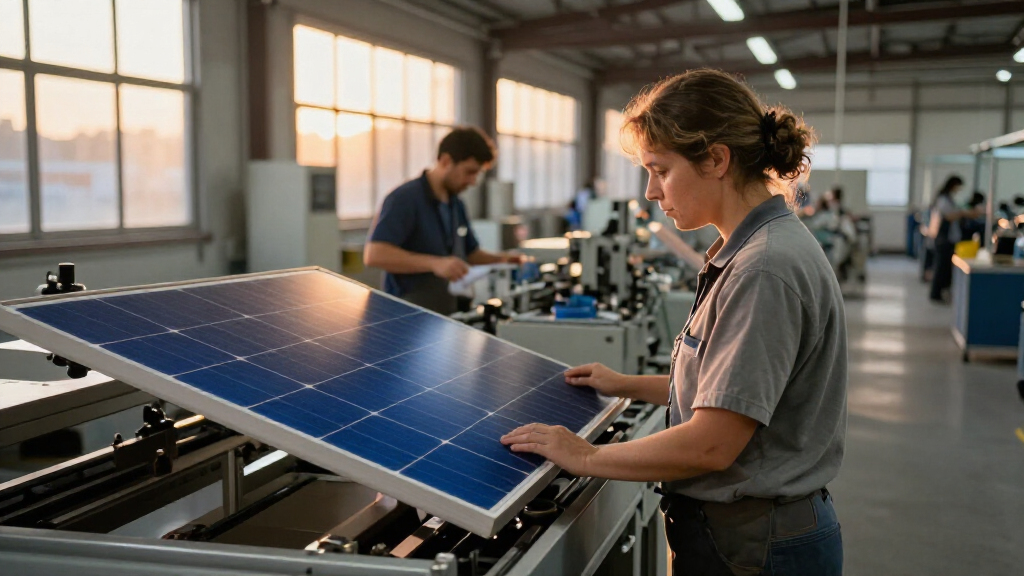
U.S. factories can now produce more finished solar panels than the country installed in 2025, but domestic manufacturing of the wafers and polysilicon used to make those panels remains a weaker link, according to Canary Media’s review of Clean Investment Monitor data. The gap matters because a panel-assembly base alone does not make the supply chain self-sufficient, and the business case for new factories depends on future demand.
The United States installed 47.9 gigawatts of solar capacity in 2025, measured in direct current capacity. Existing domestic factories have the capacity to produce more finished modules than that annual total. If announced projects and facilities under construction or commissioning are completed, module production capacity could grow by about 83%, the report says. That figure describes potential capacity growth, not a guarantee that the projects will be completed or operate at full output.
Upstream production is less developed. Solar cells, made using silicon wafers, are a key component of modules. Domestic factories have capacity to make up to 19.5 gigawatts of cells annually, following several factory openings this year, according to the report. If projects nearing completion come online, cell capacity could match the level of U.S. solar deployments in 2025.
Production of wafers and polysilicon—the processed material used to make wafers—has not kept pace with the growth in module and cell capacity. The report identifies those more capital-intensive stages as the principal gaps in the domestic chain. Capacity figures describe what factories could produce; they do not by themselves establish actual output, profitability, or the share of U.S. demand met by domestic goods.
Demand Will Shape Factory Prospects
The imbalance affects whether U.S. solar manufacturing can supply the full chain behind a panel, rather than only its final assembly. If domestic cell factories rely on imported wafers or polysilicon, the country remains exposed to overseas supply for important inputs even as more modules are made at home.
Investment decisions also depend on whether new capacity can find buyers. The report notes that federal tax credits are due to run out, raising uncertainty about the pace of installations and the demand available to support factories. For manufacturers, a large announced capacity pipeline is not the same as a durable market: plants must be completed, produce competitively, and remain in operation as policy and demand change.
Products Worth Considering

Dreame L50 Ultra Robot Vacuum and Mop Combo

Shark IQ Robot Self-Empty XL Robot Vacuum with Home Mapping, Self-Cleaning Brushroll, and Wi-Fi, Black

Dyson Big Ball Multi Floor Canister Vacuum, Yellow
As an affiliate, we earn on qualifying purchases.
From Panel Assembly to Inputs
The report describes a supply chain that runs from polysilicon to wafers to photovoltaic cells, and then to finished modules. Modules are the assembled panels installed in solar projects. Expanding module assembly can increase the amount of finished equipment made in the United States, but it does not by itself establish domestic production at the earlier stages.
U.S. solar manufacturing had nearly disappeared before expanding in recent years, according to the report. It credits federal incentives and stiffer tariffs on foreign products with helping drive the revival. The current picture is therefore a substantial manufacturing change, but one that remains uneven across different steps of production.
Future Demand Remains Wide-Ranging
It is not yet clear how many announced or in-progress factories will be completed, when they will reach full production, or whether they can operate sustainably over time. The capacity figures in the report are not a measure of current factory output or proof that domestic producers can supply every input at competitive prices.
Demand after federal tax credits expire is another major unknown. Rhodium Group modeled annual U.S. solar installations averaging between 8 and 52 gigawatts of direct current capacity in the post-2030 period. That is a scenario range, not a forecast of a single outcome. At the lower end, domestic factories could have enough capacity for a smaller market; at the upper end, more wafer and polysilicon production could be needed. The report does not establish which path will occur.
Factory Buildouts and Solar Demand
The next indicators are whether projects now under construction or commissioning begin production, and whether proposed module and cell capacity becomes operating output. Tracking wafer and polysilicon investments will show whether upstream manufacturing starts to close the gap identified in the report.
Solar installations and federal policy will also shape the market. As tax-credit support changes, manufacturers and developers will have to respond to the resulting demand. The extent to which domestic plants can keep operating and supply a larger share of the chain remains an open test of the U.S. manufacturing expansion.
Key Questions
Can the United States make enough solar panels for its annual installations?
According to the report, U.S. factories have the capacity to produce more finished modules than the 47.9 gigawatts installed in 2025. Capacity does not necessarily equal actual production.
Which parts of the solar supply chain are weaker?
Wafer and polysilicon production is less developed than module and cell manufacturing, according to Canary Media’s review of Clean Investment Monitor data.
How much solar-cell capacity does the U.S. have?
Domestic factories can produce up to 19.5 gigawatts of solar cells annually. Projects nearing completion could bring capacity to a level matching 2025 deployments, the report says.
Why could U.S. solar manufacturing growth slow?
The report points to uncertainty over installations after federal tax credits expire. Lower demand could leave manufacturers with more capacity than the market needs, while higher demand could require more upstream production.
What remains uncertain about the supply chain?
It is not yet clear which planned factories will be completed, how much they will produce, or whether U.S. producers can remain viable over the long term. Post-2030 solar installations also remain uncertain.
Source: canarymedia.com