TL;DR

Get backup power and energy gear delivered free with Prime
- Fast, free delivery on millions of items
- Prime Video, Amazon Music and more included
- Member-only deals all year
An RMI study finds that adding heat pumps in 24 states and Washington, D.C., could make better use of spare winter grid capacity and reduce residential electricity rates compared with rates otherwise expected. The estimates are directional, not forecasts, and lower rates do not guarantee lower total bills for households that switch from fossil fuels.
A new study by clean-energy think tank RMI finds that adding heat pumps in states with spare winter grid capacity could lower residential electricity rates, rather than requiring costly grid expansion. The analysis covers 24 states and Washington, D.C., but its estimates are directional, not predictions of future rates or household bills.
Electricity rates pay for both the power customers use and fixed costs such as wires, transformers, power plants and other grid equipment. Because utilities build systems to meet periods of highest demand, those assets can be underused at other times. RMI’s analysis finds that roughly half of U.S. states have spare capacity in winter, when electricity demand is generally lower than during summer peaks.
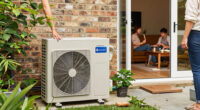
Heat pumps could use some of that winter headroom. The study says they would largely replace less-efficient air conditioners in summer, rather than add substantially to summer peak demand. In the states and district it analyzed, deploying heat pumps within existing grid capacity could reduce residential electricity rates by an average of 13% compared with what rates would otherwise be after inflation. RMI equates that estimate to about $200 a year for a residential customer.
The potential varies by state. RMI estimates Michigan could accommodate 3.6 million home heat pumps and reduce overall residential rates by as much as 27%. The study also considers hybrid systems, in which a heat pump works alongside a retained fossil-fuel furnace or boiler. In Illinois, it found that only 30% of households could install a heat pump as their sole heating appliance within the grid headroom considered; a modeled mix of 79% hybrid systems and 21% all-electric heat pumps could make greater use of available capacity.
How Winter Capacity Could Affect Rates
The findings bear on two linked issues: the cost of heating electrification and the cost of maintaining the electric system. If new electricity use can be added during periods when the grid has spare capacity, utilities may spread fixed infrastructure costs across more kilowatt-hours without immediately building additional peak capacity. RMI’s analysis suggests that heat pumps could contribute to that effect in some places.
That does not mean every household would save money by switching. A lower price per kilowatt-hour is not the same as a lower total bill, which depends on how much energy a home uses, its insulation, heat-pump performance, local electricity prices and the fuel being replaced. The analysis is about possible rate effects across a service area; RMI did not calculate household bill changes for people installing heat pumps.
The study also gives policymakers a possible reason to treat heating choices as part of grid planning. Where winter headroom exists, incentives for efficient electric heating or hybrid systems could increase use of existing infrastructure. The result is not a case for one heating setup everywhere: local capacity and household economics differ.
Products Worth Considering

Roborock Q7 M5+ Robot Vacuum and Mop

Bose TV Speaker Compact Soundbar with Bluetooth and HDMI-ARC, Black

Shark Navigator Lift-Away Upright Vacuum (NV360)
As an affiliate, we earn on qualifying purchases.
Why Grid Demand Varies by Season
Across much of the United States, electricity demand reaches its highest levels on hot summer afternoons, when air conditioners run at the same time. Utilities and grid operators must have enough capacity to meet those peaks, even if the equipment is used less at other times of year. RMI’s study focuses on states where that summer-oriented system leaves room for more winter electricity use.
Heat pumps provide heating and cooling by moving heat rather than generating it through combustion or electric resistance. Their effect on demand depends on the equipment and how it is installed. The study notes that some systems use electric-resistance backup strips when a heat pump cannot meet demand in very cold weather; those strips can draw substantially more power. Keeping a furnace or boiler for the coldest hours can limit the new electric load while allowing a household to use a heat pump much of the time.
RMI co-author Ryan Shea described underused grid capacity as a toll bridge with too few users: more use can spread fixed costs among more customers. The comparison explains the study’s rate argument, but it does not replace utility-specific analysis. RMI lacked access to detailed data from individual utilities, a limitation that affects how precisely the estimates can be applied locally.
“The larger the reduction in electricity rates, the higher likelihood that someone’s energy bill will decrease with a heat pump.”
— Ryan Shea, RMI study co-author
Limits of the Rate Estimates
RMI calls its figures directional estimates, not forecasts. The team did not have utility-specific data that could refine its calculations, so the results do not establish what rates would change in a particular utility territory or when any change might occur. The supplied report does not specify a publication date for the study.
The analysis also does not show that households installing heat pumps will necessarily pay less. Vaishnav cited a 2024 Michigan study he co-authored that found switching from fossil gas to a heat pump could raise some households’ annual bills by more than $1,000 under the fuel prices used in that analysis. That finding is a warning about household economics, not a direct estimate for every home or current price conditions.
Actual costs depend on the home, equipment, climate and relative fuel prices, as well as electricity rates. The available material also does not establish how utilities or state officials will respond to the study or whether they will change incentives or grid plans.
Local Planning Will Test the Findings
The next step for applying the findings is more detailed, local analysis. Utility-level data could show whether a particular distribution system has enough winter headroom, how many heat pumps it could accommodate and whether upgrades would still be needed. RMI’s statewide estimates can indicate where potential rate effects may be larger, but they do not settle those questions.
For policymakers, the study points to options to examine, including heat-pump incentives and hybrid installations that retain a furnace or boiler for very cold periods. Any decision would need to account for local grid limits, heating needs and household costs, not just statewide capacity estimates. The study material provides no announced policy response or schedule for follow-up work.
Key Questions
What did the RMI study find?
RMI found that heat pumps could use spare winter grid capacity in 24 states and Washington, D.C., and estimated that rates could average 13% lower than they otherwise would after inflation. The figure is a directional estimate, not a forecast.
Does the study show that every household would save money?
No. It estimates possible changes to electricity rates, not the total bills of households that install heat pumps. Total costs depend on energy use, home insulation, equipment efficiency and the prices of electricity and the fuel being replaced.
Why could heat pumps fit the grid in some states?
Electricity demand often peaks on hot summer afternoons, while some states have spare capacity in winter. RMI says heat pumps could use some of that capacity, especially if they replace existing air conditioning in summer rather than adding substantially to peak demand.
What is a hybrid heat-pump system?
It pairs a heat pump with an existing fossil-fuel furnace or boiler that can provide backup during the coldest hours. RMI modeled hybrid systems as a way to use more available grid capacity in some circumstances; the best arrangement depends on local conditions.
How certain are the state-level estimates?
RMI describes them as directional rather than predictive and says it lacked utility-specific data to refine the results. The estimates do not determine what will happen in an individual utility area.
Source: rss